LHCb Narrows the Hunt for New Physics Behind Matter's Win Over Antimatter
A new analysis of beauty-strange meson decays found an asymmetry of only one to two cases per thousand, consistent with the Standard Model but ruling out larger effects.

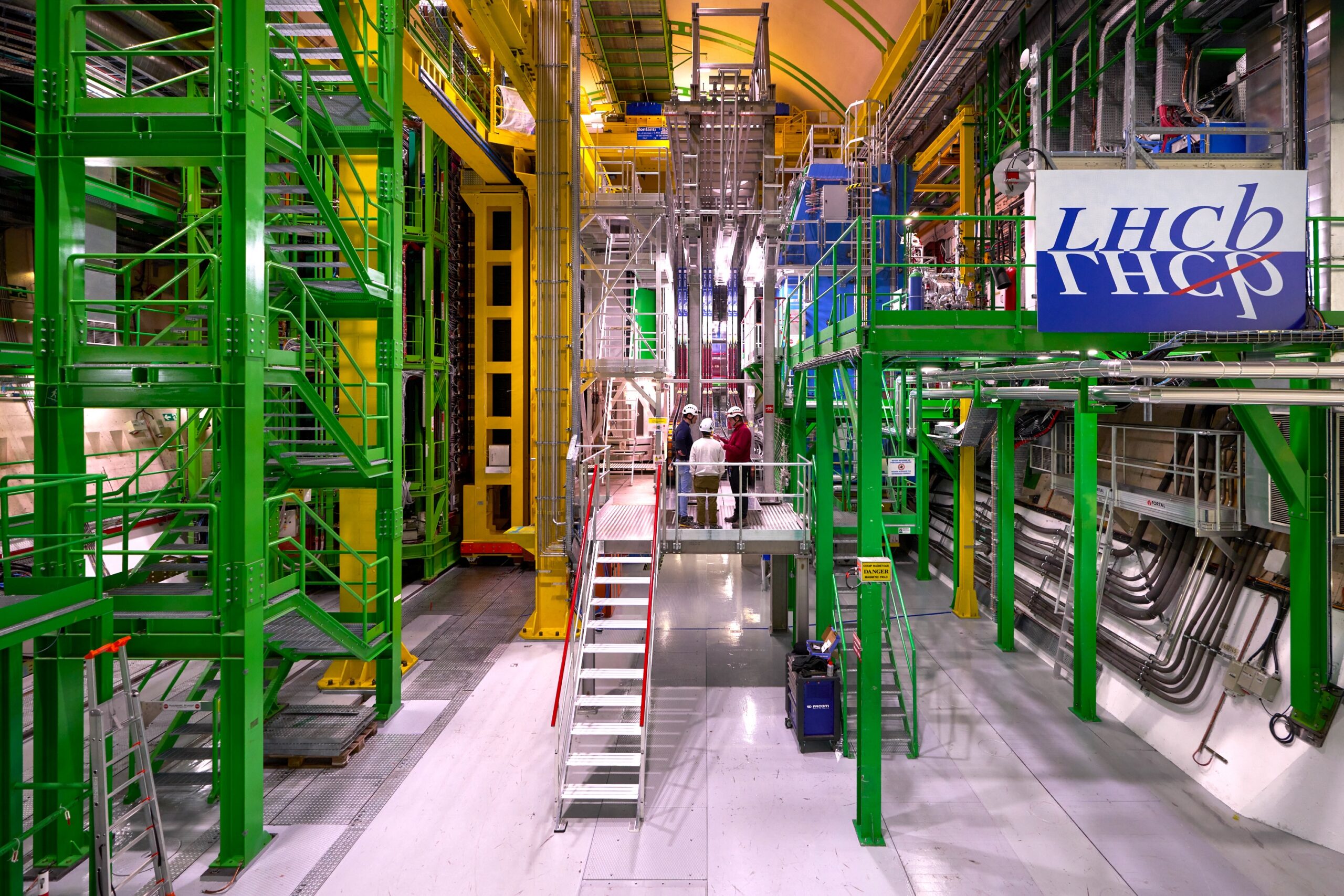
The universe should not exist. Cosmological models say equal amounts of matter and antimatter were produced shortly after the Big Bang, and when a particle meets its antiparticle both turn into energy. Yet the cosmos is made of matter. A new analysis from the LHCb experiment at CERN's Large Hadron Collider has not solved that puzzle, but it has closed off part of the territory where the answer could be hiding.
The work, published in Physical Review Letters, was carried out by physicists from the universities of Warwick, Manchester and Oxford in the United Kingdom, TU Dortmund University in Germany, and the Institute of Nuclear Physics of the Polish Academy of Sciences in Cracow. They examined data that LHCb collected between 2016 and 2018 from proton-proton collisions.
The team studied decays of Bs0 mesons, particles that contain a beauty quark and a strange antiquark, or the reverse. The goal was to look for a violation of charge-parity symmetry, known as CP symmetry. In many physical processes, swapping every particle for its antiparticle and inverting all spatial coordinates leaves the laws unchanged. Known violations of that symmetry exist, but they are far too small to explain why matter dominates.
What makes the choice of process unusual is that the Standard Model predicts no asymmetry here at all. "Interestingly, we chose to investigate a process in which the Standard Model predicts no asymmetry at all. So why study it at all?" said Dr. Agnieszka Dziurda of the Polish institute. Her answer was that an observed asymmetry would signal previously unknown physics. She added that theoretical predictions for some beauty-meson decay rates differ significantly from experimental values, which could come from effects not yet fully included in the calculations, or from physics beyond the Standard Model.
Beauty mesons suit the search because they oscillate extremely quickly between matter and antimatter states, several trillion times per second according to an earlier LHCb measurement. That meant the team could carry out the analysis without having to determine each meson's initial state.
The hardest part was making sure the detector itself did not fake a signal. Positively and negatively charged particles curve in opposite directions in the detector's magnetic field, and detection efficiency varies across the detector, which can create an apparent asymmetry when none exists. The researchers used large calibration samples and computer simulations, regularly reversed the magnet's direction, and corrected for differences in how particles and antiparticles are detected. "We had to make sure that any asymmetry observed in the data, however small, was not caused by the detector itself," Dziurda said.
The data showed a difference of roughly one to two cases per thousand decays. Because the measurement uncertainty was larger than that effect, the result is consistent with the Standard Model's prediction of none. The finding does not rule out new physics, but it narrows where that physics can hide: any unknown process that would cause an asymmetry greater than about 2% in these decays would almost certainly have been detected.
Larger datasets that LHCb has already collected with its upgraded detector should allow more precise measurements in the future. If an asymmetry exists below the current limit, those data are where it is most likely to show up first.