A Chinese Collider Squeezed the Lambda Hyperon's Electric Dipole Moment by a Factor of a Thousand and Found Nothing
BESIII used quantum entanglement between 3 million particle-antiparticle pairs to reach the 10⁻¹⁹ e·cm level for the first time. A nonzero result would have pointed straight past the Standard Model.

The BESIII collaboration has measured the electric dipole moment of the Lambda hyperon three orders of magnitude more precisely than anyone before, reaching the 10⁻¹⁹ e·cm level for the first time. The answer, reported in Science on September 3, is that there is no sign of one.
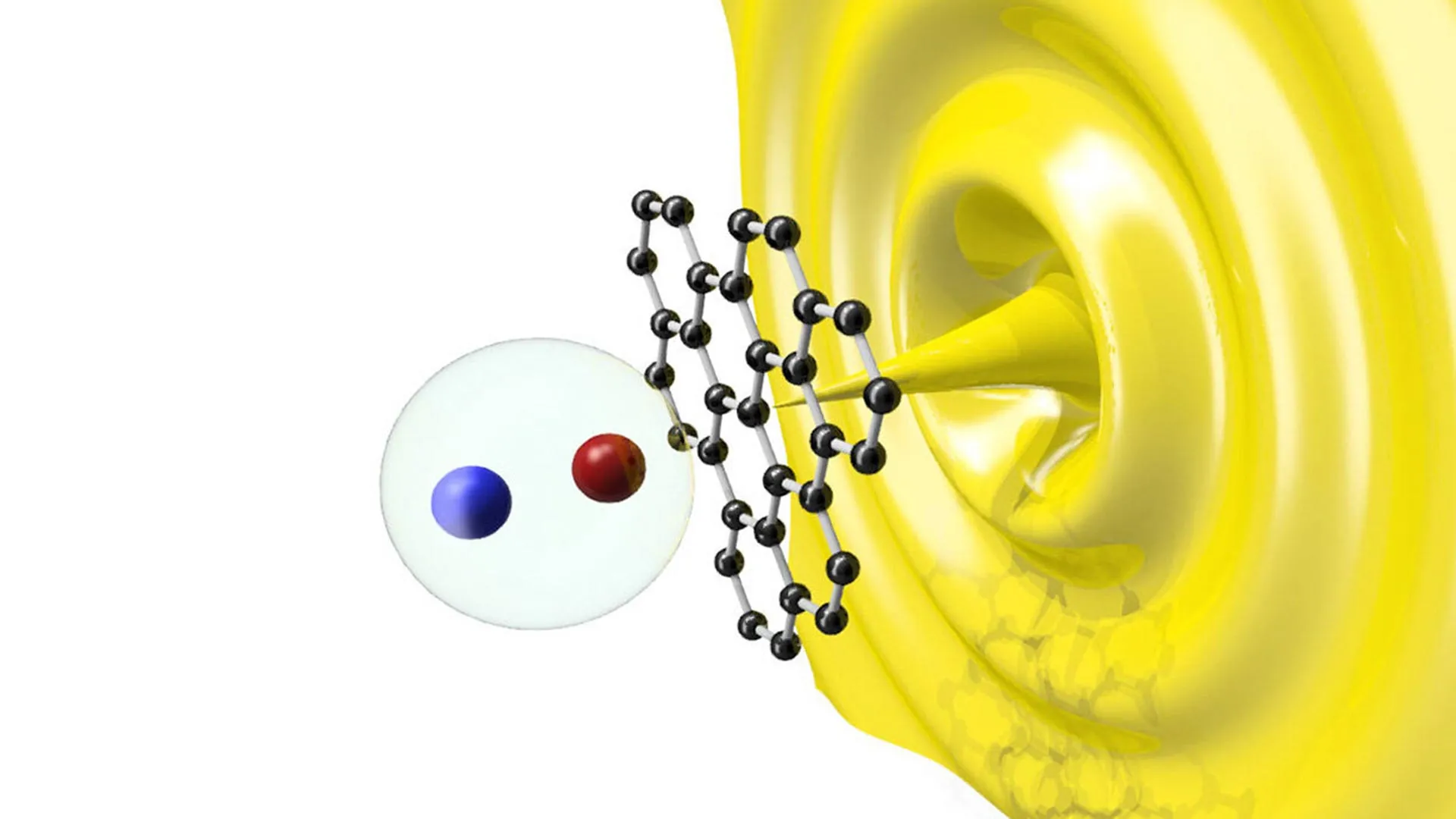
An electric dipole moment is a separation of positive and negative charge along a particle's spin axis. In the Standard Model of particle physics it is very nearly forbidden — a particle with a permanent EDM violates both time-reversal symmetry and, by extension, the combined charge-parity symmetry known as CP. The Standard Model does allow a trickle of CP violation, but far too little to explain why the universe is made of matter rather than annihilated into radiation shortly after the Big Bang. Any measured EDM bigger than the Standard Model's prediction would be new physics, immediately.
That is why EDM searches have run for seventy years on neutrons, electrons and atoms. The Lambda hyperon is a harder target and a more interesting one, because it contains a strange quark. Different theories beyond the Standard Model predict CP violation showing up in different quark sectors, so a strange-quark measurement probes territory the neutron and electron experiments do not cover well.
The Lambda's lifetime is about 260 picoseconds, which rules out the classical technique. Neutron EDM experiments hold particles in a bottle and watch their spin precess in an electric field for minutes. A hyperon decays before it can be bottled. The BESIII team, working at the Beijing Electron Positron Collider II under the Institute of High Energy Physics of the Chinese Academy of Sciences, went around the problem using quantum entanglement.
When the J/ψ meson decays into a Lambda and an anti-Lambda, the two are produced in an entangled spin state. Measuring the angular distribution of the decay products of both particles together extracts information about the spin correlation that neither particle alone would give up. The collaboration analyzed roughly 3 million high-purity J/ψ → Λ–anti-Λ events and read the EDM out of the joint decay pattern rather than from spin precession in a field.
The result is a null: no evidence for a nonzero Lambda EDM, with a limit a thousand times tighter than the previous best, which dated to fixed-target experiments decades old. Null results of this kind do real work. Every model that predicted a strange-quark EDM above 10⁻¹⁹ e·cm is now excluded, which narrows the space that theorists of supersymmetry, extended Higgs sectors and left-right symmetric models have left to work in.
The method is the part likely to outlive the number. Entanglement-based measurement of short-lived baryons opens the same technique to other hyperons produced at BESIII and at future super tau-charm facilities, where the event samples would be orders of magnitude larger. The matter-antimatter asymmetry remains unexplained, and the search has just gained a new instrument.