After Nearly 50 Years of Searching, Physicists Say They've Cornered the Glueball — a Particle Made of Pure Force
The BESIII collaboration in Beijing reported that a particle called X(2370) is dominated by a pseudoscalar glueball, a knot of gluons with no quarks in it at all, closing in on one of quantum chromodynamics' oldest unconfirmed predictions.
Everything you have ever touched is made of matter particles held together by force particles. Quarks make the protons and neutrons; gluons are the glue. The strange prediction that quantum chromodynamics — the theory of the strong force — has carried for half a century is that the glue can hold itself together, with no quarks involved at all. Such an object is called a glueball, and until now nobody had produced a convincing one.
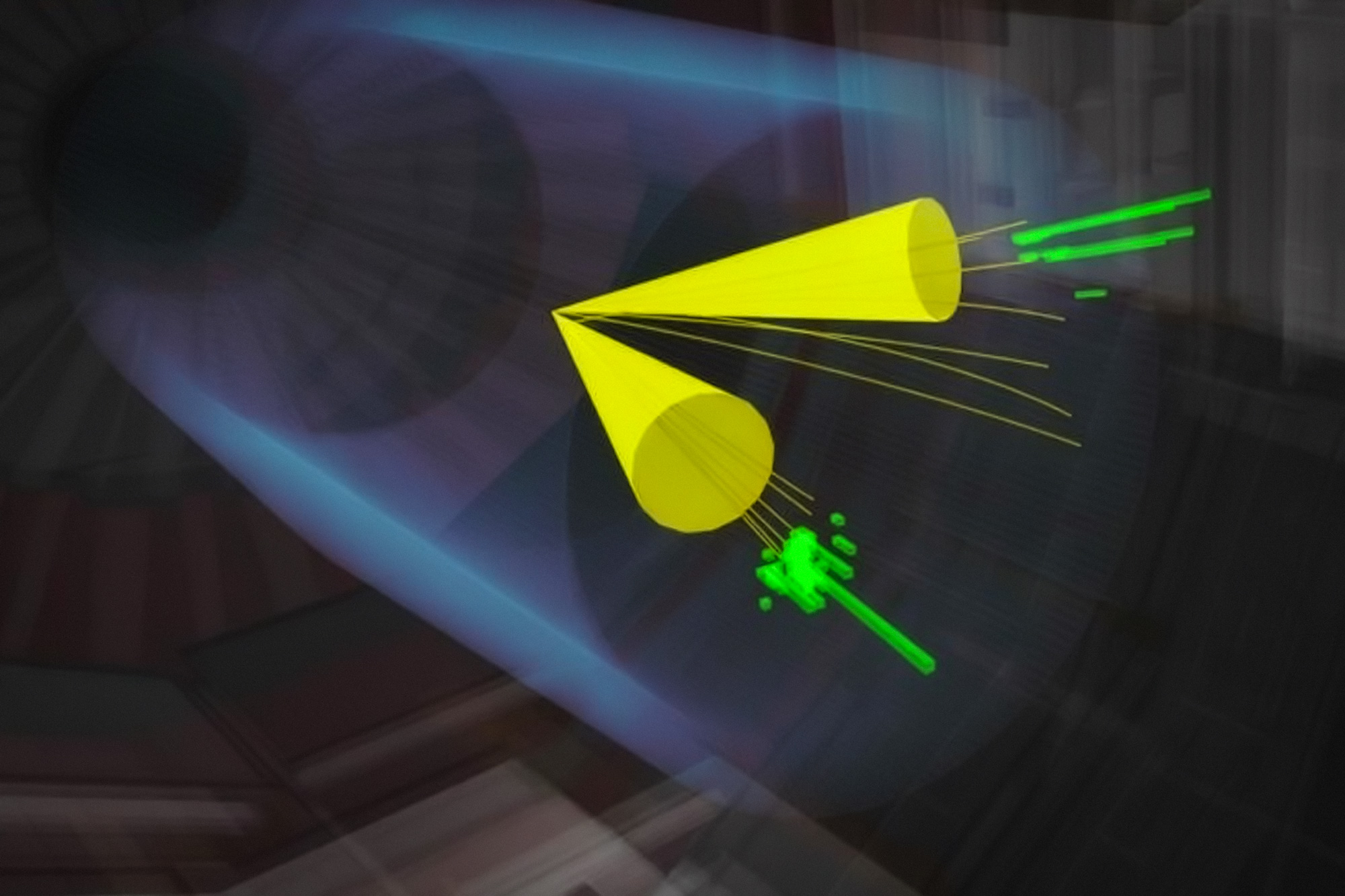
At the International Conference on High Energy Physics in Brazil, the BESIII Collaboration reported that a particle it has been chasing for 15 years, designated X(2370), is dominated by a pseudoscalar glueball component. That is a specific claim, not a vague one: the collaboration assigned it spin-parity quantum numbers of 0⁻⁺, the exact combination lattice QCD calculations predict for the lightest pseudoscalar glueball, and found its mass in complete agreement with those predictions as well.
The evidence was assembled in stages, and the pace tells you how hard the measurement is. BESIII first spotted X(2370) in 2011, in the decays of J/ψ particles produced at the Beijing Electron Positron Collider. Thirteen years later, in 2024, the collaboration used a sample of 10 billion J/ψ particles to pin down the spin and parity for the first time. Recently it found several new decay modes and — the decisive step — determined the particle's "flavor-singlet" nature, meaning it shows no preference among quark types, which is the defining fingerprint of something built from gluons rather than quarks.
J/ψ decays are the right hunting ground for a reason. The J/ψ is a bound state of a charm quark and its antiquark, and when it decays it frequently does so through an intermediate state of pure gluons — a gluon-rich environment where a glueball, if it exists, has an unusually good chance of forming. The Beijing collider was built to produce these particles in enormous quantities, and its decades-long focus on strong-interaction physics is what made a 10-billion-event sample possible.
Why this matters beyond the particle catalogue: quantum chromodynamics is a non-Abelian gauge theory, which in plain terms means its force carriers interact with each other, unlike photons, which pass through one another without noticing. The discovery of asymptotic freedom in the 1970s confirmed QCD works at high energies. A glueball is the low-energy consequence of that same self-interaction — force carriers binding into matter — and it is the piece that has been missing.
The collaboration describes the result as the clearest experimental outcome from nearly 50 years of glueball searches, and is careful to say the X(2370) is glueball-dominated rather than a pure glueball; real hadrons at this mass can mix with ordinary quark states. But if the identification holds, physicists have their first look at an entirely new category of matter — matter made of nothing but the force that holds matter together.