MIT Scientists Turn LHC Near-Misses Into a Microscope for the Strong Nuclear Force
A new technique using grazing-angle particle interactions allows physicists to directly measure how gluons behave under extreme nuclear density — the particles that literally hold the universe together.
Physicists at MIT have turned what would ordinarily be considered missed shots in the Large Hadron Collider into a powerful new tool for studying the fundamental force that holds atomic nuclei together. In a paper published in Physical Review Letters on March 26, 2026, a team led by MIT assistant professor Gian Michele Innocenti described how grazing-angle interactions — cases where particle beams barely miss each other rather than directly colliding — can be used to probe the behavior of gluons inside atomic nuclei under extreme density conditions. The technique transforms the LHC's 27-kilometer underground accelerator ring into what Innocenti calls a "super-high-accuracy microscope" for the strong nuclear force.
Gluons are the force-carrying particles of the strong nuclear force, the fundamental interaction responsible for binding quarks together into protons and neutrons, and binding protons and neutrons together inside atomic nuclei. Without gluons, matter as we know it could not exist — they are the particles that keep the universe's atomic structure intact. Despite their foundational importance, the behavior of gluons in dense nuclear environments, where many nucleons are packed together and their individual gluon fields overlap, has been difficult to measure experimentally. Existing theoretical frameworks make predictions about "gluon saturation" — a state in which gluon density stops growing even as energy increases — but direct measurements have been challenging.
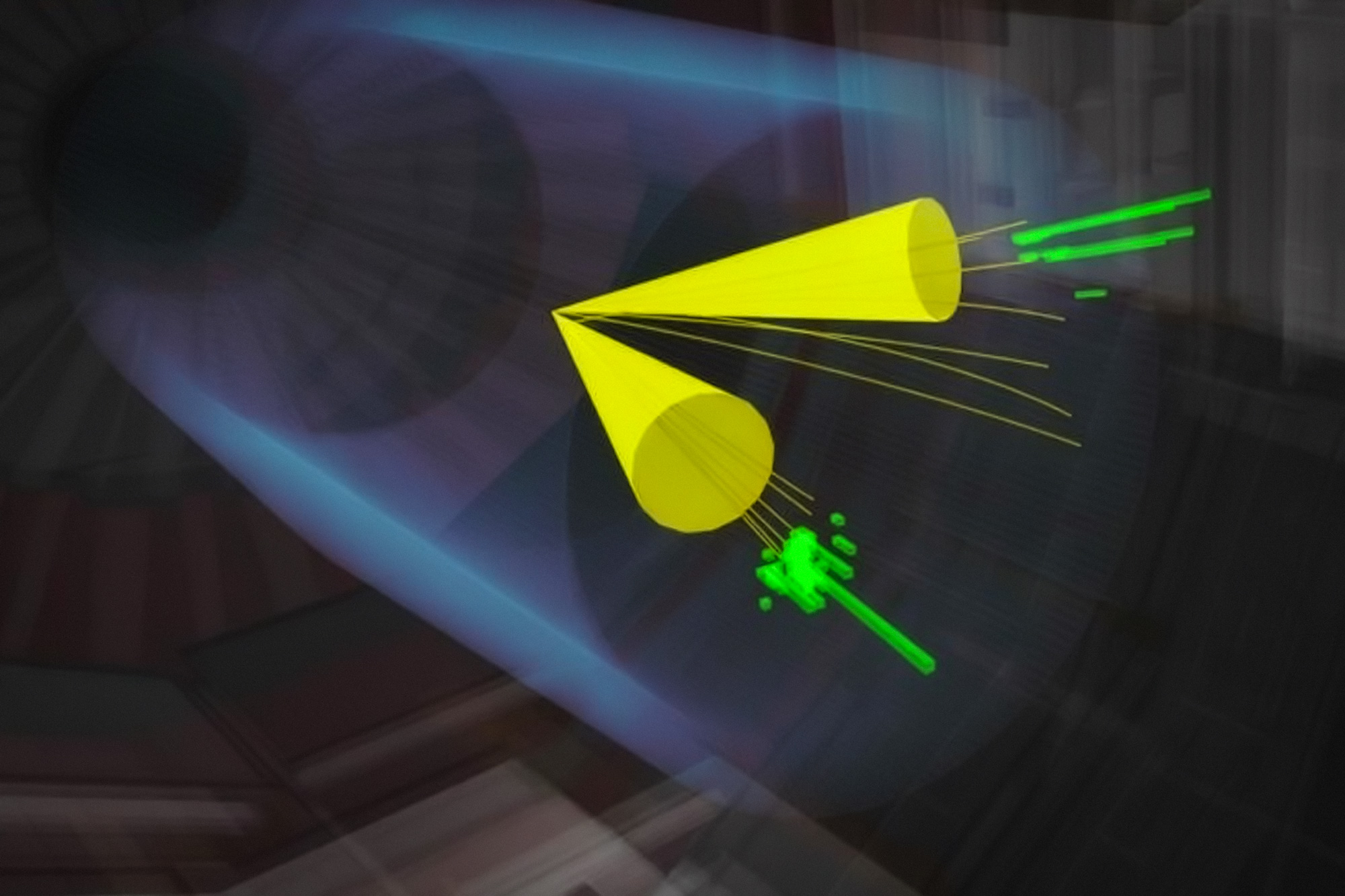
The MIT team focused on a class of interactions called photonuclear events, which occur when two heavy ion beams in the LHC travel close enough to each other to interact via their electromagnetic fields without the nuclei themselves touching. In these grazing-angle passes, one nucleus effectively emits a photon that strikes the other nucleus, producing particles that can be detected and analyzed. The key experimental signature is the production of D0 mesons — particles containing a charm quark — whose behavior reflects the internal gluon structure of the nucleus being probed.
The analysis required sifting through tens of billions of LHC collision events to extract hundreds of rare photonuclear interactions with sufficient statistical precision to be meaningful. The team used data from the CMS detector, one of the LHC's two large general-purpose experiments, and developed specialized algorithms to distinguish photonuclear D0 meson events from the enormous background of ordinary hadronic collisions. The resulting measurements probe the density and spatial distribution of gluons inside heavy nuclei at a level of precision previously unachievable with any existing technique.
"When nuclear matter is squeezed together, gluons start behaving in a funny way," Innocenti explained in describing the physics motivation. "We need to know how these gluons behave in extreme conditions because gluons keep the universe together." The measurements provide the first direct experimental data on gluon behavior at high nuclear density from LHC collisions, complementing earlier results from the HERA electron-proton collider at DESY in Hamburg, which provided foundational data on gluon distributions in single protons but not in larger nuclei.
The technique offers a complementary approach to the planned Electron-Ion Collider (EIC), a major US Department of Energy facility under development at Brookhaven National Laboratory in New York, which is specifically designed to map nucleon structure with high precision. While the EIC will operate at lower energies than the LHC, the MIT result demonstrates that the LHC's existing detectors — even in near-miss configurations — can access nuclear gluon physics previously thought to require dedicated facilities. The paper's title, "Measurement of D0 Meson Photoproduction in Ultraperipheral Heavy Ion Collisions," gives little hint of the conceptual shift it represents: the LHC as a gluon microscope, not just a particle factory.