CERN Confirms 80th Particle Discovered at LHC: A New Doubly Charmed Baryon Four Times Heavier Than a Proton
The LHCb experiment announced a 7-sigma discovery of the Xi-cc-plus, completing the doubly charmed isospin doublet and providing physicists with a precision test of quantum chromodynamics.
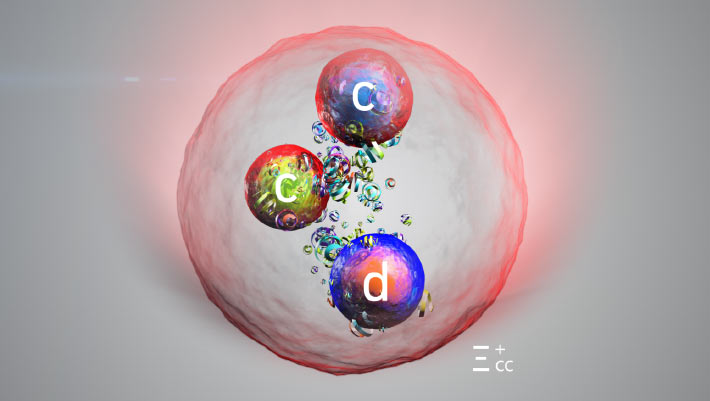
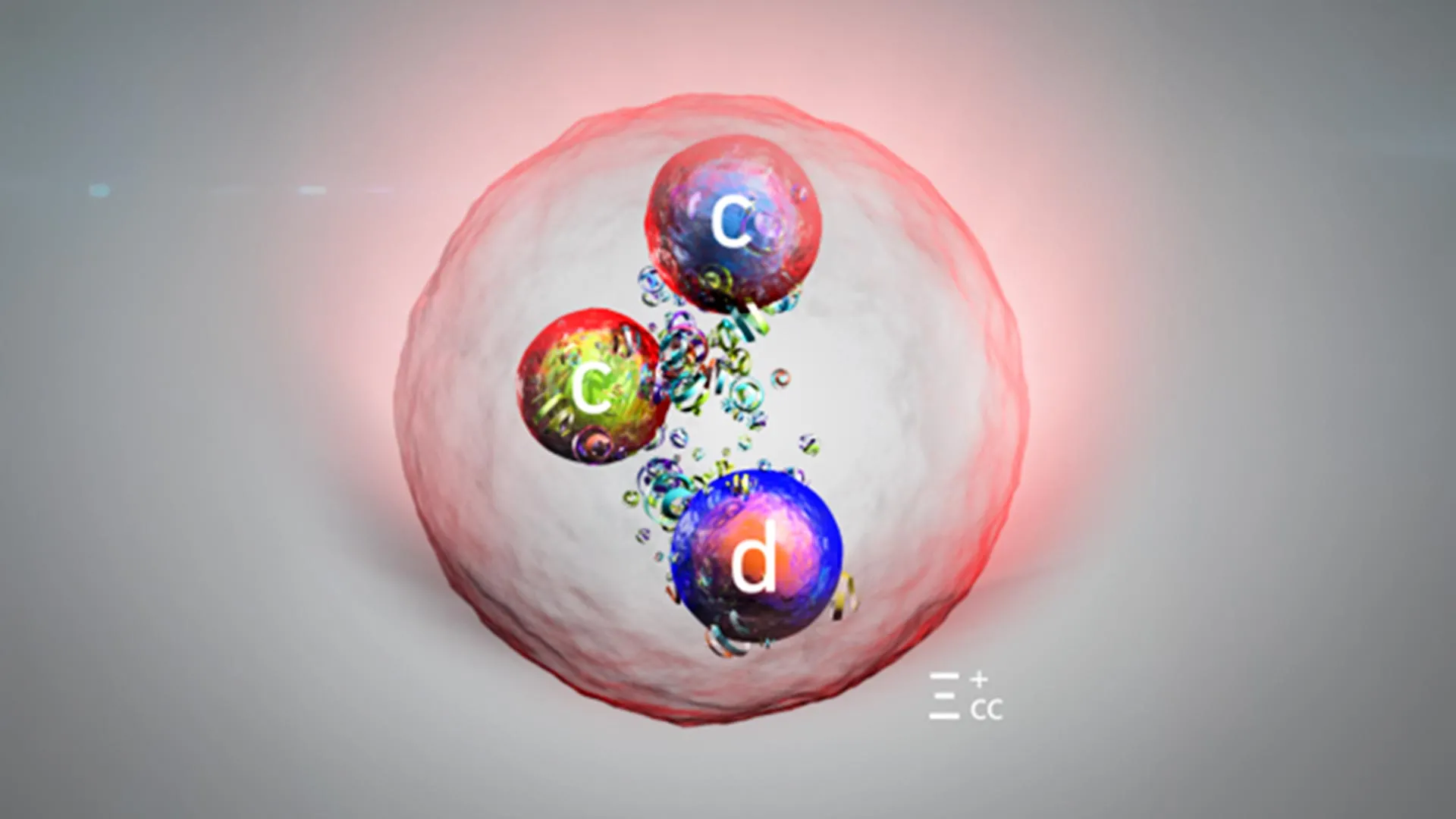
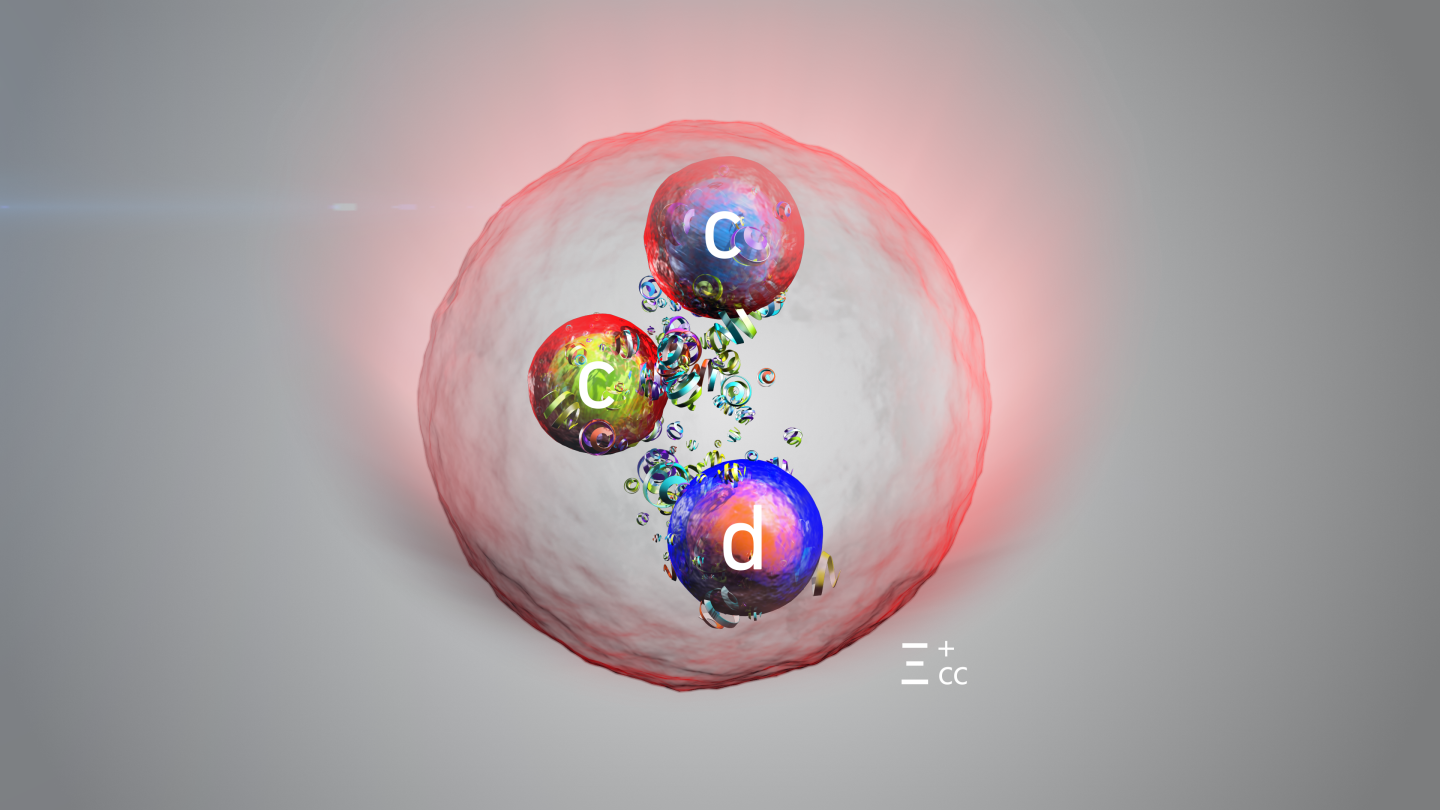
GENEVA — Physicists at CERN's Large Hadron Collider have announced the discovery of a new subatomic particle — a proton-like baryon containing two charm quarks and one down quark, known as the Ξcc⁺ (Xi-cc-plus) — in what the laboratory describes as a 7-sigma confirmation, well above the five-sigma threshold that the field requires before calling a result a discovery. The particle, detected by the LHCb experiment using data collected during LHC Run 3 in 2024, brings the total number of hadrons discovered by the Large Hadron Collider to 80.
The Xi-cc-plus is roughly four times heavier than a proton, reflecting the heft of its two charm quarks — each of which is already about 1.3 times the mass of a proton by itself. Its discovery completes what physicists call the doubly charmed isospin doublet: a pair of predicted particles that differ from each other only in their lighter quark, one carrying an up quark and one a down quark. The first member of the doublet, the Ξcc⁺⁺, was discovered by LHCb in 2017. The new Ξcc⁺ was expected but harder to detect because its predicted lifetime is six times shorter than its 2017 counterpart, making it decay before it can leave a clean signal in the detector. Advanced analysis algorithms developed for Run 3 data collection made the observation possible.
"The result will help theorists test models of quantum chromodynamics, the theory of the strong force," said LHCb Spokesperson Vincenzo Vagnoni. Quantum chromodynamics, or QCD, describes how quarks are bound together by gluons — the carriers of the strong nuclear force — but its predictions become extremely difficult to calculate for particles with heavy quarks, where relativistic effects and complex many-body interactions conspire to make exact solutions intractable. The doubly charmed isospin doublet provides physicists with a rare controlled comparison: two nearly identical particles whose only difference is a single quark swap, allowing theorists to isolate the effect of that swap with unusual precision.
CERN Director-General Mark Thomson said the discovery demonstrated "how LHCb's unique capabilities play a vital role in the success of the LHC." The LHCb detector was specifically designed to study particles containing beauty and charm quarks, with a geometry optimized for detecting the displaced vertices — tiny gaps between where a collision happened and where its products first interact with detector material — that betray the presence of particles with very short lifetimes. That design choice, which might have seemed arcane when construction began in the late 1990s, has paid off repeatedly: LHCb has now contributed dozens of entries to the hadron PDG table and has become one of the most productive discovery machines in the history of particle physics.
For the broader physics community, the Xi-cc-plus completes a chapter in the systematic exploration of the hadron spectrum predicted by the quark model. Physicists can now directly measure the mass difference and lifetime ratio between the two doubly charmed baryons and compare those numbers against QCD lattice calculations — a stringent test of whether theorists' computational methods are accurate enough to be trusted in regimes where no analytical solutions exist. The LHCb collaboration, which includes more than 1,500 physicists from 20 countries, presented the result at a CERN seminar and submitted it simultaneously to Physical Review Letters.