CERN Announces Discovery of Rare 'Doubly Charmed' Subatomic Particle With 7-Sigma Certainty
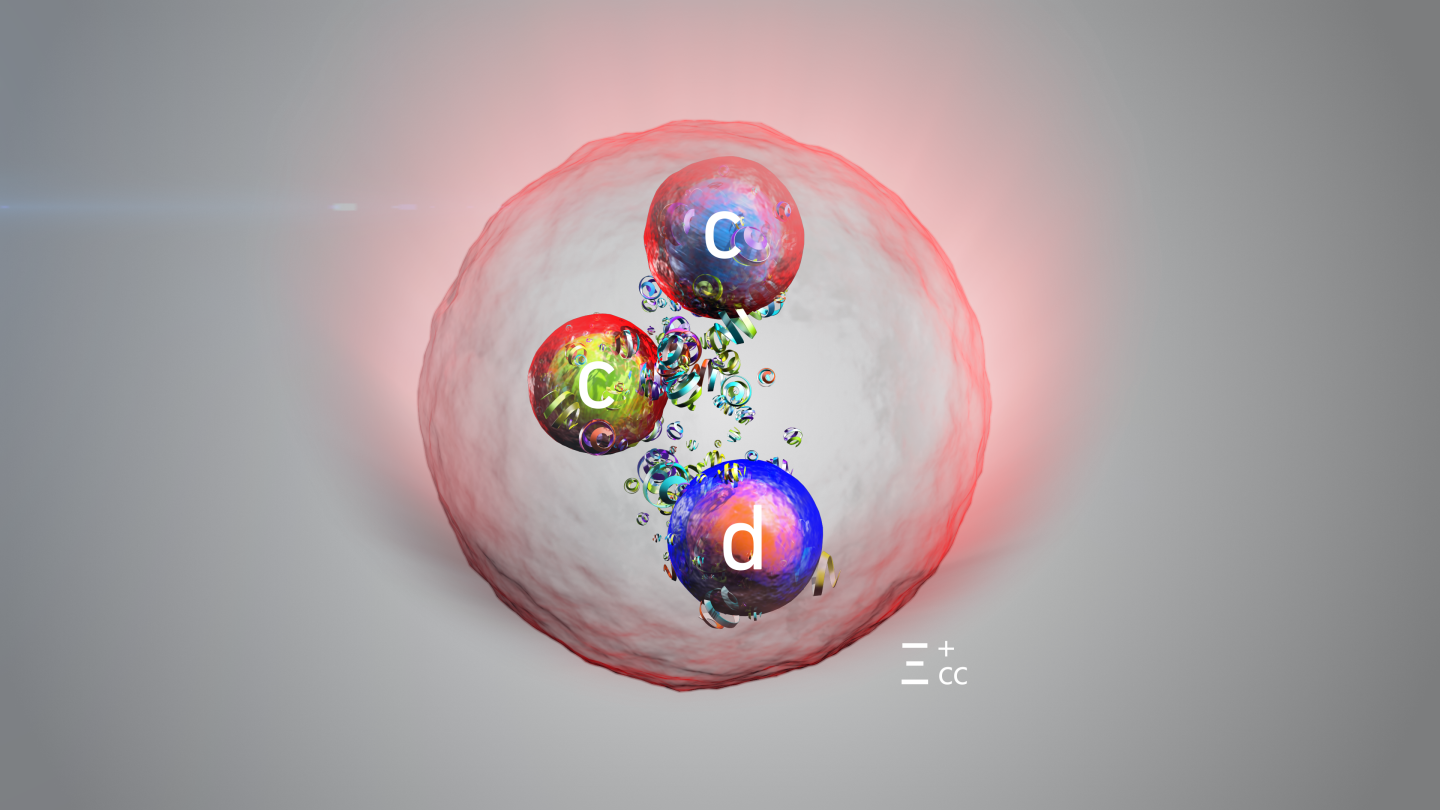
The LHCb collaboration at CERN's Large Hadron Collider has confirmed the existence of the Ξcc⁺ baryon — a particle made of two charm quarks and one down quark — in the 80th hadron discovery in LHC history.
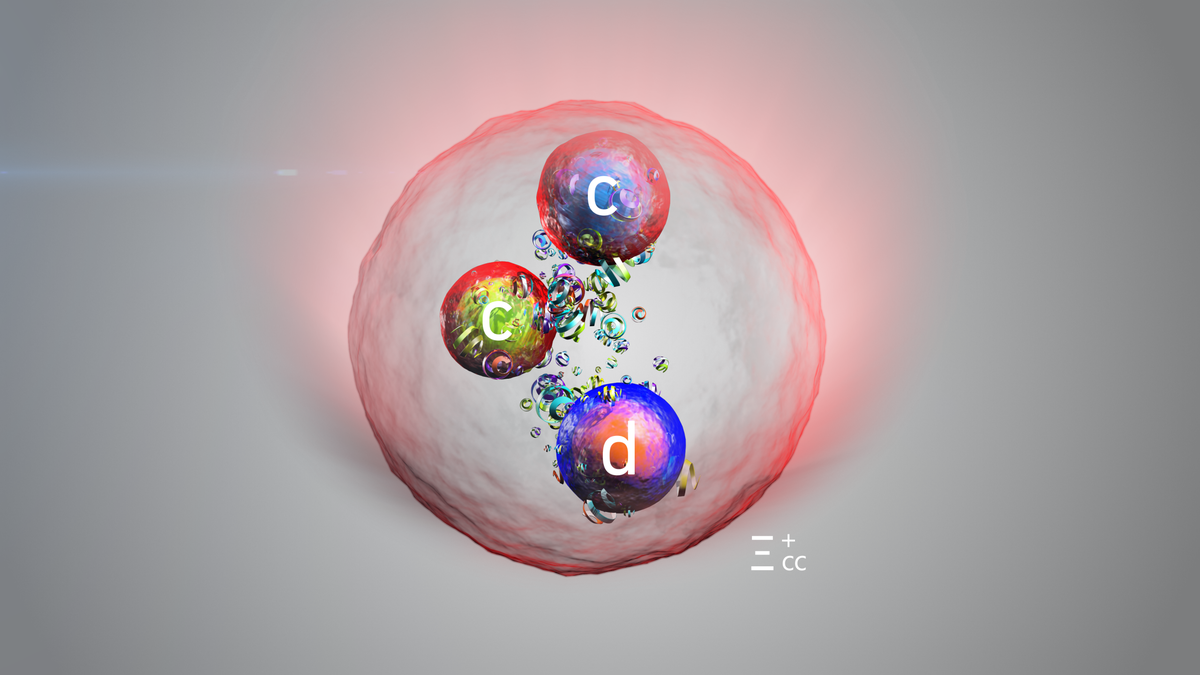
The LHCb collaboration at CERN's Large Hadron Collider announced on March 17 the discovery of a new subatomic particle — the Ξcc⁺ (Xi-cc-plus), a "doubly charmed baryon" made of two charm quarks and one down quark. The discovery, presented at the Moriond conference with a statistical significance of seven sigma — well above the five-sigma threshold required for a formal discovery claim — marks the 80th hadron to be identified in the history of the LHC program, and the first major particle discovery since the LHCb detector underwent a comprehensive upgrade in 2023.
Charm quarks are among the heavier varieties of quark, the fundamental building blocks that combine in various arrangements to form particles like protons and neutrons. Ordinary protons consist of two "up" quarks and one "down" quark. A doubly charmed baryon, by contrast, contains two of the much heavier charm quarks, making it roughly four times heavier than a proton. The particle's existence was predicted by the Standard Model of particle physics, but detecting it required the extraordinary sensitivity of the upgraded LHCb detector, which processes hundreds of millions of particle collisions per second.
The LHCb team identified the Ξcc⁺ through the debris of proton-proton collisions from LHC Run 3, looking for a specific decay signature that is both rare and unmistakable. The signal — a clear peak of approximately 915 events clustered around a mass of 3,620 MeV/c² — emerged with the seven-sigma certainty that leaves virtually no room for statistical error. The particle is closely related to a sibling particle, the Ξcc⁺⁺ (Xi-cc-plus-plus), which LHCb discovered in 2017; the difference between the two is that the new particle substitutes a down quark for an up quark, giving it a slightly different charge and a predicted lifetime up to six times shorter due to subtle quantum effects.
LHCb spokesperson Vincenzo Vagnoni said the result would help theorists test models of quantum chromodynamics — the mathematical framework that describes how quarks are bound together by the strong nuclear force, one of the four fundamental forces of nature. "The result will help theorists test models of quantum chromodynamics and its role in binding quarks into conventional and exotic hadrons," Vagnoni said. CERN Director-General Mark Thomson added that the discovery demonstrated how the 2023 detector upgrades "directly lead to new discoveries."
The strong nuclear force operates very differently from the more familiar electromagnetic force. While electromagnetism weakens with distance, the strong force actually grows stronger as quarks are pulled apart — a property known as "confinement," which explains why quarks are never observed in isolation. Doubly charmed baryons are particularly valuable for testing QCD models because their unusual quark content creates a more complex internal structure than ordinary baryons, providing theorists with a more demanding test of their calculations.
The discovery underscores the continuing productivity of the LHC decades after it first switched on. While the discovery of the Higgs boson in 2012 represented the machine's most celebrated achievement, the LHCb experiment has specialized in cataloguing the zoo of exotic hadrons and confirming long-predicted particles that complete the periodic table of the subatomic world. Each discovery fills in another square in that table and subjects the Standard Model to an increasingly rigorous interrogation.