Four-User Quantum Network Proves Its Entanglement Without Trusting Any Detector
Shandong University physicists verified entanglement on six links across 20 kilometers of fiber each, closing a loophole that tampered measurement equipment could exploit.

Physicists at Shandong University in China have found a way to confirm that a quantum network is really sharing entanglement without having to trust the detectors that measure it. The work, led by senior author He Lu with first author Lu Liu, appears in Physical Review Letters, and Ingrid Fadelli reported on it for Phys.org on October 14.
The problem is basic to quantum communication. Networks that distribute entangled particles could make communication more secure, but users must be able to confirm that the particles are truly entangled and estimate how much entanglement they share. Most verification methods assume the measuring devices are honest. The researchers note that earlier tests could be fooled by tampered measurement results, so that entanglement appeared to be present when none existed.
The group had already addressed this in 2014 with a technique called measurement-device-independent entanglement witnessing. It worked without trusting the detectors, but it required preparing extra photons in known states, which made experiments technically demanding.
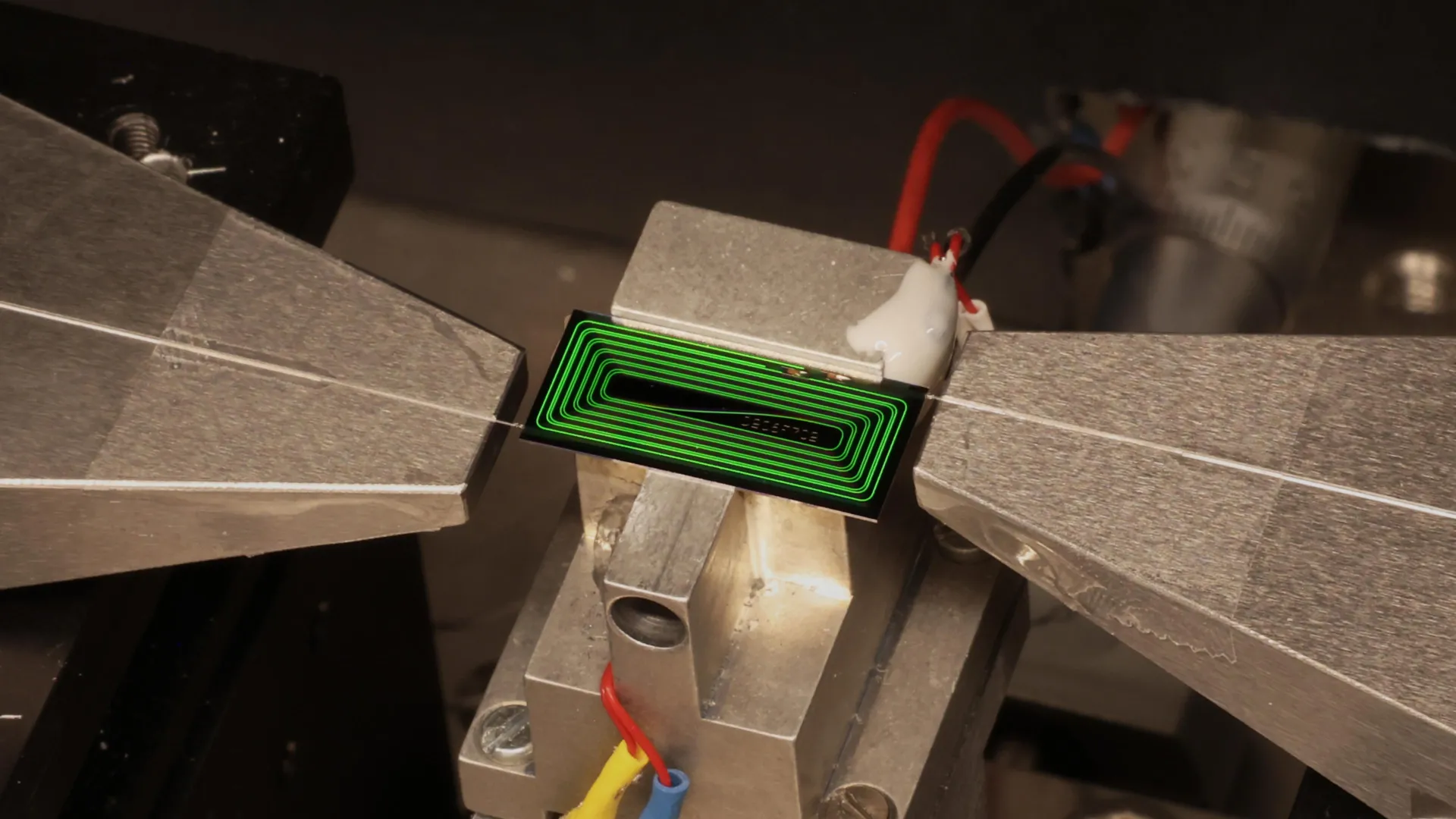
The new version removes that overhead. The team built a fully connected network of four users. A small, broadband photonic chip made of lithium niobate produced pairs of entangled photons across several wavelength channels, which gave six user-to-user connections, each running over 20 kilometers of optical fiber. The trick is to use two properties of the same photons: arrival time, in the form of time bins, carries the entanglement being tested, while polarization, the orientation of the light wave, prepares the known states needed as trusted inputs. A joint measurement on both properties tests entanglement without extra photons.
The team recorded coincidence counts between pairs of users and confirmed entanglement on all six links. The same data also gave a lower bound on how much entanglement each pair shares. "Building a quantum network is only part of the challenge," Lu said. "We also need to know whether the entanglement distributed across the network is genuinely there." He added that the method "allows us to quantify entanglement by establishing a lower bound on the amount shared between users."
There are limits. The approach still depends on reliably preparing the known test states, and this was a first demonstration on a single four-user network, so scaling to larger ones has not been shown. The Phys.org report does not give figures for the entanglement bounds or for performance under realistic loss and noise.
Lu said the group plans to extend the method to larger networks, to high-dimensional entanglement, which time-bin encoding makes possible, and to multipartite entanglement, where several users share a single entangled state. The team hopes to pair broadband integrated photon sources with scalable verification to support more advanced quantum networks.