Revolutionary Chip-Scale Ultrafast Laser Achieves Breakthrough After Two Decades
EPFL researchers successfully miniaturize powerful femtosecond laser technology onto a photonic chip, promising dramatic cost reductions.
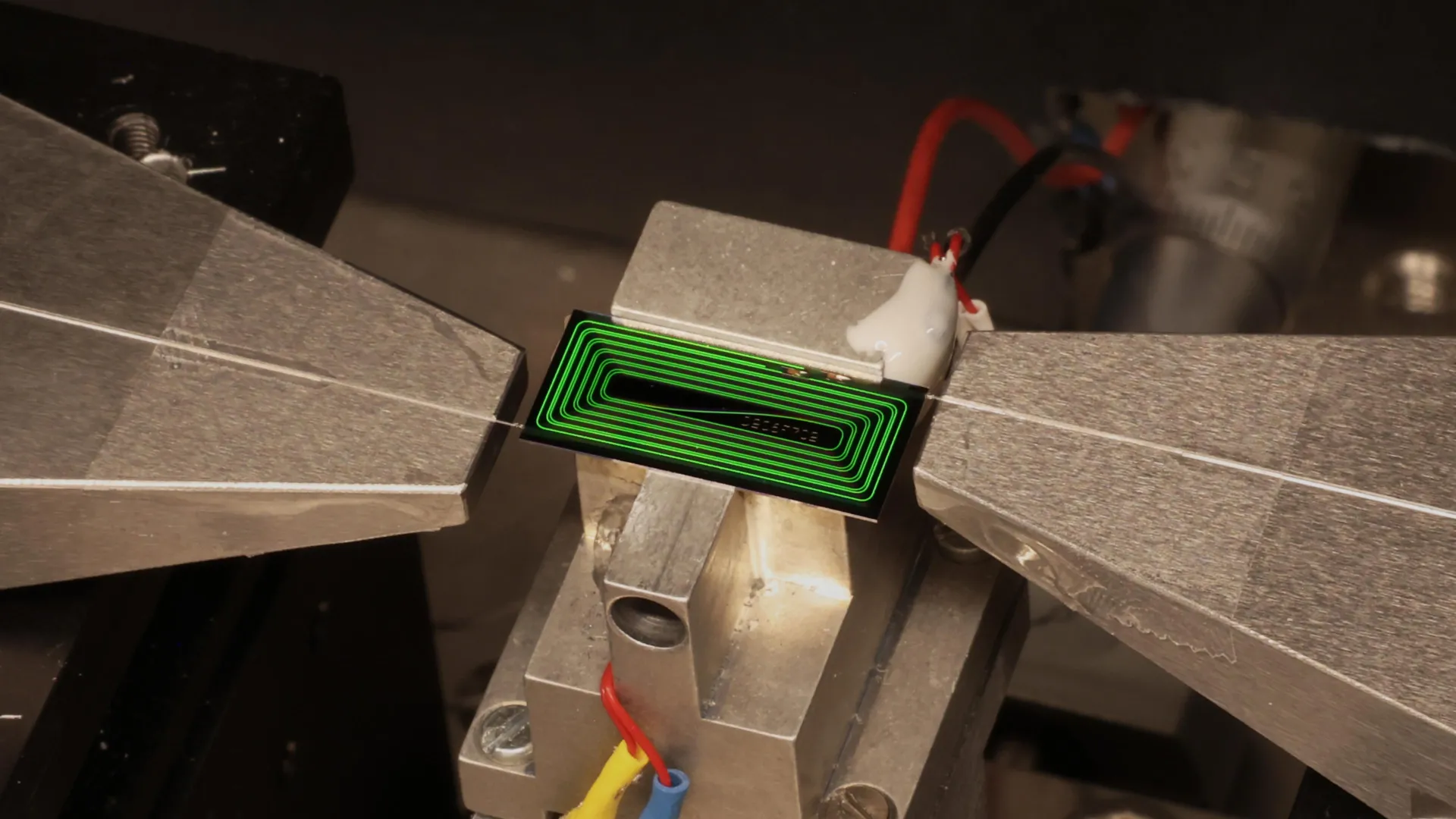
Researchers at EPFL have achieved a long-sought breakthrough in photonic technology by developing the first chip-scale ultrafast laser that can match the performance of traditional tabletop femtosecond laser systems. The innovation delivers pulse energies of 1.05 nanojoules and pulse durations as short as 147 femtoseconds, representing a dramatic miniaturization of technology that has remained bulky and expensive for decades.
For more than twenty years, creating a high-pulse-energy femtosecond laser on a photonic chip was widely regarded as one of the holy grails of integrated photonics. Traditional ultrafast lasers, despite their critical importance in applications ranging from precision manufacturing and eye surgery to optical atomic clocks, have required entire optical tables and costly equipment. The new device promises to make these powerful tools far more accessible and practical for widespread use.
The breakthrough relies on an elegant laser architecture known as the Mamyshev oscillator, which had previously received relatively little attention in integrated photonics research. The system places a nonlinear waveguide between two optical filters that each transmit different portions of the light spectrum. As intense laser pulses travel through the waveguide, they expand into a broader range of colors, with part of the broadened pulse able to pass through both filters and continue circulating within the laser cavity.
What makes this design particularly attractive is its compatibility with standard chip manufacturing processes. The Mamyshev oscillator does not require any components that are difficult to fabricate on erbium-doped silicon nitride chips, making it potentially suitable for mass production. Additionally, the architecture is far less susceptible to the nonlinear effects that can destabilize other laser designs when confined to the extremely small waveguides used in photonic chips.
The successful demonstration of chip-scale ultrafast laser technology could revolutionize fields that currently depend on large, expensive laser systems. Applications in medical diagnostics, telecommunications, scientific research, and precision manufacturing could all benefit from dramatically reduced equipment costs and size requirements. The 42-centimeter laser cavity represents just the beginning of what researchers believe could be a new generation of compact, affordable ultrafast laser systems.