Scientists Achieve Breakthrough in Chip-Scale Ultrafast Laser Technology
After 20 years of attempts, EPFL researchers have successfully miniaturized powerful femtosecond lasers onto photonic chips, potentially revolutionizing precision manufacturing and atomic clocks.
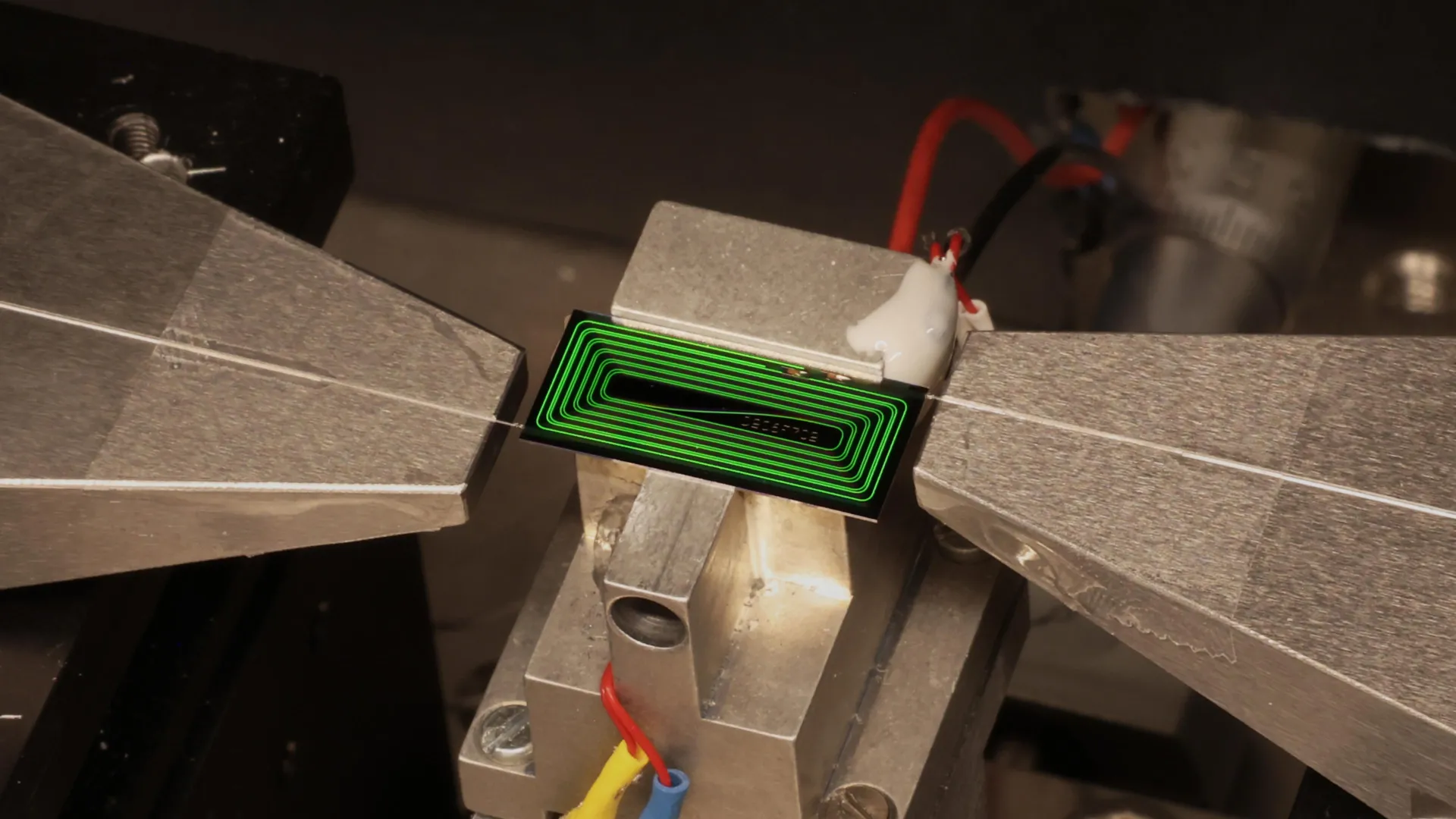
Researchers at the Swiss Federal Institute of Technology Lausanne (EPFL) have achieved a long-sought breakthrough in laser technology, successfully creating the first integrated ultrafast laser capable of matching the performance of traditional tabletop femtosecond systems. The chip-based device delivers pulse energies of 1.05 nanojoules and pulse durations as short as 147 femtoseconds, representing a dramatic miniaturization of technology that has remained large and expensive for decades.
Ultrafast lasers, which produce pulses lasting just a few hundred femtoseconds or quadrillionths of a second, are among the most powerful tools in modern optics. These systems enable technologies ranging from precision manufacturing and eye surgery to optical frequency combs, the Nobel Prize-winning innovation that powers the world's most accurate optical atomic clocks. Despite their importance, these lasers have traditionally required entire optical tables and significant laboratory infrastructure.
The breakthrough was achieved using a laser architecture called the Mamyshev oscillator, a design that had received relatively little attention in integrated photonics. Professor Tobias J. Kippenberg, who led the research team, explained that "for more than twenty years, a high-pulse-energy femtosecond laser on chip was widely regarded as a holy grail of integrated photonics." The system places a nonlinear waveguide between two optical filters, each transmitting different portions of the light spectrum.
The elegant design works by allowing intense laser pulses to expand into a broader range of colors as they travel through the waveguide, with part of that broadened pulse passing through both filters to continue circulating within the laser cavity. Weaker light behaves differently, getting blocked by the filters and removed from the cycle. This self-selecting mechanism ensures only the strongest pulses survive, creating stable ultrafast output.
According to co-leading author Zheru Qiu, the Mamyshev oscillator design is particularly well-suited for integrated photonic devices because it doesn't require components that are difficult to manufacture on silicon nitride chips. The laser cavity measures just 42 centimeters in length, representing a massive reduction in size compared to traditional systems while maintaining comparable performance metrics that could revolutionize fields from medical diagnostics to quantum computing.