Scientists Achieve Breakthrough by Shrinking Powerful Laser Onto Computer Chip
After 20-year quest, researchers create chip-scale ultrafast laser matching performance of room-sized systems, opening door to miniaturized precision technologies.
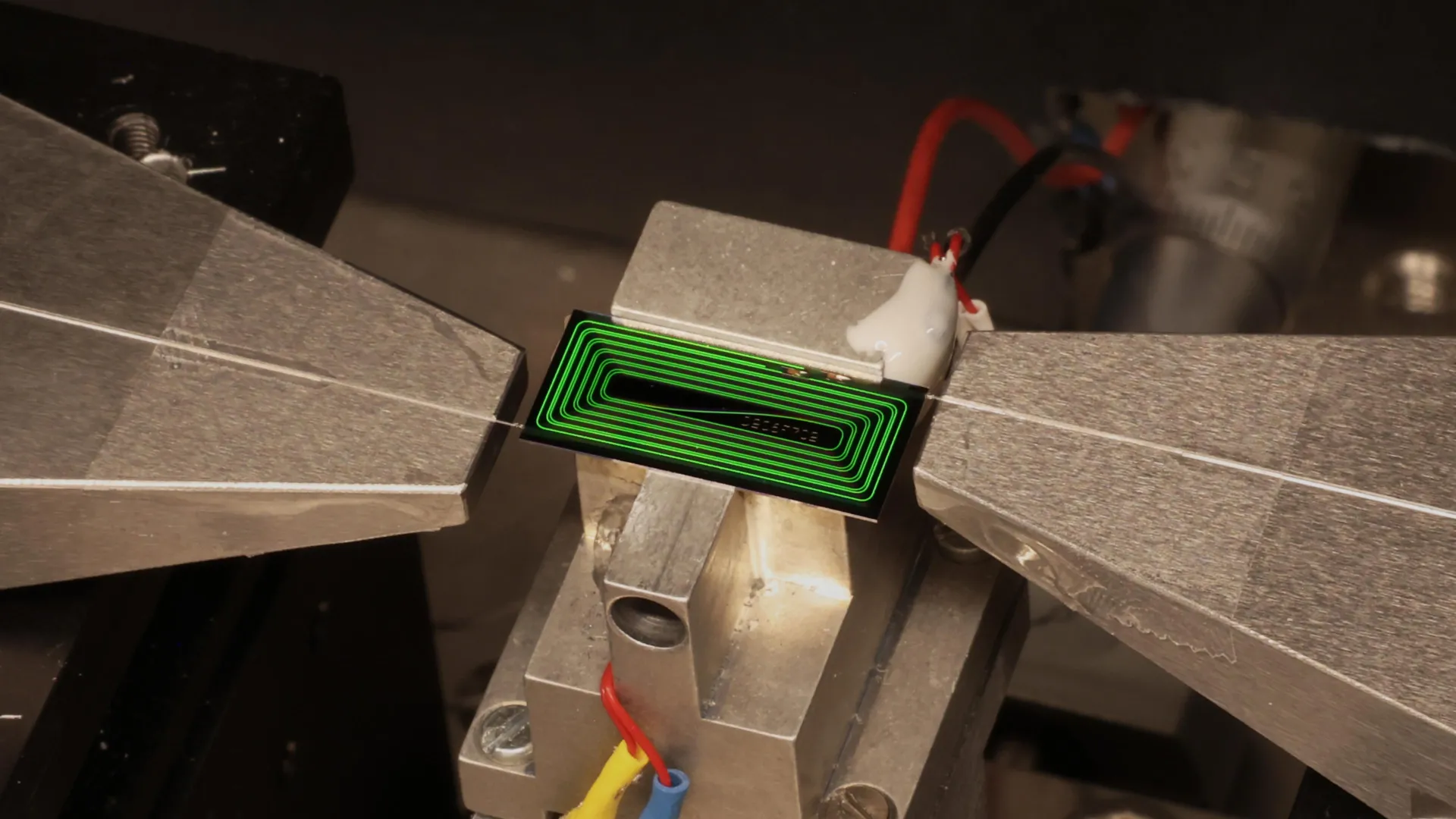
Researchers at EPFL have achieved a long-sought breakthrough in photonics by successfully developing the first chip-scale ultrafast laser capable of matching the performance of traditional tabletop femtosecond laser systems. The innovation represents the culmination of more than two decades of scientific effort to miniaturize one of the most powerful tools in modern optics.
The new device delivers pulse energies of 1.05 nanojoules and generates pulses lasting just 147 femtoseconds, all within a compact photonic chip. These ultrafast pulses, lasting mere quadrillionths of a second, have applications ranging from precision manufacturing and eye surgery to optical frequency combs that power the world's most accurate atomic clocks. The achievement could dramatically reduce the size and cost of advanced laser technologies.
Professor Tobias J. Kippenberg, who led the research team, noted that "for more than twenty years, a high-pulse-energy femtosecond laser on chip was widely regarded as a holy grail of integrated photonics." The breakthrough was accomplished using a laser architecture called the Mamyshev oscillator, which places a nonlinear waveguide between two optical filters to create self-selecting pulse formation.
The design proves particularly well-suited for photonic chips because it remains stable despite the strong nonlinear effects that occur when light is confined to extremely small waveguides. Co-leading author Zheru Qiu explained that the architecture "does not require any component that is difficult to make on this erbium-doped silicon nitride chip," making it practical for widespread implementation.
The successful miniaturization of ultrafast laser technology could enable new applications in medical diagnostics, telecommunications, and scientific instrumentation. By bringing laboratory-grade laser performance to chip-scale devices, the innovation may accelerate the development of portable precision instruments and make advanced optical technologies more accessible across multiple industries.