Scientists Successfully Shrink Powerful Ultrafast Laser Onto Single Chip
EPFL researchers have developed the first integrated ultrafast laser that matches tabletop femtosecond laser performance, potentially making advanced laser technologies far smaller and more accessible.
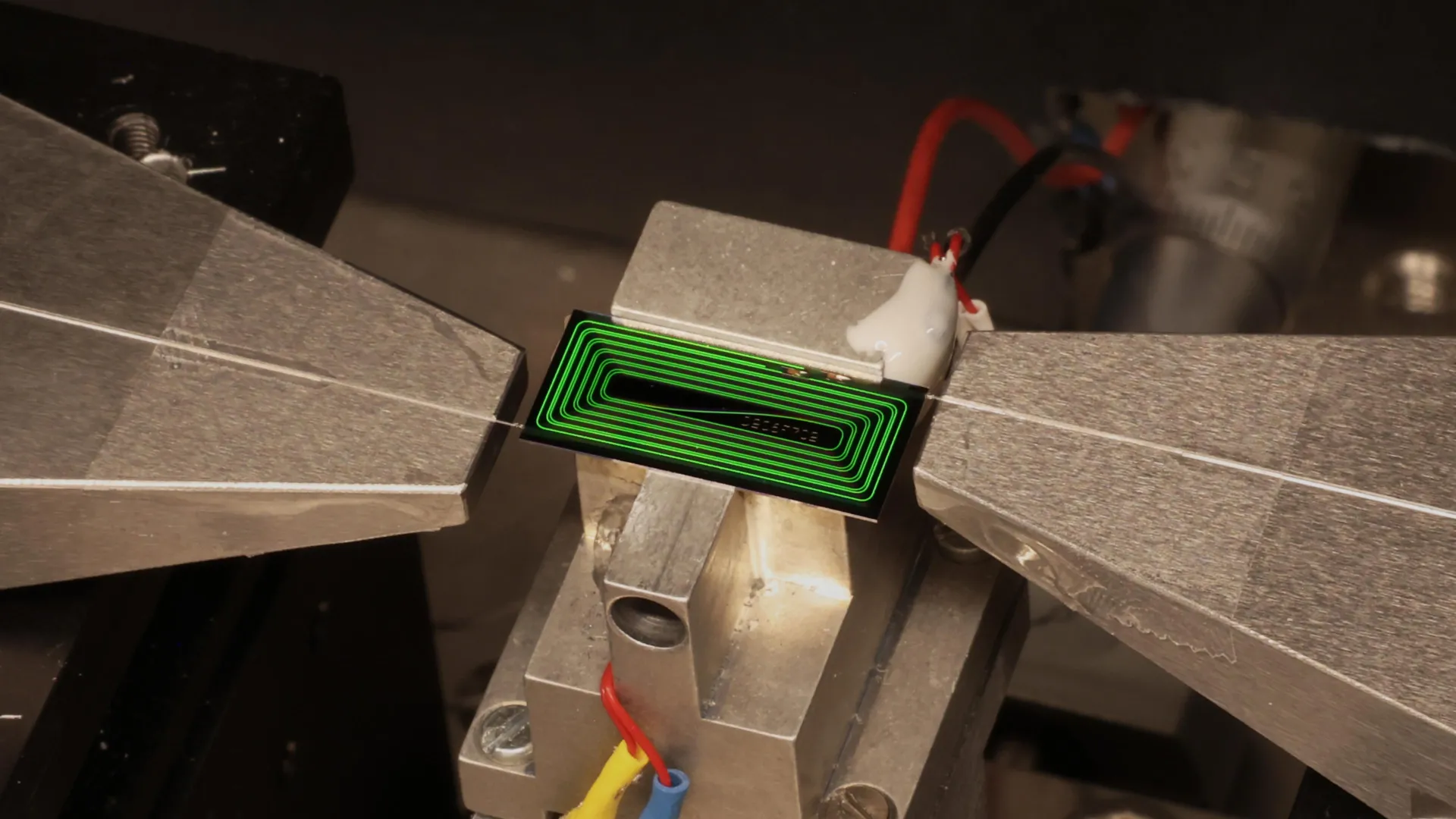
Researchers at EPFL have achieved a two-decade-long goal in photonics by successfully creating a chip-scale ultrafast laser that performs on par with traditional tabletop femtosecond lasers. The breakthrough, published in Nature, represents a major milestone in miniaturizing laser technology, with the potential to make advanced laser applications far smaller, cheaper, and more accessible across multiple industries from medical diagnostics to precision manufacturing.
For decades, ultrafast lasers producing pulses lasting just a few hundred femtoseconds have been among the most powerful tools in modern optics, enabling technologies ranging from precision eye surgery to optical frequency combs that power the world's most accurate atomic clocks. Despite their importance, these lasers have largely remained large, expensive systems occupying entire optical tables, limiting their widespread adoption and practical applications.
The EPFL team, led by Professor Tobias Kippenberg, accomplished this feat using a laser architecture known as the Mamyshev oscillator, a design that had received relatively little attention in integrated photonics. "For more than twenty years, a high-pulse-energy femtosecond laser on chip was widely regarded as a holy grail of integrated photonics," said Kippenberg. "Our result shows that it is not only possible, but that it can be achieved with a surprisingly elegant architecture."
The system places a nonlinear waveguide between two optical filters, each transmitting different portions of the light spectrum. As intense laser pulses travel through the waveguide, they expand into a broader range of colors, with part of the broadened pulse passing through both filters and continuing to circulate within the laser cavity. Weaker light behaves differently, being blocked by the filters and removed from the cycle, creating a self-selecting mechanism for maintaining intense pulses.
The chip-based laser delivers pulse energies of 1.05 nanojoules and pulse durations as short as 147 femtoseconds, matching the performance of much larger systems. The device's 42-centimeter laser cavity represents a dramatic size reduction compared to traditional setups while maintaining the precise control and reliability needed for scientific and industrial applications. This advancement could democratize access to ultrafast laser technology and enable new applications in portable devices and integrated systems.