
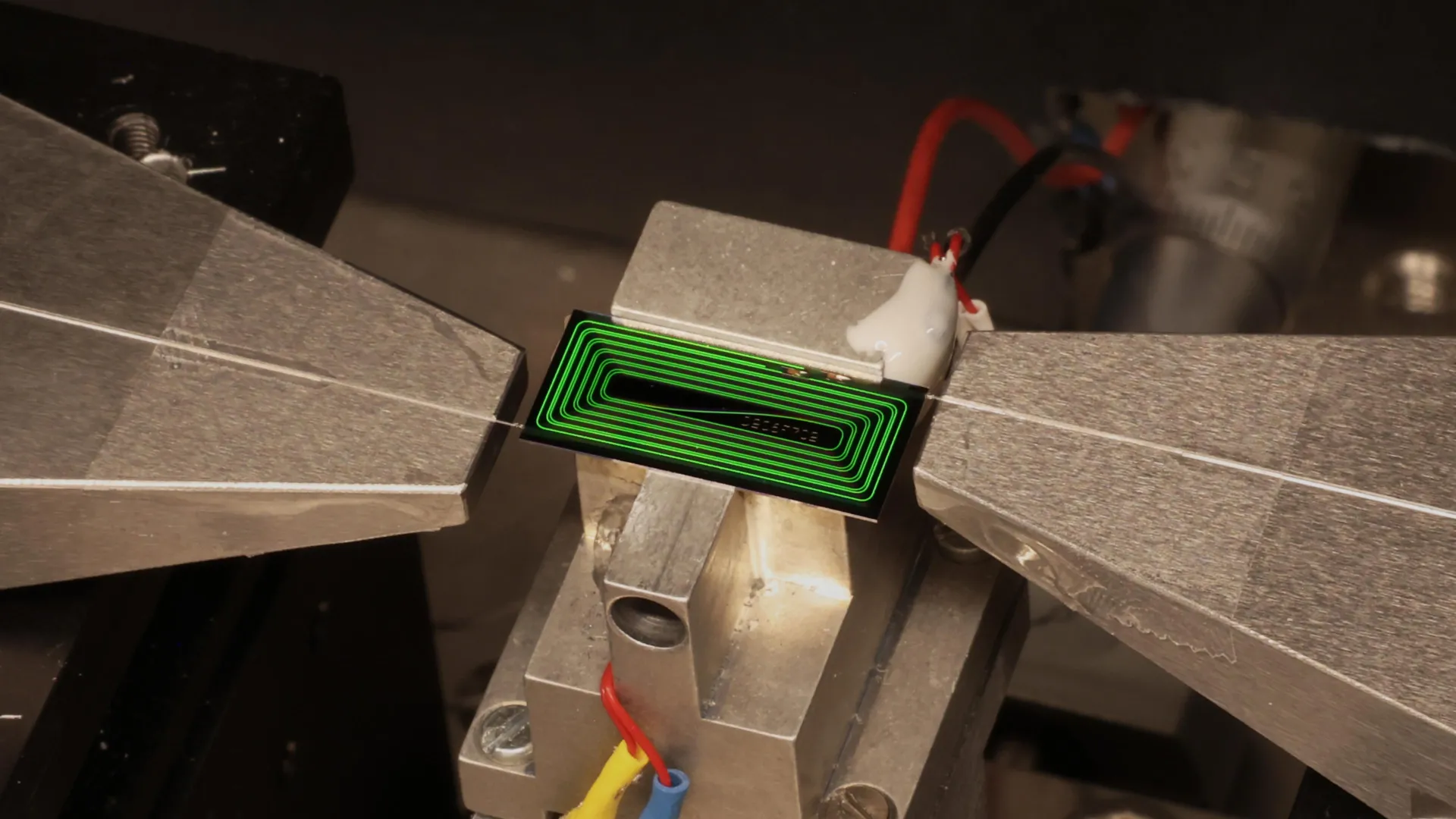
EPFL Builds a Chip-Scale Blue Laser Stable Enough for Underwater Communication
The 461-nanometer laser pairs a linewidth below 30 kilohertz with frequency tuning over 900 megahertz, and it sent an image through water and detected candle smoke.

Topic
10 stories from Planck Standard. Latest: October 29, 2026.

The 461-nanometer laser pairs a linewidth below 30 kilohertz with frequency tuning over 900 megahertz, and it sent an image through water and detected candle smoke.

EPFL and Weizmann physicists measured e/4 charges in a special quantum state of gallium arsenide, a result that strengthens the case for a route to error-proof quantum computers.

After 20 years of attempts, EPFL researchers have successfully miniaturized powerful femtosecond lasers onto photonic chips, potentially revolutionizing precision manufacturing and atomic clocks.

EPFL researchers achieve 20-year goal of integrating ultrafast laser technology that could revolutionize medical devices and atomic clocks.

EPFL researchers have developed the first integrated ultrafast laser that matches tabletop femtosecond laser performance, potentially making advanced laser technologies far smaller and more accessible.

EPFL researchers develop chip-scale ultrafast laser that matches tabletop performance, potentially revolutionizing medical diagnostics and atomic clock technology.

After 20-year quest, researchers create chip-scale ultrafast laser matching performance of room-sized systems, opening door to miniaturized precision technologies.

EPFL researchers successfully miniaturize powerful femtosecond laser technology onto a photonic chip, promising dramatic cost reductions.

EPFL researchers achieve breakthrough that could miniaturize powerful femtosecond laser technology for medical diagnostics and atomic clocks.

Swiss researchers stacked two perovskite layers on a silicon base to break the single-junction theoretical limit, potentially paving the way for space-grade solar efficiency at terrestrial prices.