EPFL Builds a Chip-Scale Blue Laser Stable Enough for Underwater Communication
The 461-nanometer laser pairs a linewidth below 30 kilohertz with frequency tuning over 900 megahertz, and it sent an image through water and detected candle smoke.

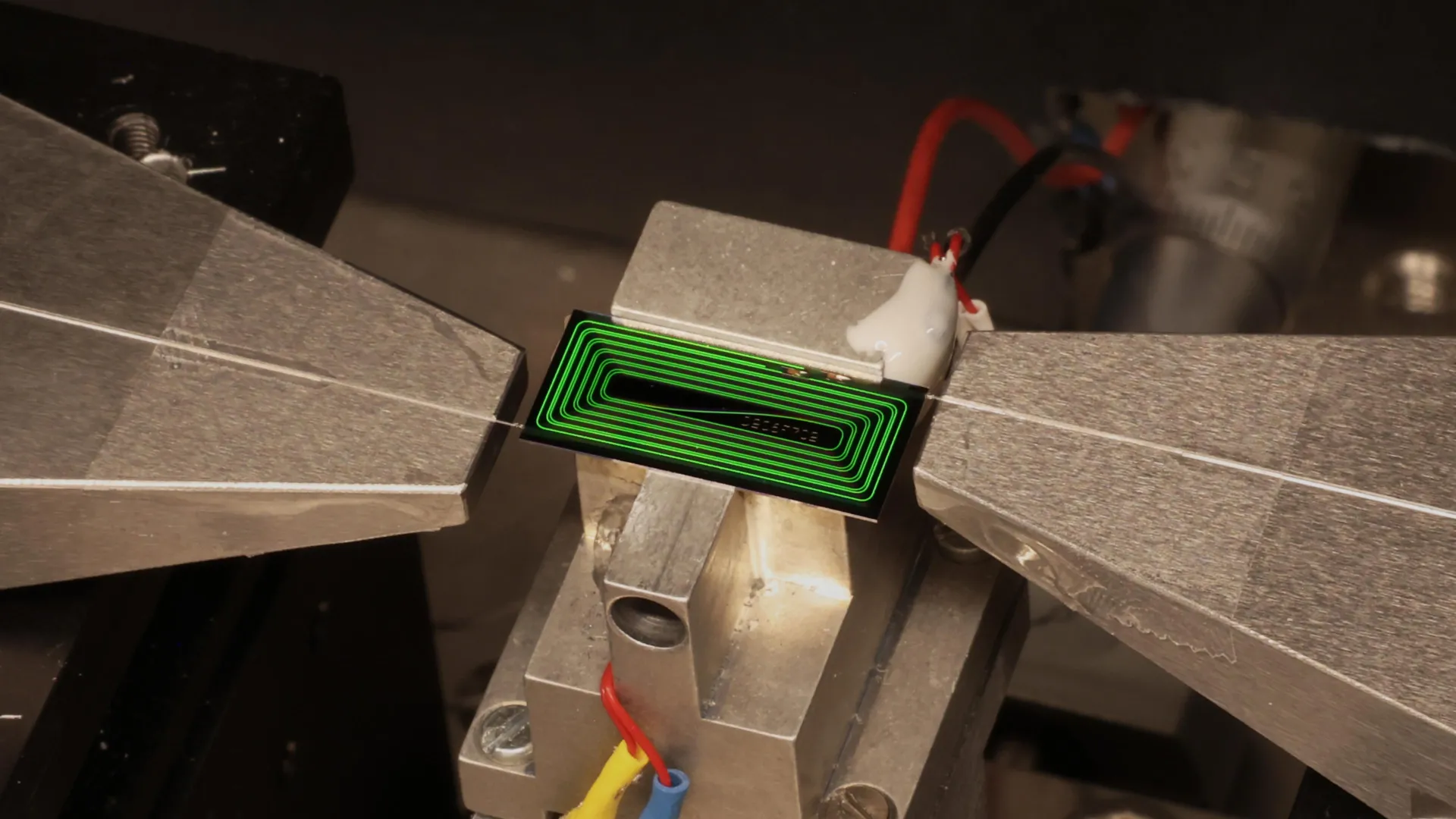
Researchers at EPFL in Switzerland have built a blue laser small enough to sit on a chip that is both very stable and rapidly tunable, a combination that has been hard to achieve at blue wavelengths.
The work, led by Tobias J. Kippenberg and Simone Bianconi, is described in Nature Photonics. The device could support underwater communication, environmental sensing and quantum technologies.
Blue light is useful for several reasons. It travels through water more easily than the infrared light used in most optical communication systems today, and it scatters strongly off tiny particles in the air, which makes it attractive for pollution monitoring and scientific instruments. But those uses demand precise control. The frequency must stay stable enough to tell a signal from background noise, and it must also change quickly when needed to carry information or make measurements.
Existing blue laser systems often depend on bulky optical components to reach that precision. Shrinking them onto photonic chips, which guide and control light through microscopic structures, has proved difficult because at blue wavelengths even tiny imperfections in those structures scatter light and degrade performance.
The EPFL team connected a conventional blue laser to a chip carrying a microscopic ring. The ring selects a precise frequency of light and feeds some of it back into the laser, helping it produce a steadier beam. To cut light losses, the researchers made the chip's light-guiding structures exceptionally thin, only 25 nanometers. They also added components made from aluminum nitride, a material that changes shape when voltage is applied. The resulting mechanical stress alters how light travels through the ring, so the laser's frequency can be adjusted quickly.
The laser operates at about 461 nanometers. One configuration produced exceptionally stable light with a linewidth below 30 kilohertz, a measure of how precisely the laser holds its frequency. Another allowed the team to tune the frequency across a range exceeding 900 megahertz, repeating the adjustments up to 1 million times per second.
The researchers tested two applications. First, they encoded a digital image of the EPFL logo into changes in the laser's frequency and sent it through a 30-centimeter column of water. The receiving system reconstructed the image, demonstrating the principle of underwater communication with the device.
Second, they used the laser to detect candle smoke in the air. The smoke produced a clear change in the detected signal, while an infrared laser at 1,550 nanometers showed no detectable change under comparable conditions. The experiment did not measure how much smoke was present, so it shows sensitivity to airborne particles rather than a calibrated sensor.
Precise frequency control also makes the technology relevant to atomic clocks and quantum computing, where stable blue light is essential. The demonstrations are laboratory tests over short distances, but they show that a compact, tunable blue laser is possible without the bulky optics that have held the field back.