Caltech Broke the Rule That Says One Photon Pair Can Only Double a Microscope's Resolution
They Got Four Times.
The trick was routing one half of an entangled pair through the lenses three times instead of once. Lihong Wang's group had been stuck at 1.8× since 2023.

A team at Caltech has pushed a quantum microscope to roughly four times the resolution of a conventional one, beating a limit that the field had generally accepted as the ceiling for what a single pair of entangled photons can do.
The constraint is well known to anyone who works on quantum imaging. "In general, people think that with a single photon pair, you can, at most, increase the resolution from the classical diffraction limit by two times," said Lihong Wang, the Bren Professor of Medical Engineering and Electrical Engineering at Caltech, who led the work. His own group's earlier system, published in 2023, landed at about 1.8× — close to that theoretical doubling and, apparently, close to the end of the road.
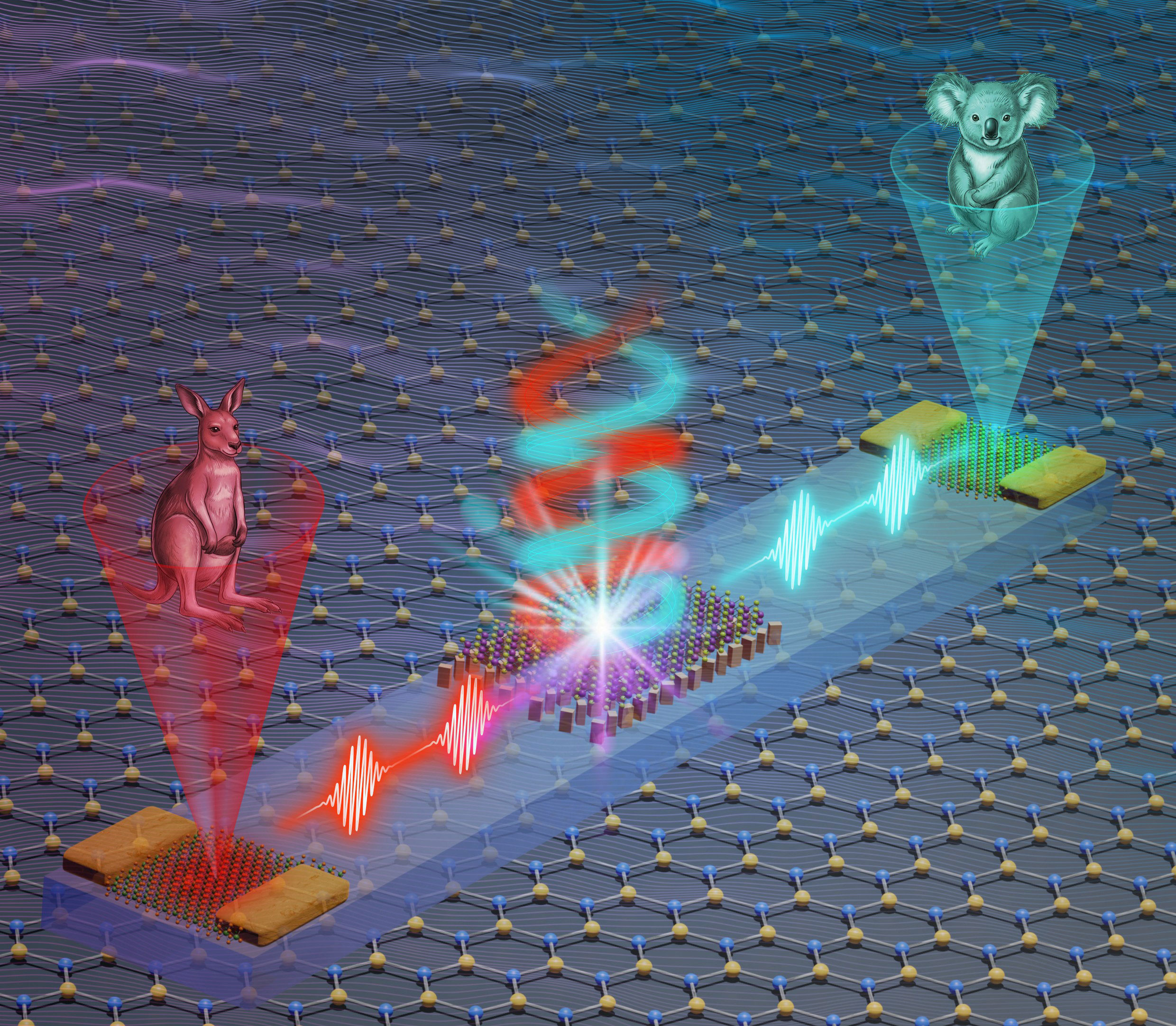
The technique is called quantum microscopy by coincidence, or QMC. It starts by splitting a photon into two entangled partners, conventionally labeled the signal and the idler. Because the pair is entangled, the two behave in imaging terms like a single object with half the wavelength, and halving the effective wavelength is what buys the resolution. The signal photon is the one that carries the picture; the idler is its correlated twin.
What Wang's group changed is deceptively simple: instead of sending the idler photon through the microscope's optics once, they routed it through the lenses three times, while the signal photon still made a single pass. Each additional pass compounds the effective wavelength reduction. Tested against standard resolution targets — the calibrated patterns of progressively finer lines used to benchmark any microscope — the multi-pass configuration resolved features about four times finer than a classical instrument, more than double the group's previous result. The work appears in Science Advances, with graduate researcher Xin Tong as first author, under the title "Above-twofold quantum super-resolution microscopy enabled by multiple idler passes with entangled biphotons."
The practical draw is not just sharpness but gentleness. Conventional super-resolution methods generally buy detail by dumping more light into the sample, and intense illumination is exactly what kills living cells and bleaches fluorescent labels partway through an experiment. An entangled-photon approach extracts more spatial information per photon, which means a biologist could in principle image living tissue at high resolution without cooking it — the tradeoff that currently limits how long anyone can watch a live cell.
Semiconductor inspection is the other target. Chip manufacturers hunt for defects at feature sizes that optical microscopes can no longer resolve, forcing them onto slower and more expensive electron-based tools. A four-fold optical improvement does not close that gap on its own, but it moves the boundary, and it does so with an instrument built from lenses and crystals rather than a vacuum chamber.