Stanford Develops Room-Temperature Quantum Device Using Twisted Light
The breakthrough quantum system operates without extreme cooling by using twisted photons to entangle light and electrons, potentially enabling smaller and cheaper quantum technologies.
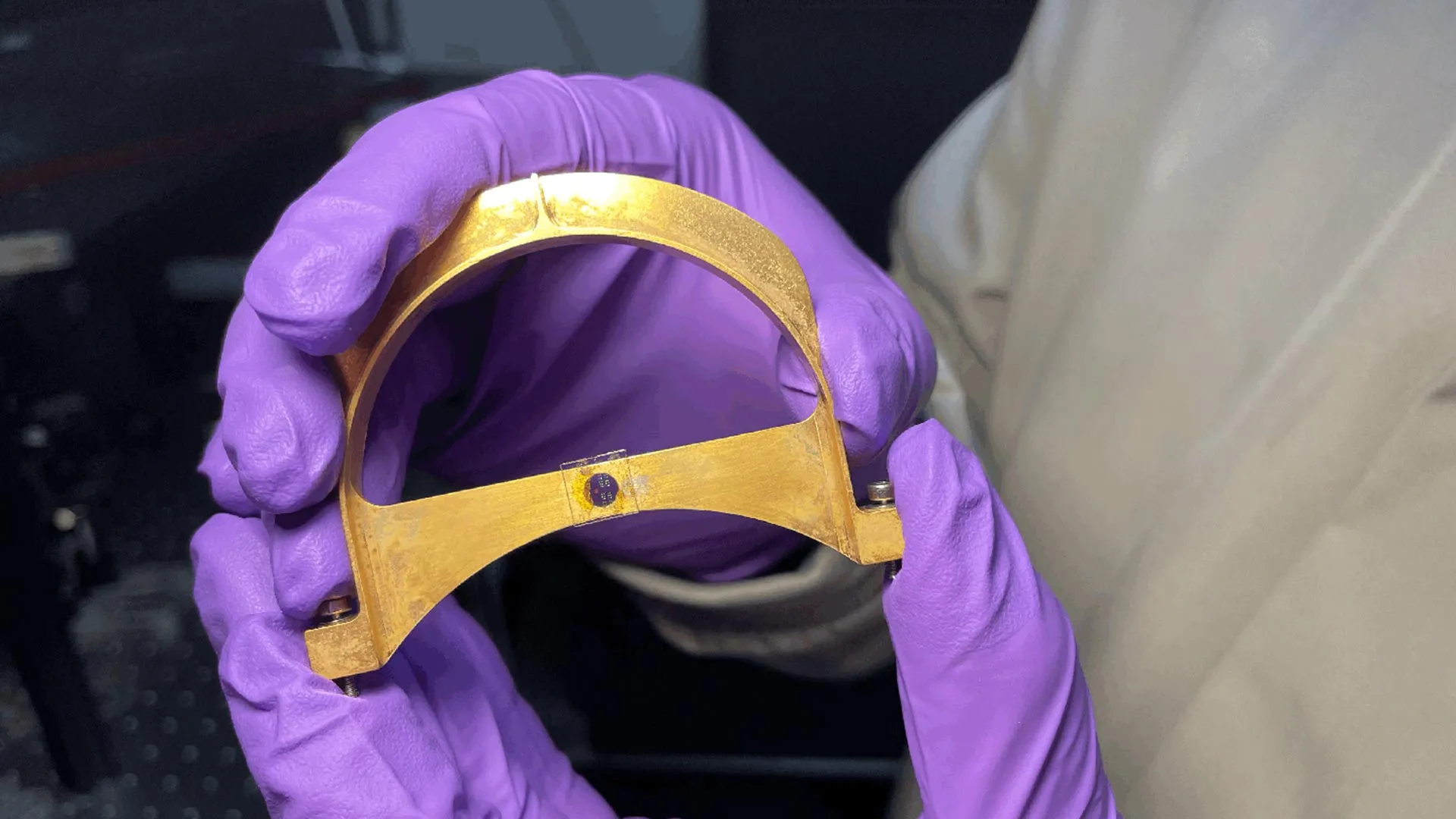
Stanford University researchers have developed a revolutionary nanoscale optical device that achieves quantum entanglement at room temperature, potentially solving one of the biggest obstacles to practical quantum technology deployment. The device successfully links quantum properties of photons and electrons without requiring the extreme cooling systems that make current quantum computers prohibitively expensive and complex to operate.
The breakthrough device combines a thin patterned layer of molybdenum diselenide with a nanopatterned silicon substrate to generate what researchers call 'twisted light.' According to Jennifer Dionne, a Stanford professor of materials science and engineering who led the study published in Nature Communications, the silicon nanostructures enable photons to spin in a corkscrew fashion. 'We can use these spinning photons to impart spin on electrons that are the heart of quantum computing,' explained Feng Pan, the study's first author and a postdoctoral scholar in Dionne's lab.
Most existing quantum computers require temperatures near absolute zero, approximately -459 degrees Fahrenheit, to maintain the delicate quantum states necessary for computation and communication. This cooling requirement makes quantum systems extremely expensive to build and operate, limiting their practical applications. The Stanford device eliminates this constraint by maintaining stable quantum entanglement between photons and electrons at normal room temperatures, dramatically reducing the technical barriers to quantum technology adoption.
The patterned nanostructures at the heart of the device are incredibly small, roughly comparable to visible light wavelengths and invisible to the naked eye. Despite their tiny size, these structures precisely manipulate photons to create the twisted light necessary for quantum entanglement. The molybdenum diselenide belongs to a family of materials called transition metal dichalcogenides, which are valued for their unique optical and quantum properties that make this room-temperature operation possible.
The research represents a significant step toward practical quantum communication systems that could transmit information across long distances using quantum-encrypted channels. Dionne noted that the device provides 'a very versatile, stable spin connection between electrons and photons that is the theoretical basis of quantum communication.' The ability to operate at room temperature could enable quantum technologies to move beyond specialized laboratory environments into real-world applications, from secure communications networks to advanced computing platforms that leverage quantum mechanical effects for unprecedented processing capabilities.