Stanford Scientists Develop Room-Temperature Quantum Device Using Twisted Light
The breakthrough device uses twisted light to entangle photons and electrons without extreme cooling, potentially making quantum technology smaller and more affordable.
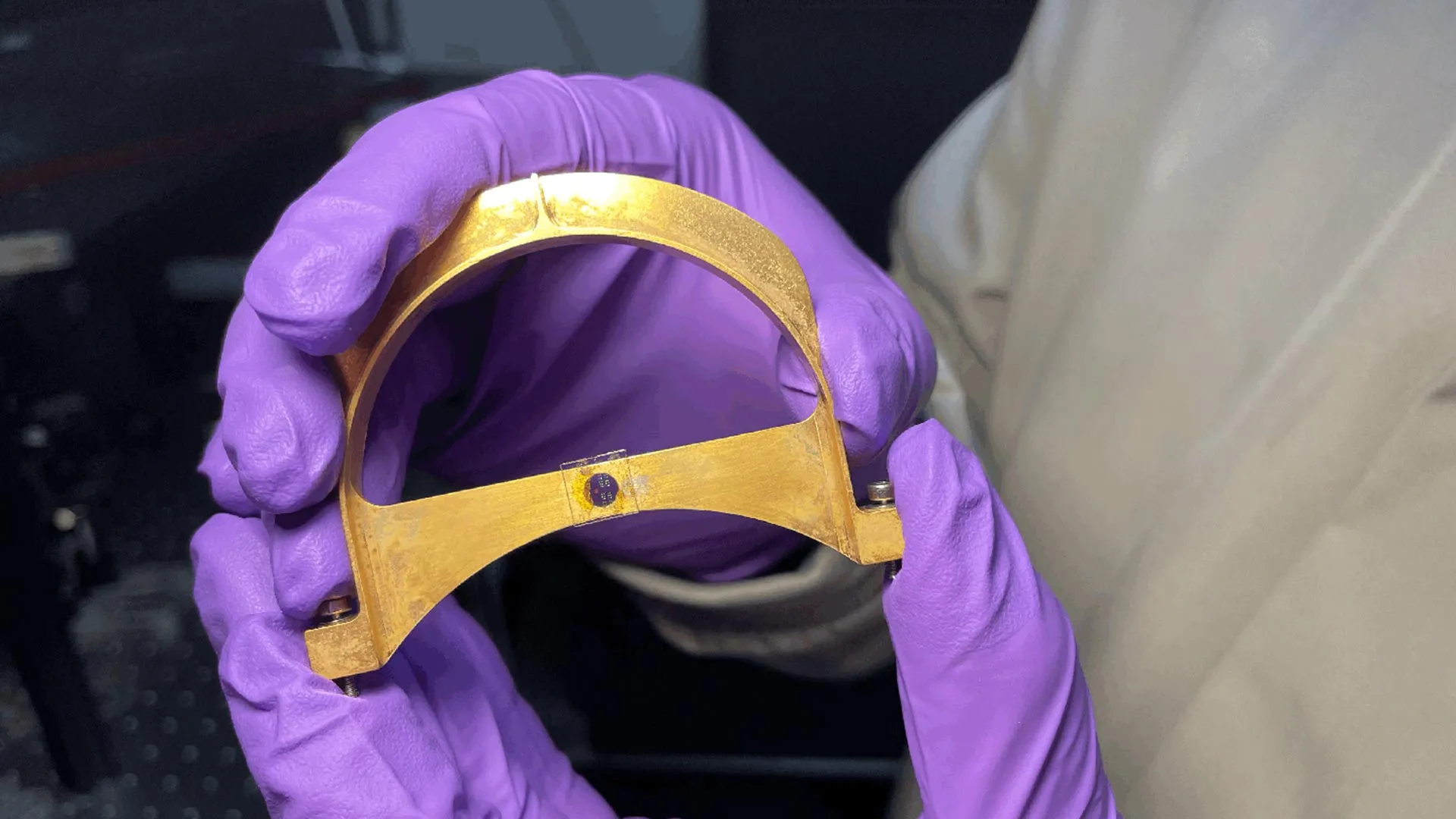
Stanford University researchers have developed a revolutionary nanoscale optical device that operates at room temperature while linking the quantum properties of light and electrons, potentially eliminating one of the biggest barriers to practical quantum technology deployment. The advance could dramatically reduce the cost and complexity of quantum systems, which currently require temperatures near absolute zero to maintain the delicate quantum states necessary for computation and communication.
The new device enables entanglement between photons and electrons through what researchers call "twisted light." Professor Jennifer Dionne of Stanford's materials science and engineering department, who serves as senior author of the study published in Nature Communications, explained that while the material itself is not entirely new, the application represents a breakthrough. The device provides a versatile, stable connection between electron spins and photons that forms the theoretical foundation of quantum communication.
The innovative system combines a thin patterned layer of molybdenum diselenide (MoSe2) with a nanopatterned silicon substrate. Molybdenum diselenide belongs to a family of materials called transition metal dichalcogenides, valued for their unique optical and quantum properties. The silicon nanostructures play a critical role by generating photons that spin in a corkscrew fashion, which can then impart spin properties to electrons that serve as the heart of quantum computing.
Postdoctoral scholar Feng Pan, the paper's first author, noted that the patterned structures are incredibly small, roughly comparable to the wavelength of visible light and invisible to the naked eye. Despite their microscopic size, these nanostructures allow researchers to manipulate photons with extraordinary precision, controlling their spin direction in specific ways. This level of control is essential for creating the qubits that serve as the basic building blocks of quantum information systems.
The room-temperature operation represents a significant departure from conventional quantum devices that require expensive and complex cooling systems. By eliminating the need for extreme cooling, the Stanford device could make quantum technology more accessible for practical applications ranging from secure communications to advanced computing platforms. The breakthrough addresses one of the most significant technical and economic barriers that have limited the widespread adoption of quantum technologies.