Stanford Quantum Computing Breakthrough Uses Twisted Light Without Extreme Cooling
A new room-temperature quantum device uses twisted light to entangle photons and electrons, overcoming one of the biggest hurdles in quantum technology development.
Researchers at Stanford University have developed a revolutionary nanoscale optical device that operates at room temperature while creating quantum entanglement between photons and electrons, potentially eliminating the need for the extreme cooling systems that make current quantum computers prohibitively expensive to operate. The breakthrough could pave the way for smaller, more affordable quantum technologies capable of secure long-distance communication.
Most quantum computers today require temperatures near absolute zero, approximately -459 degrees Fahrenheit, to maintain the delicate quantum states necessary for computation and communication. This new device overcomes that limitation by using "twisted light" to create stable quantum connections at normal temperatures. The advance represents a significant step toward making quantum technologies more practical and accessible.
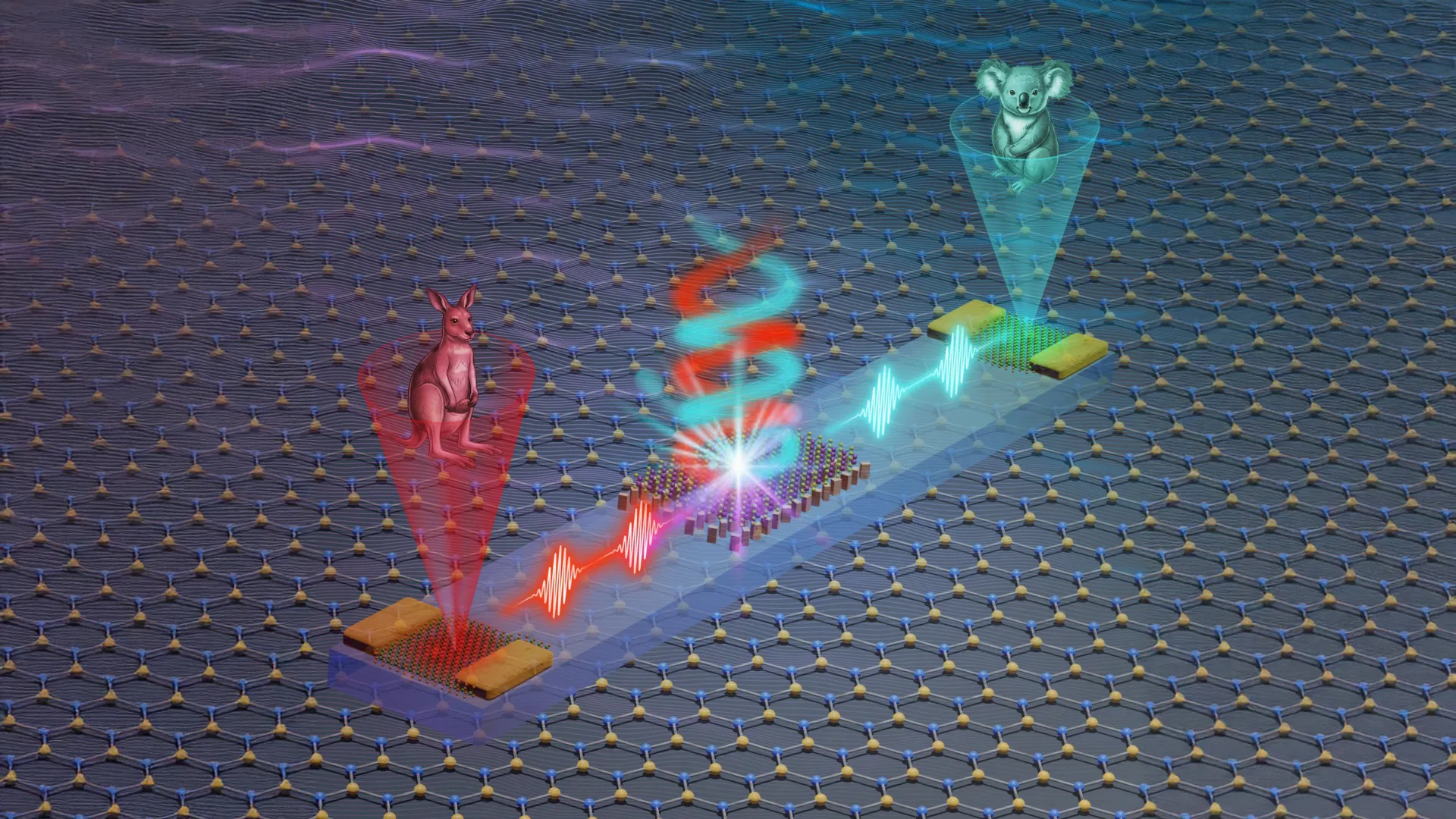
The device combines a thin patterned layer of molybdenum diselenide (MoSe2) with a nanopatterned silicon substrate. According to Jennifer Dionne, a professor of materials science and engineering at Stanford and senior author of the study published in Nature Communications, the silicon nanostructures generate twisted light that enables precise manipulation of photons. "The photons spin in a corkscrew fashion, but more importantly, we can use these spinning photons to impart spin on electrons that are the heart of quantum computing," explains first author Feng Pan.
The twisted light becomes entangled with electron spins, creating qubits - the fundamental building blocks of quantum information systems. Unlike classical computing bits that represent either zeros or ones, qubits can leverage quantum mechanical effects to process and transmit information in entirely new ways. The researchers can use this entanglement for quantum communication applications that require the secure transmission of information.
One of the most significant challenges in quantum technology has been maintaining stable quantum states, a process known as coherence. Many existing systems require extreme cooling to prevent decoherence, which destroys the quantum properties essential for these technologies. The Stanford device's ability to maintain quantum entanglement at room temperature could dramatically reduce the cost and complexity of quantum systems, making them viable for a much broader range of applications including secure communications, advanced sensing, and eventually quantum computing.