Billions of Atoms in a Crystal Start Flashing in Rhythm on Their Own, Making a New Kind of Laser
Caltech and Stanford physicists found ytterbium ions fire microwaves and infrared light in perfect step, creating a frequency comb that could link quantum computers.

Shine a laser into a crystal and you expect a steady glow as its atoms absorb energy and give it back. In early 2024, Caltech researchers looking for something else saw a crystal flash instead, in a regular rhythm like a metronome. Now they know why, and they have turned the effect into a new kind of laser.
The flashes came from billions of atoms embedded in the crystal. Coupled to a tiny superconducting circuit, the atoms had synchronized and begun emitting light together through a quantum phenomenon called superradiance. "Remarkably, the atoms were flashing in two very different kinds of light at once—microwaves and infrared light—in perfect step with each other," said Caltech's Andrei Faraon. "That had not been observed before."
Working with a Stanford team led by Joonhee Choi, Faraon's group worked out the mechanism and used it to build a superradiant frequency comb. The work appears in Nature, with Tian Xie, who did it as a Caltech graduate student, as lead author. A frequency comb emits many evenly spaced colors of light, like the teeth of a comb, and works as a ruler for light. Combs sharpen atomic clocks, ultrafast science and chemical identification.
Superradiance has been known for more than 50 years. In an ordinary laser, light bouncing between mirrors prompts excited atoms to release energy in step, and the mirror spacing helps set the frequency. Superradiance has no mirrors. The atoms lock into step on their own through a shared electromagnetic field and radiate together. Earlier work showed such atoms can give a quick flash or a steady beam. The surprise here was a repeated, regular rhythm that forms a comb.
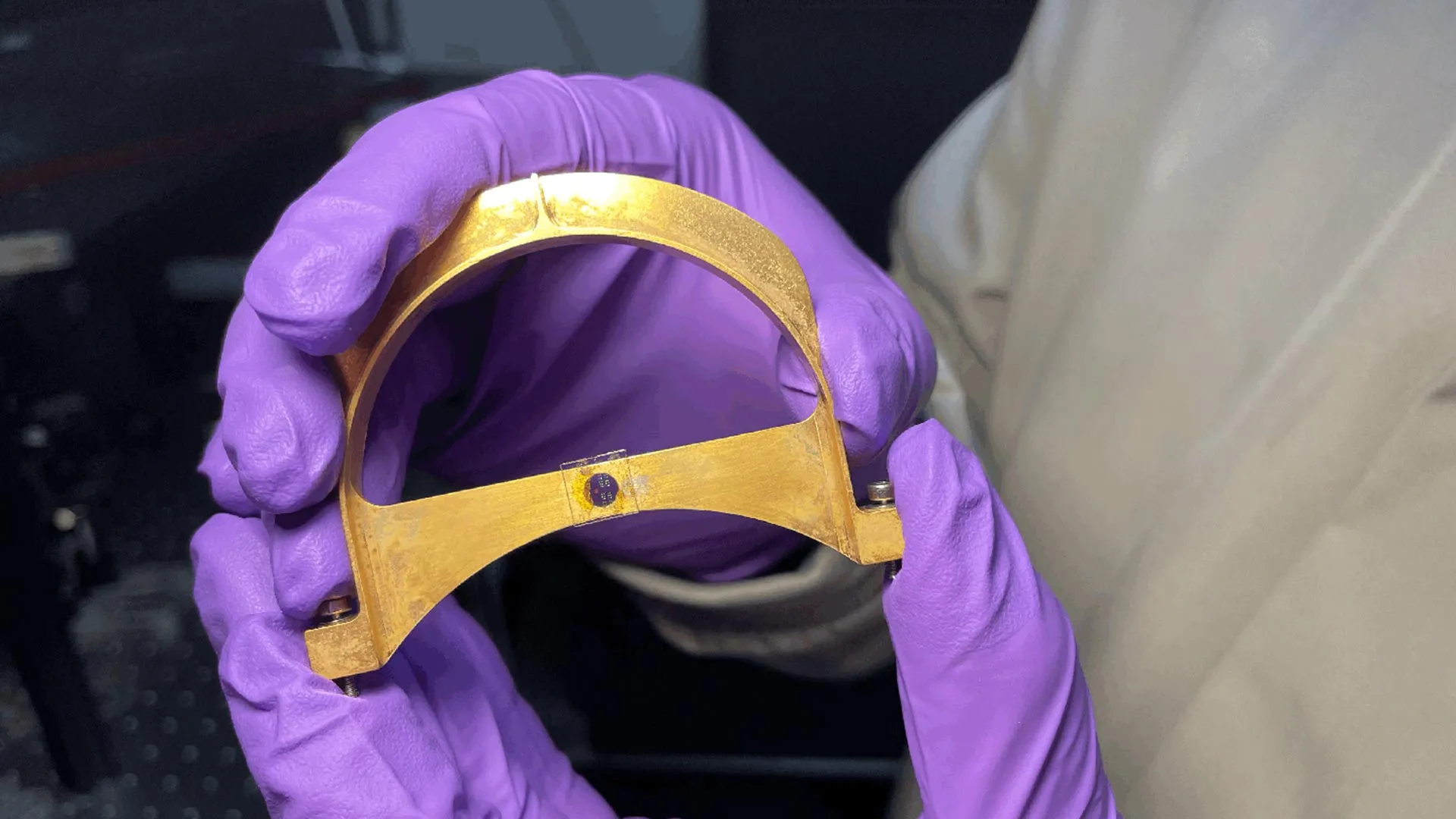
The team embedded billions of ytterbium ions in a yttrium orthovanadate crystal beneath a layer of superconducting material that trapped microwaves. A laser energized the ions, which emitted microwaves. Because they all felt the same microwave field, they synchronized. Past a certain laser power, the ions switched from steady emission to pulsing in rhythm. "Imagine a crowd suddenly starting to clap in perfect rhythm without anyone leading them," Choi said.
The payoff is stability. "Other mode-locked frequency combs depend on bouncing light off mirrors in a cavity, and those cavity lengths can fluctuate due to things like temperature," Xie said. "Because superradiance comes from atom–atom interference, it's absolutely frequency-stable, and therefore it can, in principle, be a much better platform than previous frequency combs."
The comb could also help connect quantum machines. Many quantum computers use superconducting circuits that work with microwaves, which lose quantum information easily unless kept near absolute zero, about minus 273 degrees Celsius. Optical light can carry information over long distances through fiber, but superconducting circuits cannot send or receive it directly. Ytterbium ions interact with both, because the same ion has a small energy gap tied to microwaves and a larger one tied to optical light.
Next, the team wants to shape the rhythm at will. "So that the atoms become a kind of programmable light source," Faraon said. By tuning the atoms with laser light, they hope to adjust emission strength, pulse spacing and format to suit specific applications.