Excitons Drive Floquet Effects 100 Times Stronger Than Light Alone — A Breakthrough for Ultrafast Quantum Devices
A global team at OIST and Stanford found that bound electron-hole pairs in atomically thin semiconductors reshape a material's quantum properties far more efficiently than laser light, at a fraction of the energy cost.
A global research team led by the Okinawa Institute of Science and Technology and Stanford University has discovered that excitons — quantum quasiparticles formed when an electron and a positively charged "hole" are bound together by attraction — can drive Floquet effects in two-dimensional semiconductor materials at intensities two orders of magnitude stronger than direct optical illumination achieves. The finding, published in Nature Physics, fundamentally changes the physics community's understanding of Floquet engineering, suggesting that the exciton-mediated route to reshaping a material's quantum properties requires far less energy and produces more durable effects than previously considered possible.
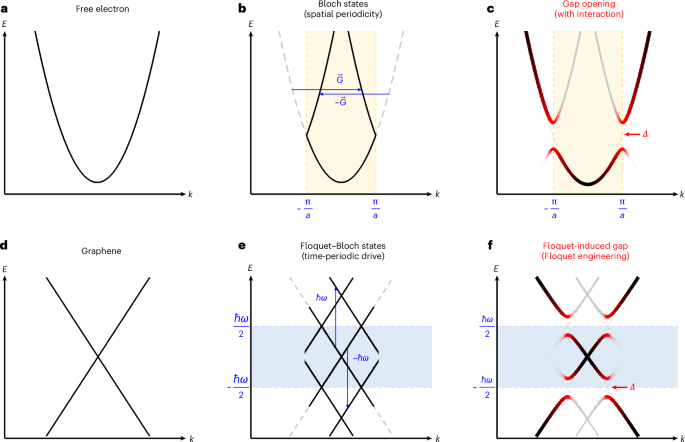
Floquet engineering exploits the mathematical framework of Floquet theory — a set of equations describing how a system's behavior changes under periodic driving — to temporarily endow materials with electronic properties they do not naturally possess. The idea is that by exposing a material to oscillating light or other periodic fields, physicists can effectively dress its electrons in a coat of photons that reshapes the material's band structure, the quantum-mechanical property that determines whether it conducts electricity, insulates against it, or behaves as something more exotic like a topological material. The challenge is that achieving strong enough Floquet effects to be useful typically requires extremely intense laser pulses that heat the material and destroy the very quantum states researchers are trying to create.
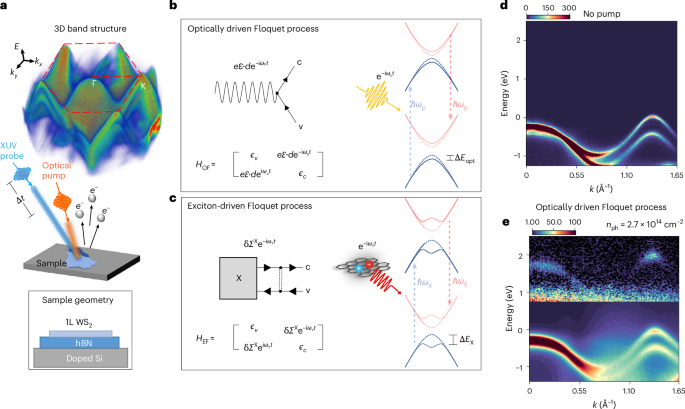
The OIST-Stanford team's key insight was that in monolayer semiconductors — atomically thin materials like molybdenum disulfide or tungsten diselenide that have attracted enormous interest for their unusual optical and electronic properties — excitons provide a far more efficient intermediary for Floquet driving than light alone. When a laser pulse creates an exciton in such a material, the exciton's oscillating electric field acts on nearby electrons in the same way that an external electromagnetic field would, but with a coupling strength that is intrinsically much larger because the exciton's field is concentrated within the atomic monolayer rather than extending into free space. The researchers measured Floquet effects driven by this excitonic field that were approximately 100 times stronger than the best optically driven results in similar materials, and found that the effects persisted for significantly longer timescales — hundreds of femtoseconds instead of tens — giving them a durability that makes experimental study and potential applications far more tractable.
The physics implications of the result are wide-ranging. The team showed that excitonic Floquet driving could open electronic band gaps in their monolayer semiconductor with sufficient efficiency to be potentially useful for switching applications — creating a material that is a conductor when no exciton is present and a semiconductor or insulator when one is created by a weak laser pulse. This is a qualitatively different mode of optical control than anything available in bulk semiconductor technology, and one that operates on ultrafast timescales. The energy required to switch the material's properties is orders of magnitude smaller than what conventional optical Floquet approaches require, which matters enormously for any future device application where power dissipation is a constraint.
The discovery arrives at a moment when the broader field of Floquet engineering is experiencing rapid experimental progress after years of being primarily a theoretical pursuit. Earlier this year, separate teams reported the first direct observation of Floquet states in graphene and in other two-dimensional systems, establishing that the phenomenon is not merely a theoretical curiosity but can be measured and characterized in real materials. The OIST-Stanford result adds a new twist: not only can Floquet effects be created and observed, but they can be driven by excitonic fields at intensities far below what anyone had previously anticipated needing. The research community's next challenge is to demonstrate control over these states — turning them on and off reliably, tuning their properties, and preserving them long enough to perform useful quantum operations, capabilities that would transform Floquet engineering from a scientific phenomenon into a technological platform.