Physicists Find Ytterbium Compound's Spins Behave Like a Liquid Crystal, Explaining a Long-Standing Puzzle
Neutron scattering at Rice University shows manganese spins in YbMnBi2 line up in a preferred direction without forming magnetism, a 'spin nematic' state that appears near room temperature.

In some materials, physical properties arise not from individual particles but from the collective behavior of their quantum spins. Researchers led by Pengcheng Dai at Rice University have now found that in one compound containing the rare-earth element ytterbium, those spins act much like the molecules in a liquid crystal: they favor a certain direction without lining up to create magnetism on a larger scale. The work was published in Physical Review X.
Spin is a quantum property of particles such as electrons that effectively turns them into tiny bar magnets pointing in particular directions. When many spins interact, the patterns they form strongly influence how a material conducts electricity and heat. In an ordinary magnet the spins line up to create an overall magnetization. That order breaks down above a certain temperature, leaving the spins pointing in random directions.
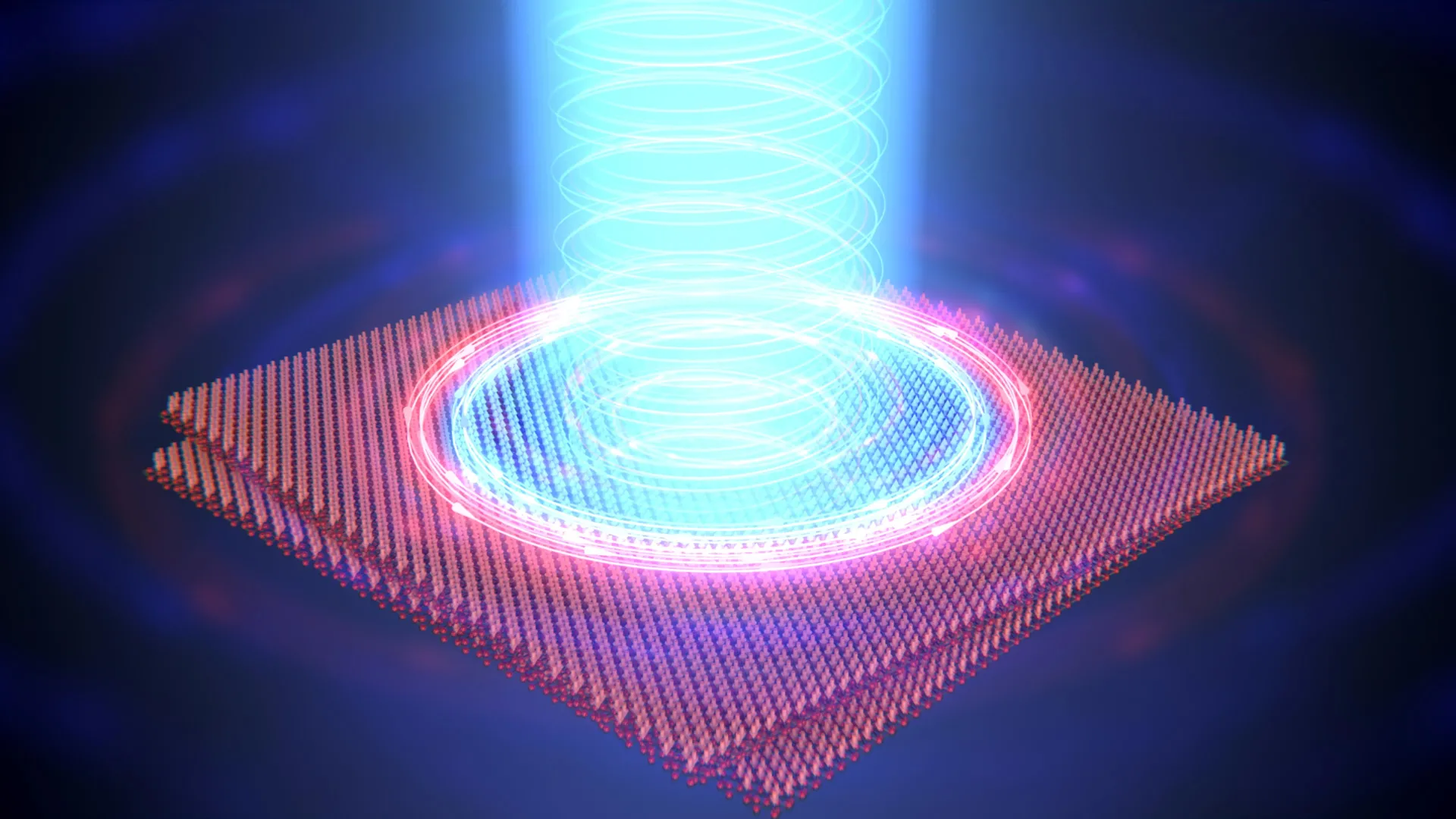
Earlier studies suggested that some magnetic compounds may host an in-between "spin nematic" state. As with the rod-shaped molecules in a liquid crystal display, the spins share a preferred direction without forming magnetic order. Dai's team asked whether this state could exist in YbMnBi2, a compound of ytterbium, manganese and bismuth.
They had a reason to suspect it. In a magnetic field, currents of electricity and heat flowing through the material are pushed sideways far more strongly than expected, even at temperatures where its magnetic order has vanished. Until now that behavior has lacked a convincing explanation.
To investigate, the researchers fired beams of neutrons at crystals of YbMnBi2 and of a closely related compound in which calcium replaces ytterbium. Because neutrons carry spins of their own, the team could control their orientation and measure how they scattered off the spins inside each crystal. That let them compare how the spins fluctuated along different directions while varying the temperature and the strength of an applied magnetic field.
As they cooled the ytterbium compound from 450 kelvin, about 177 degrees Celsius, the manganese spins began fluctuating more strongly in some directions than others at around 400 kelvin. That is about 260 degrees Fahrenheit. The material was still too warm for magnetic order, which sets in at around 290 kelvin, or 62 degrees Fahrenheit. The calcium compound showed no sign of the effect, which the team says is strong evidence for a fluctuating spin nematic state.
Based on the result, Dai's team proposes that the state arises because the heavy ytterbium atoms tie the motion of electrons closely to their spins. In a magnetic field, the ytterbium atoms' own spins can then interact with the nematic state and create a twisted spin arrangement that deflects moving electrons sideways. The paper, by Yaofeng Xie and colleagues, describes it as a spin nematic liquid crystal with scalar spin chirality in a tetragonal lattice.
Beyond explaining the odd behavior of YbMnBi2, the results could guide efforts to build similar effects into other materials. That could eventually benefit spintronics, an emerging technology that carries information using spin rather than electrical charge. Because the effect appears without magnetic order and at around room temperature, it could be especially promising for practical devices.