Scientists Use a Single Laser Pulse to Flip an Entire Ferromagnet's Polarity — Without Any Heat
Physicists at ETH Zurich and the University of Basel published in Nature the first demonstration of all-optical, room-temperature control of a ferromagnet's magnetic orientation, using twisted layers of molybdenum ditelluride and a focused laser beam to switch collective electron spin states permanently.
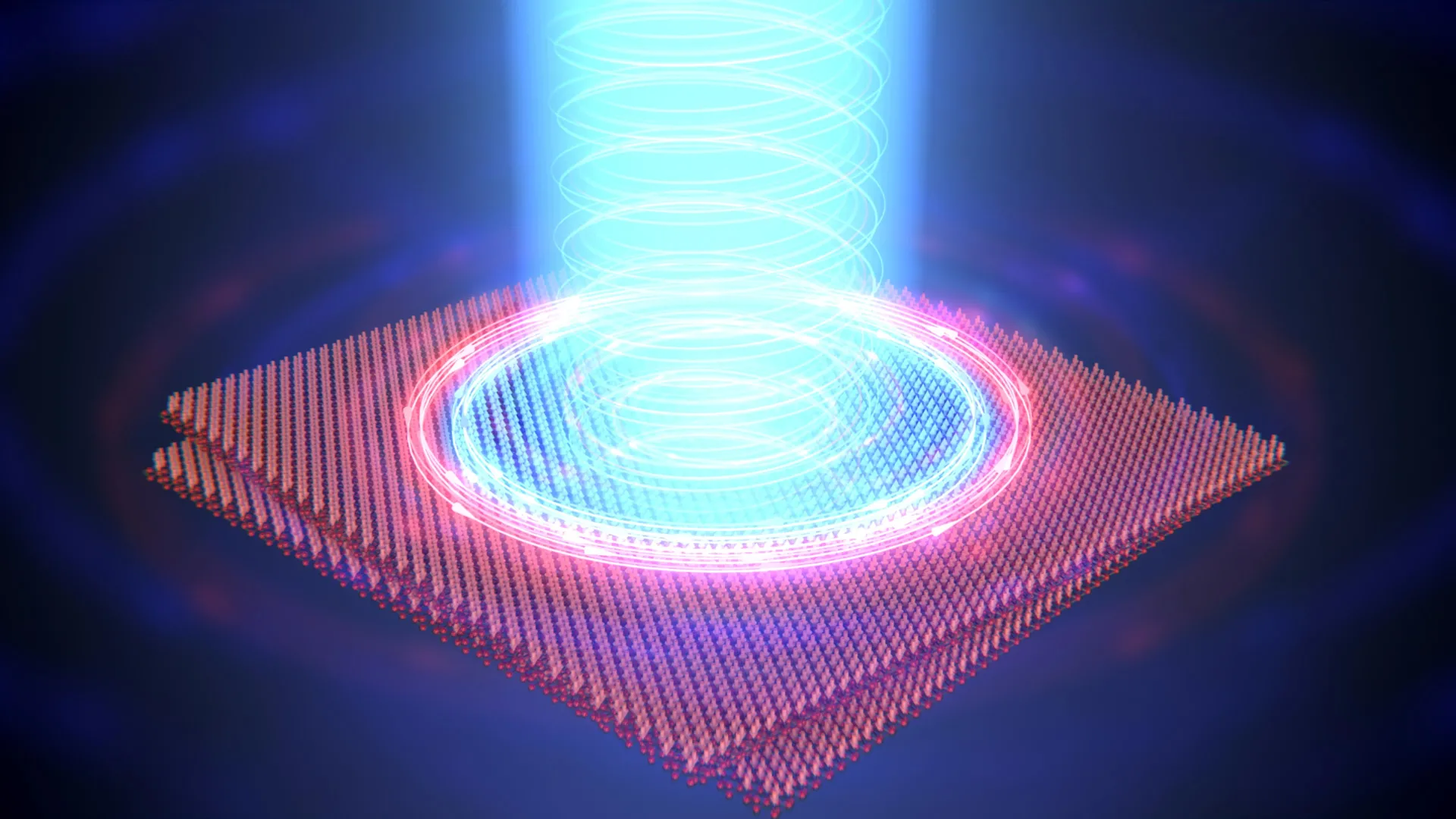
Physicists at ETH Zurich and the University of Basel have demonstrated that a single laser pulse can permanently flip the magnetic polarity of an entire ferromagnet without heating the material, overcoming a fundamental barrier that had limited optically controlled magnetism to individual electrons rather than the collective spin states that determine a material's magnetic orientation. The discovery, published in Nature and led by Professor Ataç Imamoğlu at ETH Zurich and Professor Tomasz Smoleński at the University of Basel, opens the possibility of writing arbitrary magnetic configurations onto chips using only light — a capability that could transform data storage, quantum computing, and precision sensing technologies.
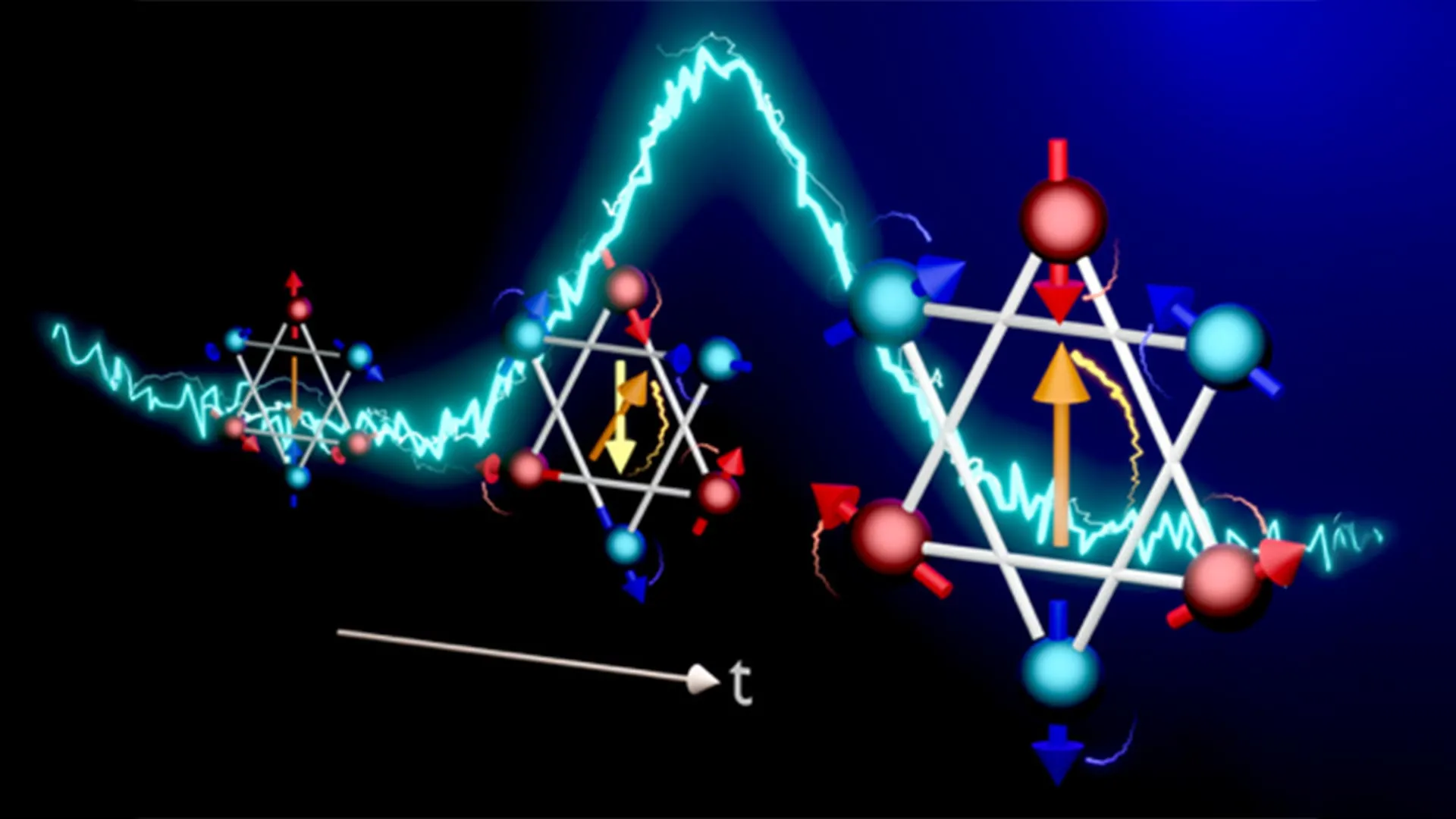
The experiment used an exotic material: two atomically thin sheets of the semiconductor molybdenum ditelluride, stacked with a slight twist between them. This twisted-bilayer geometry creates unusual topological electronic states in which electrons organize into quantized patterns governed by the material's geometric properties. When the researchers directed a focused laser pulse at the material, all the electron spins in the illuminated region flipped their collective orientation simultaneously and permanently — a striking demonstration that light can control an entire ferromagnet's magnetic state rather than just individual spins. Crucially, the switching occurred without raising the material's temperature above its critical threshold, and the topology of the switched state was found to influence the switching dynamics, creating a rich interplay between light, magnetism, and geometric structure.
'We combine the three big topics in modern condensed matter physics in a single experiment,' Imamoğlu said, referring to topology, magnetism, and light-matter interaction. The combination of these three domains in one material system represents a convergence that theorists had predicted but experimentalists had been unable to achieve with any material studied previously. Smoleński noted that the permanence of the switching and its topological character make it unlike previous demonstrations of laser-induced magnetic control, which typically required strong magnetic fields, cryogenic temperatures, or produced only transient rather than persistent changes. 'We will be able to optically write arbitrary and adaptable topological circuits on a chip,' Smoleński said, pointing toward practical applications in optical data storage and quantum circuit fabrication.
The practical implications span multiple fields. In data storage, the ability to address individual magnetic regions using focused laser beams could enable storage densities far exceeding what conventional magnetic recording heads can achieve, potentially enabling a new generation of optical-magnetic hybrid storage devices that combine the speed of light with the permanence of magnetic recording. In quantum computing, magnonic systems based on topological ferromagnets could host exotic quasiparticles useful for robust quantum information processing. For precision sensing, the team noted that optically controlled ferromagnets could be used to construct miniature interferometers capable of detecting extremely small electromagnetic fields — useful in applications ranging from brain imaging to quantum navigation systems that require extreme sensitivity.
The material's properties also make it an ideal platform for exploring the intersection of topology and magnetism, a research frontier that has produced several Nobel Prize-winning discoveries in recent years. Topological materials exhibit behaviors governed by geometric invariants that remain stable against small perturbations — a property that makes them potentially valuable for robust quantum computing applications where error correction is essential. The ETH Zurich and Basel team is now working to extend the technique to a broader class of two-dimensional magnetic materials and to develop methods for reading out the magnetic state optically without disturbing it. This non-destructive readout capability is a necessary step toward practical devices that use light to both write and read magnetic information, potentially enabling all-optical magnetic memory that operates at the speed of light pulses rather than the mechanical speeds of conventional storage.