Physicists Trapped Water Between Soft Membranes So It Could Not Freeze, and Finally Watched It Turn Into Glass
Confined inside phytantriol lipid layers, water skipped ice entirely down to minus 120 Celsius. Its molecular motion changed sharply between minus 35 and minus 20.

Water has a stretch of temperature that experimenters have never been able to get into. Below about minus 40 Celsius, pure water crystallizes so fast that no instrument can catch it in a liquid state, and the region between that point and the deep-freeze glassy phase has been called no-man's land for decades. An international team has now walked through part of it by giving water nowhere to build ice.
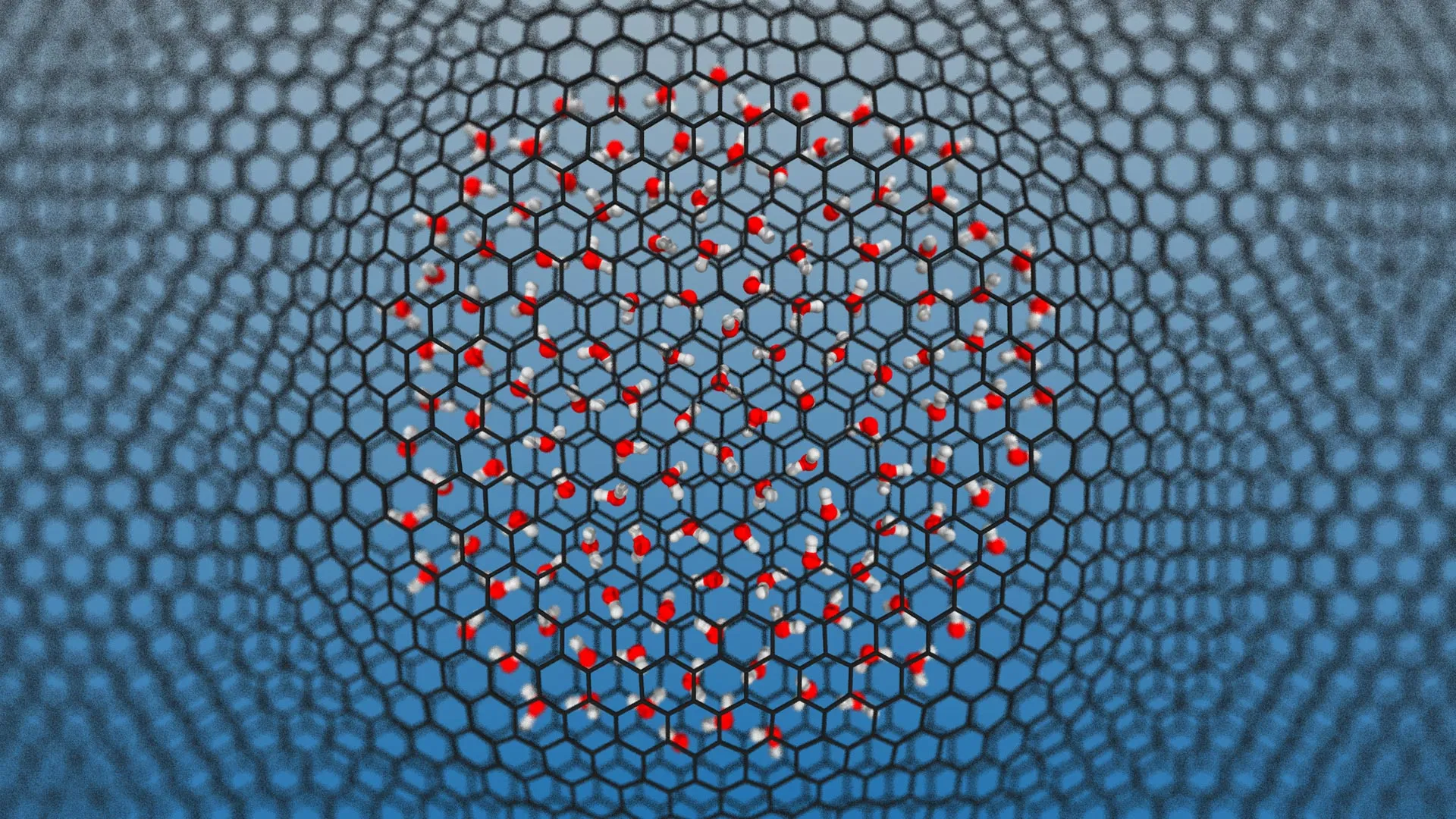
The trick was soft nanoconfinement. Researchers trapped water inside ultra-thin lipid membranes made of phytantriol, a molecule that self-assembles into layered structures with water channels a few nanometers across. Ice needs room to nucleate and grow an ordered crystal; a channel that narrow denies it that room. The membranes themselves stayed fluid throughout, so the water was not pinned against a rigid wall — the confinement was soft, which is closer to the situation inside a living cell than a silica pore is.
The measurements were done at Australia's ANSTO facilities and published in Nature Communications, with Patrick Züblin as lead author. Small- and wide-angle X-ray scattering mapped the structure down to minus 120 Celsius and confirmed no ice formed. Neutron scattering did the harder job: the high-resolution backscattering spectrometer Emu and the time-of-flight spectrometer Pelican track how hydrogen atoms move, on timescales from picoseconds to nanoseconds, which is where a liquid stops behaving like a liquid.
The sharp change showed up between minus 35 and minus 20 Celsius. Across that window the water's molecular dynamics shifted markedly — molecules stopped rearranging on the timescale of the measurement and started rattling in place, the signature of a liquid falling out of equilibrium and locking into a glass. Low-temperature microscopy, nuclear magnetic resonance and computer simulations backed up the scattering data.
Why this matters beyond the phase diagram: the debate over water's low-temperature behavior has run for more than a century and turns on whether liquid water has a second critical point, hidden in the region where ice always intervenes. Some models predict two distinct liquid forms of water, high-density and low-density, separated by a transition line ending in that critical point. Being able to hold water liquid, in a soft environment, across a wider temperature range than before gives those models something to be tested against.
The practical end is cryopreservation. Freezing kills cells mostly by making ice, and vitrification — turning the water in tissue into a glass instead of a crystal — is how sperm, embryos and some tissues survive storage today. It currently requires high concentrations of cryoprotectant chemicals that are themselves toxic. A physical route to vitrification that relies on confinement geometry rather than antifreeze chemistry is a different lever on the same problem, and the same logic applies to food freezing, where ice crystals are what wreck texture.
The team notes that the water in a cell is confined by soft membranes too, which means the behavior they measured may be closer to biological reality than any bulk-water measurement.