AI Finds 70 New Gravitational Lenses in the Largest 2D Map of the Universe, Astronomers Confirm
A neural network sifted a 5.6-trillion-pixel sky survey, and spectroscopy on the Very Large Telescope confirmed 70 of 76 candidates as true cosmic magnifying glasses.

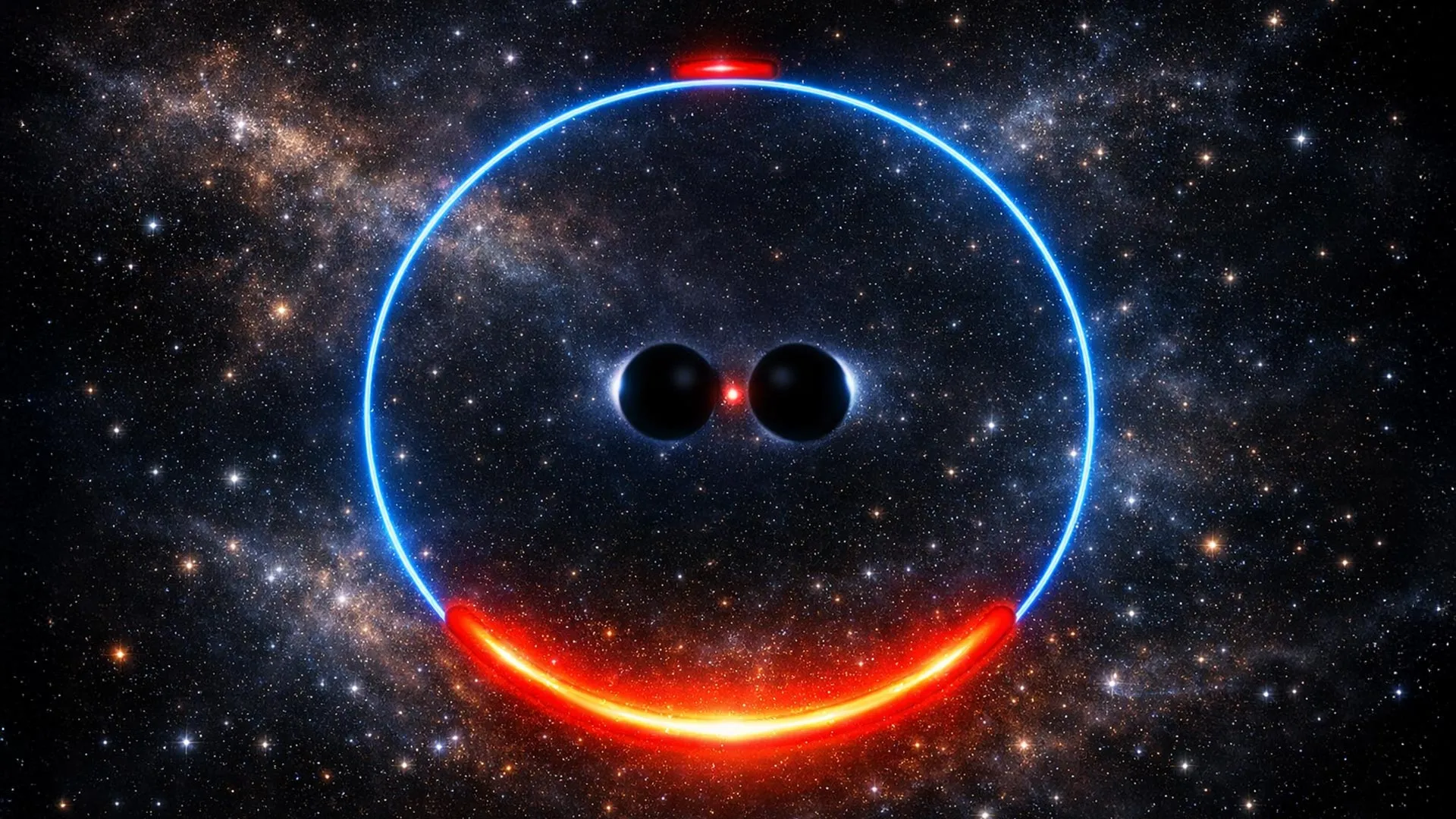
An international team has used artificial intelligence and the largest two-dimensional map of the universe to discover 70 new gravitational lenses, rare alignments in which a massive foreground object magnifies a more distant one behind it. The results were published in The Astrophysical Journal Supplement Series, and NSF NOIRLab announced them this week.
The map comes from the DESI Legacy Imaging Surveys, which released it in August 2026. It contains 5.6 trillion pixels and nearly 4 billion celestial objects, including stars, galaxies, black holes and asteroids, and took 13 years to build. It combines three ground-based surveys: the Dark Energy Camera Legacy Survey on the Blanco 4-meter Telescope in Chile, the Mayall z-band Legacy Survey at Kitt Peak in Arizona, and the Beijing-Arizona Sky Survey, supplemented by data from NASA's WISE satellite.
Searching that much sky by eye was judged impractical. Xiaosheng Huang of Santa Clara University and the Lawrence Berkeley National Laboratory led a team that trained a residual neural network, a type of machine learning built to recognize subtle image patterns, to flag potential lenses. Earlier work produced a catalog of about 3,500 candidates, and the searches relied on computing at the National Energy Research Scientific Computing Center.
Candidates must be confirmed by measuring the distances to both the lensing object and the background object. The AI-powered search yielded 76 candidates, and the team used the MUSE instrument on the European Southern Observatory's Very Large Telescope to confirm 70 of them as true lenses. MUSE records a spectrum at every point across an image, producing a three-dimensional dataset, so one observation covers the lensing galaxy, the background object and nearby neighbors. The observations were collected between 2022 and 2024.
The study was led by Emerald Lin, an undergraduate at UC Berkeley, and Ivonne Toro Bertolla, a research assistant at NSF NOIRLab and Las Campanas Observatory. It is titled "DESI Strong Lens Foundry. IV. Spectroscopic Confirmation of DESI Lens Candidates with VLT/MUSE."
Gravitational lenses work as natural telescopes. They can magnify galaxies from the early universe, reveal how dark matter is distributed, help refine measurements of the universe's expansion rate and aid in detecting exoplanets. The 70 new lenses join the DESI Strong Lens Foundry Project, one of the largest collections of confirmed lenses. Researchers plan to combine them with observations from the Hubble Space Telescope, the James Webb Space Telescope, the recently launched Nancy Grace Roman Space Telescope and the Vera C. Rubin Observatory.
Aleksandar Cikota, an associate scientist at NSF NOIRLab who co-authored the study and leads the follow-up program, said the Legacy Surveys' images "have provided an unprecedented foundation for discovering new gravitational lenses." He said the team is building "a carefully confirmed sample that researchers can use for years to come."