
Science
Webb Studies a Tiny Galaxy With Less Than 0.5% of the Sun's Oxygen
The galaxy LAP2, magnified about 50 times by a foreground cluster, ranks among the most chemically primitive galaxies known.
Topic
17 stories from Planck Standard. Latest: November 27, 2026.
The galaxy LAP2, magnified about 50 times by a foreground cluster, ranks among the most chemically primitive galaxies known.

By tracking how gravity bends the Big Bang's afterglow, scientists charted mass across a huge patch of sky and tightened limits on how clumpy the cosmos is and how heavy neutrinos can be.

A galaxy cluster's gravity bent the light of 'SN Ares,' creating a rare cosmic clock that could someday measure how fast the universe is expanding.

Machine learning, citizen scientists and experts combed Euclid's first major data release for strong gravitational lenses, which were once so rare that fewer than 1,000 were confirmed.

JWST images of a galaxy 6.5 billion light-years away more than double the previous count of 44 individual stars brightened by gravitational lensing.

If the preprint holds up, EBG-1 would be an unusually efficient source of the radiation that cleared the early universe's fog, but it is one object and the estimate rests on model assumptions.

Astronomers using a gravitational lens say the galaxy MG B2016+112 hosts the most tightly paired black holes yet confirmed at such a distance, seen when the universe was about 2 billion years old.

A neural network sifted a 5.6-trillion-pixel sky survey, and spectroscopy on the Very Large Telescope confirmed 70 of 76 candidates as true cosmic magnifying glasses.

If dark matter is made of ultralight particles that ripple like waves, those ripples should shift the multiple images of a distant quasar. The simulations matched a real lensed quasar better than standard models.

GW231123 was reported as a 190-to-265-solar-mass collision. A Max Planck reanalysis published Thursday says gravitational lensing magnified the signal, and the real total is 100 to 180.

A Flatiron Institute simulation of the galaxy’s entire history finds that about 91% of stellar-mass black holes drift alone, and roughly 3% were kicked out of the galaxy altogether.

Oxford and Max Planck scientists say tightly bound black-hole binaries act as cosmic lenses, magnifying background stars into repeating flashes that betray their presence.
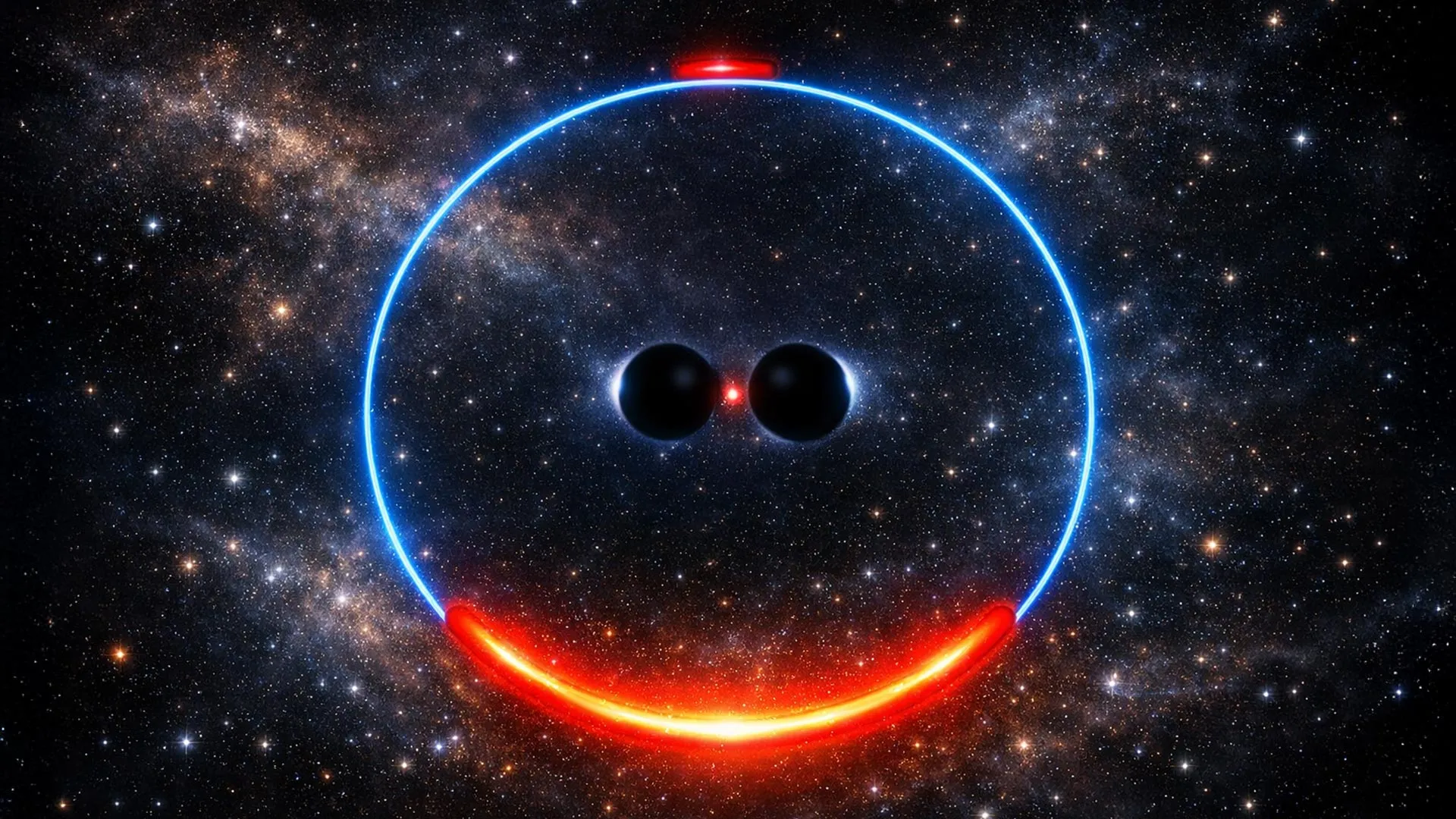
Researchers at Oxford and the Max Planck Institute propose hunting elusive supermassive black hole binaries by watching for repeating flashes of background starlight bent and magnified as the pair orbits.
Using the James Webb Space Telescope and a cosmic magnifying glass, scientists measured a dormant giant in a galaxy 10 billion light-years away, smashing the previous distance record fifteenfold.

Hai-Bo Yu's model of dense, million-solar-mass dark-matter clumps explains anomalies in gravitational lensing, stellar streams, and satellite galaxies that have stumped the standard cold dark matter picture.

International astronomers led by Stockholm University's Oskar Klein Centre discovered SN 2025mkn, a Type II supernova 9 billion light-years away whose light is bent and amplified by an entire foreground galaxy, creating a natural telescope of unprecedented power.
An unprecedented superluminous supernova, split into multiple images by a foreground galaxy, may help resolve the Hubble Tension