Stanford Built a Neural Network Out of Atoms and Light. It Held Seven Times More Memories
Ten thousand ultracold atoms in a mirrored cavity behaved like a spin glass, and the photons bouncing between them acted as synapses that rewired themselves.

A team at Stanford has built a working neural network out of atoms and photons, and reported that it stores and recalls up to seven times as many memories as a conventional network of the same size. The work, led by Benjamin Lev, the Stanford Fortitude Professor of Physics and Applied Physics, appeared in Science on September 3 with Brendan P. Marsh as lead author.
The device is what the group calls a quantum-optical spin glass. A spin glass is a physical system whose parts are pulled in conflicting directions and settle into many different low-energy arrangements rather than one. Those arrangements are the useful part: each valley in the energy landscape can hold a pattern, and the system can be nudged back into the right valley from a partial or corrupted starting point.
That behavior is exactly what an associative memory does. Show a person a blurred photograph of a face and they return the whole face; show a Hopfield network a fragment of a stored pattern and it relaxes into the complete one. The limit on such networks has always been capacity — how many distinct patterns a given number of nodes can hold before the valleys merge and recall breaks down.
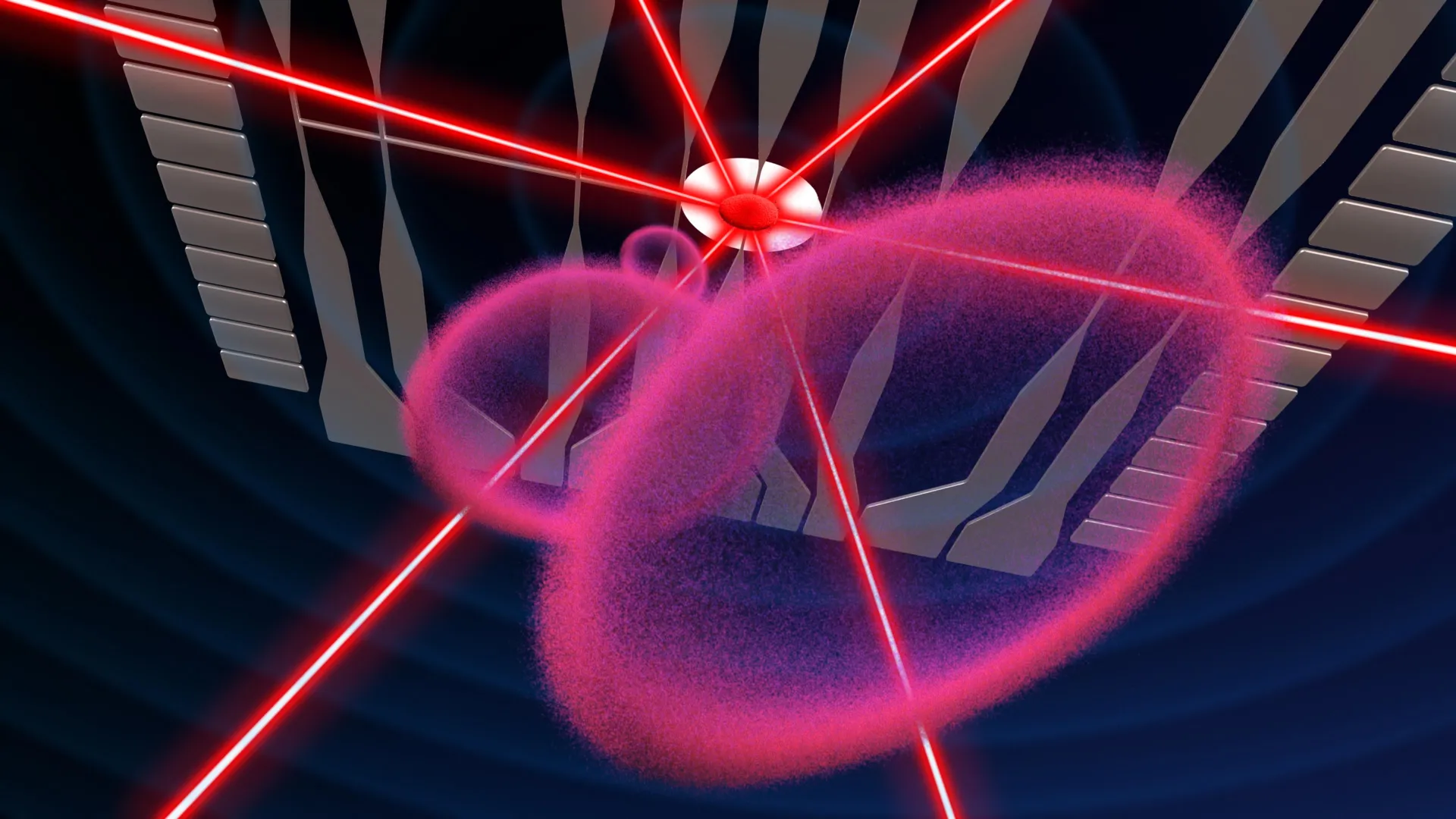
The Stanford setup gets its nodes from matter and its connections from light. The researchers trapped ultracold atomic gases — Bose-Einstein condensates containing more than 10,000 atoms — inside an optical cavity built from curved mirrors in a vacuum chamber. Laser light bounced between those mirrors thousands of times, and each pass let photons carry influence from one group of atoms to another. Those photon-mediated links play the role of synapses, and unlike the wires in a chip they are not fixed: the strength of a connection depends on the state of the atoms it connects.
Working with up to 20 spins, the team measured up to sevenfold greater memory capacity than a Hopfield network of the same size. The system also showed short-term plasticity, meaning the effective connection strengths shifted during operation in a way that resembles how synaptic weights change in a brain during learning, rather than being set once and held.
"We can now make neural networks at the atomic level, and they adjust themselves in a way that is somewhat similar to how we believe our brains learn," Lev said.
Twenty spins is a laboratory demonstration, not a competitor to a data center. What the result establishes is that the all-to-all, photon-mediated connectivity available inside an optical cavity is a genuinely different resource from the sparse, fixed wiring of silicon, and that the difference shows up as capacity rather than just speed. Scaling the number of spins while keeping the cavity coherent is the next problem, and it is not a small one — cavity losses and atom heating both grow with the size of the condensate.
The broader interest is in whether quantum hardware buys anything for machine learning that classical hardware cannot cheaply reproduce. Most proposals so far have struggled to show an advantage that survives a fair comparison. A sevenfold capacity gain against a matched Hopfield network is a concrete, measurable claim, and one other groups can now try to reproduce.