NASA’s Cold Atom Lab Is Brewing the Fifth State of Matter in Orbit
An upgraded quantum facility aboard the International Space Station is chilling atoms to near absolute zero, exploiting weightlessness to build matter waves impossible to make on Earth.

Aboard the International Space Station, a refrigerator-sized instrument is creating one of the strangest forms of matter known to physics. NASA's upgraded Cold Atom Lab is chilling atoms to within a hair of absolute zero to produce Bose-Einstein condensates — a "fifth state" of matter in which a cloud of atoms stops behaving like individual particles and merges into a single, coordinated quantum wave.
"At the coldest temperatures, matter behaves drastically different from anything we have experienced," said Jason Williams, the project scientist at NASA's Jet Propulsion Laboratory, which designed and operates the facility for the agency's Biological and Physical Sciences division. The lab cools its samples to below minus 459 degrees Fahrenheit — colder than the depths of interstellar space.
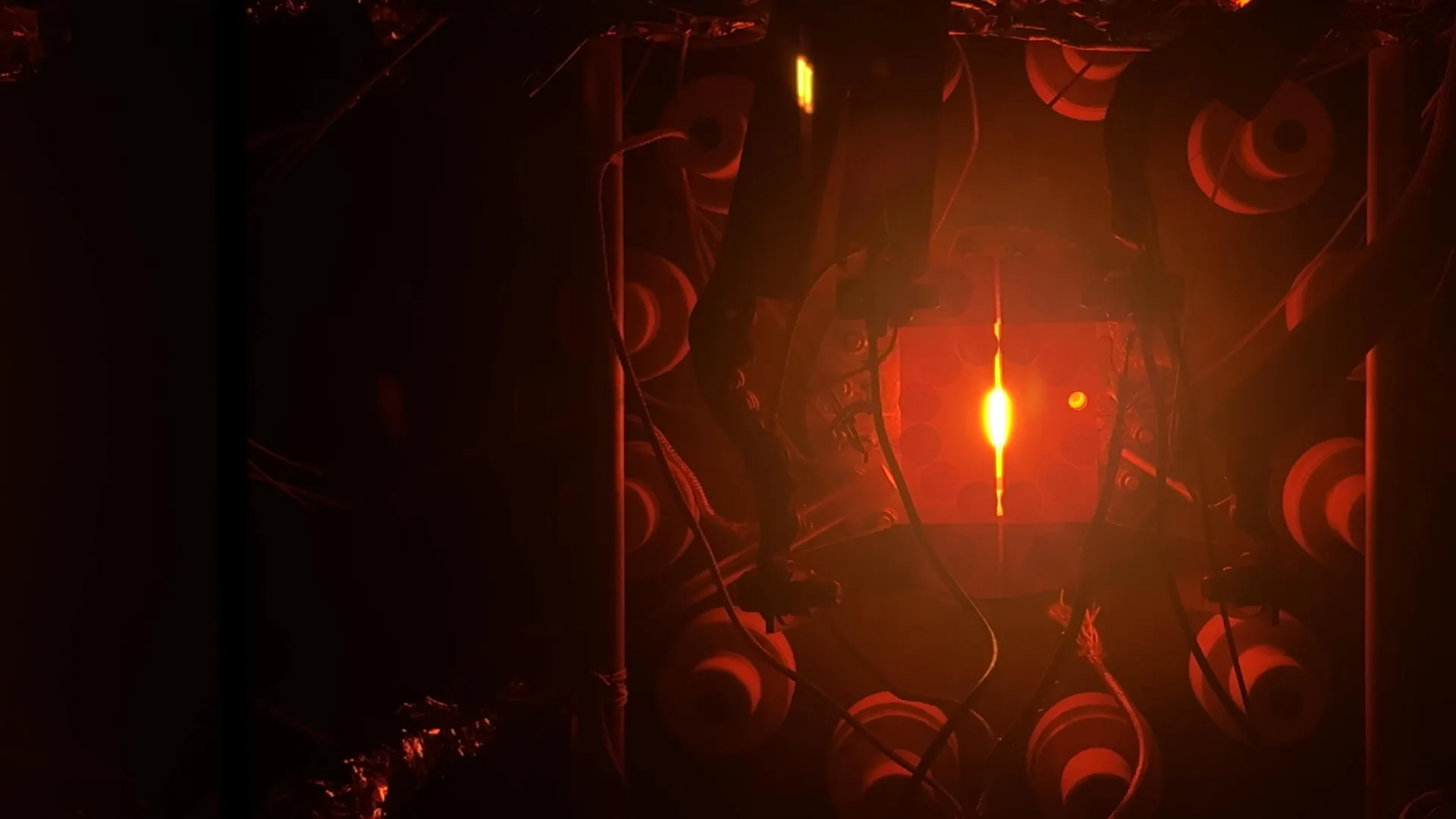
The process is a study in extremes. The instrument first heats tiny strips of rubidium or potassium metal to about 750 degrees Fahrenheit to release a vapor of atoms, then uses precisely tuned lasers to slow them almost to a standstill, draining away their heat. Magnetic fields trap and hold the ultracold cloud in place long enough for scientists to study it. The recent upgrade — the fourth major enhancement since the lab was installed in 2018 — arrived at the station on April 11 aboard a commercial resupply mission.
Microgravity is the secret ingredient. On Earth, gravity quickly pulls these delicate atom clouds apart, giving researchers only fractions of a second to observe them. In orbit, the condensates float freely and expand into far larger quantum waves than anything achievable in a ground laboratory, allowing longer and more sensitive measurements. The lab currently supports five international research teams, managed by Caltech with JPL's Ethan Elliott and Kamal Oudrhiri among the scientists overseeing operations.
Beyond the fundamental physics, the work has practical ambitions. The same quantum behavior that makes condensates exotic also makes them extraordinarily sensitive to motion, gravity and time — properties that could power a new generation of ultra-precise tools for navigation, positioning, timekeeping and gravitational sensing. Such "quantum sensors" might one day guide spacecraft without satellite signals or map subtle variations in a planet's gravity from orbit. For now, the Cold Atom Lab serves as a one-of-a-kind testbed, proving that the coldest known matter in the universe can be made, and studied, far above our heads.
The facility is unusual in another respect: it can be run remotely by scientists on the ground, who design experiments and download results without ever leaving Earth. That model has turned the orbiting lab into a shared resource for researchers around the world and a proving ground for the hardware that future quantum missions will need to survive the rigors of spaceflight. NASA officials say lessons from each upgrade feed directly into the design of next-generation instruments, including atom interferometers that could test the fundamental laws of physics — among them whether all objects truly fall at the same rate — with a precision impossible in any earthbound laboratory.