Black Hole Winds May Explain Why Giant Galaxies Run Short on Stars
Using the XRISM X-ray observatory, astronomers tracked ferocious outflows from the supermassive black hole in NGC 4151 that can strip away the very gas needed to build new stars.
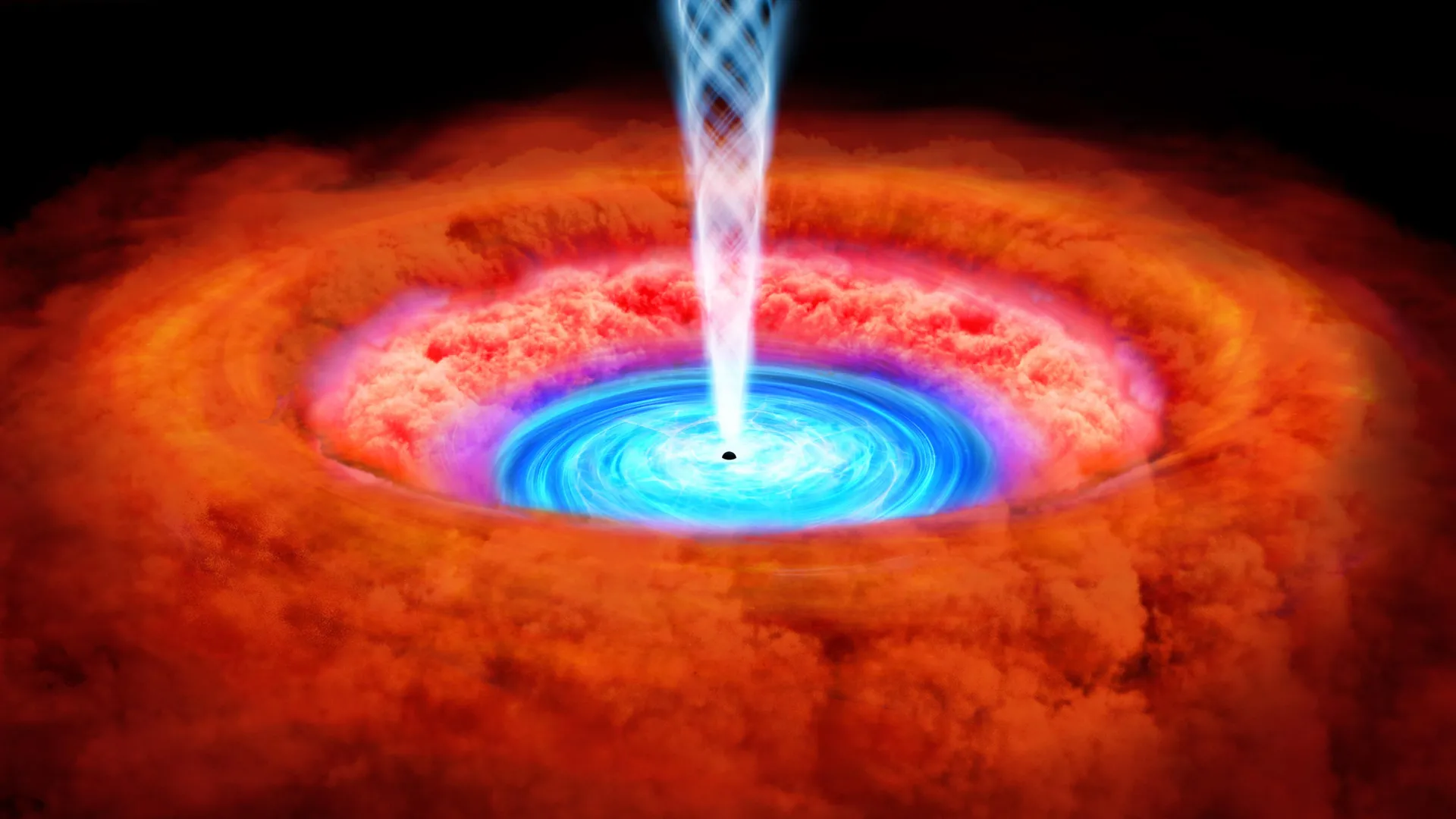
Astronomers may be closing in on a long-standing cosmic puzzle: why some of the universe's biggest galaxies contain far fewer stars than theory says they should. The answer, a new study suggests, may be blowing in the wind — specifically, the violent gales unleashed by the supermassive black holes at galactic centers.
Using the X-Ray Imaging and Spectroscopy Mission, or XRISM, researchers trained the observatory on NGC 4151, an active galaxy roughly 50 million light-years from Earth whose central black hole is actively devouring surrounding material. As gas spirals into the black hole, it powers an enormous, superheated disk that in turn drives powerful outflows capable of sweeping gas clear out of the galaxy.
XRISM, led by Japan's space agency in partnership with NASA and the European Space Agency, launched in 2023 and offers energy resolution about ten times sharper than its predecessors. That precision let the team dissect the black hole's emissions in unprecedented detail. "With XRISM, we have the greatest resolution observing the brightest AGN, and we're getting the richest information on outflows," said Xin "Cindy" Xiang, a doctoral student at the University of Michigan who led the analysis.
The data revealed a striking pattern in the timing of the winds. The strongest, fastest outflows appeared when the galaxy's X-rays were "hard" — high energy — but relatively faint, and the most rapid winds typically arrived about 10,000 seconds, or roughly three hours, after bright X-ray flares. That cadence offers clues about how the black hole's feeding cycle translates into the gusts that reshape its host galaxy.
Crucially, those winds carry away the cold gas that galaxies need to form new stars. If supermassive black holes routinely purge their surroundings of star-making fuel, that could explain why the most massive galaxies appear starved of stars compared with what cosmological models predict — a discrepancy astronomers have struggled to account for.
The idea is a cornerstone of what astronomers call "feedback" — the notion that a galaxy's central black hole and its stars are locked in a self-regulating relationship. When the black hole feeds voraciously, it heats and expels the surrounding gas, choking off the raw material for new stars and, in turn, slowing its own growth. Pinning down how that feedback operates in real time has been one of the central challenges of modern astrophysics, in part because the winds are faint and fast-changing.
The findings, presented at the 248th meeting of the American Astronomical Society in Pasadena, California, add to growing evidence that black holes are not merely passive sinkholes at the centers of galaxies but active engines shaping their evolution. By catching the winds in the act, researchers hope to refine models of how galaxies grow — and why so many fall short of their theoretical potential.
Originally reported by ScienceDaily.