Scientists Build a Light-Powered Chip That Could Reshape AI and Quantum Computing
An international team has created the first chip that can generate, steer and read light-based signals in a single device at room temperature, a milestone for the emerging field of 'valleytronics.'

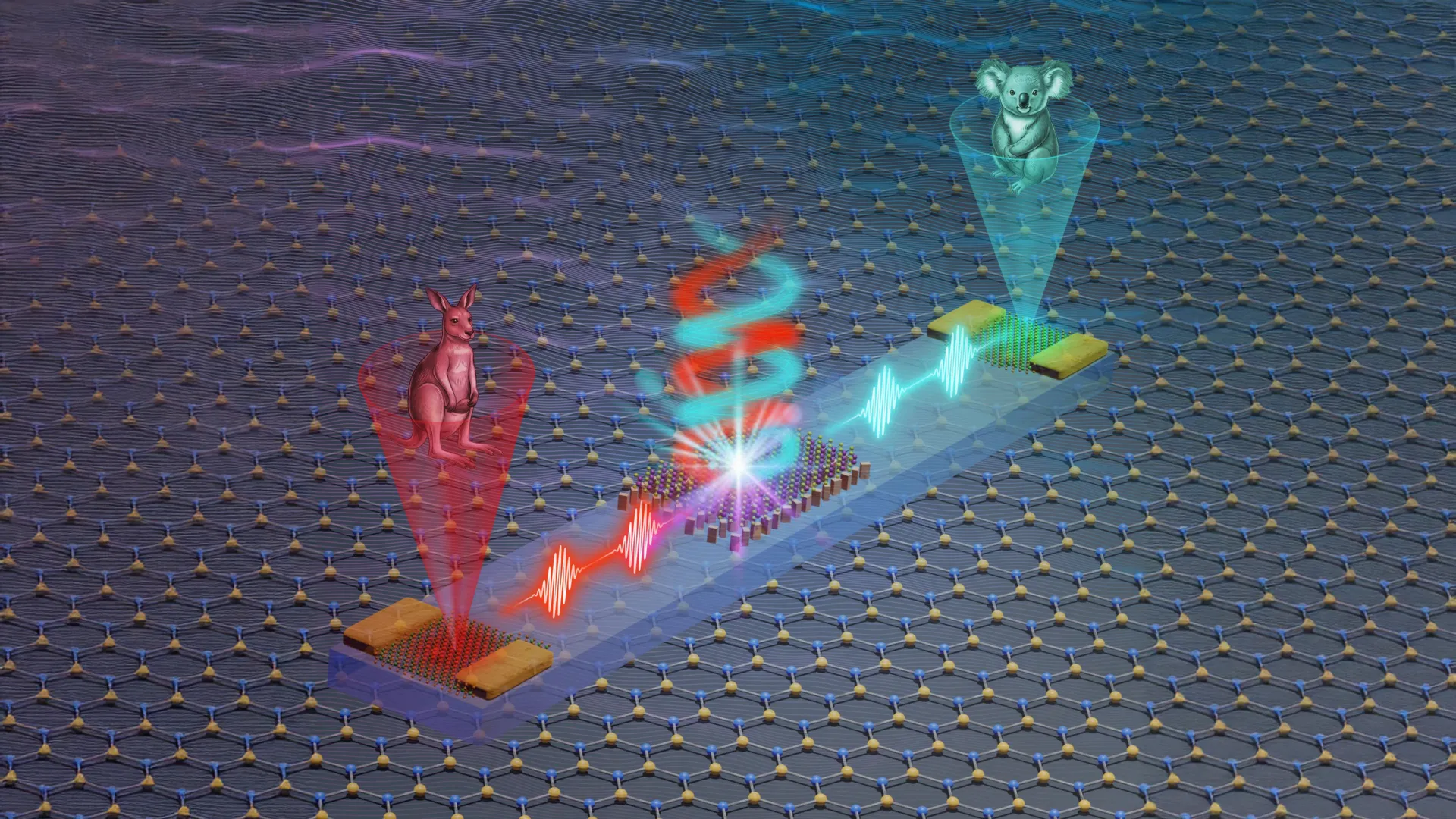
Physicists have built a chip that can produce specialized light signals, guide them along precise paths and convert them into electrical signals — all within a single compact device — marking a significant advance for a fast-growing field known as valleytronics.
The work, published June 2 in Nature Photonics, was led by researchers at Monash University in Australia as part of an international collaboration spanning Australia, China, Singapore, Germany and Japan. Contributors included the Singapore University of Technology and Design, LMU Munich and the University of Technology Sydney, combining expertise in nanophotonics, two-dimensional materials and optoelectronics.
Valleytronics encodes information using a quantum property called the "valley degree of freedom," an alternative to the electrical charge that powers conventional electronics. By harnessing this property in atom-thin materials and tiny nanostructures, the team built a chip that operates at room temperature — a crucial practical advantage, since many quantum technologies require elaborate cooling to function. In a demonstration of its capabilities, the chip processed two separate images simultaneously, showing it can handle multiple streams of information at once.
"Photonic devices use light to achieve massive bandwidths, ultra-fast data transmission speeds, and lower energy consumption," said Dr. Haoran Ren, one of the researchers behind the project. Those qualities make light-based chips attractive candidates for the next generation of computing, where the energy demands of artificial intelligence and the fragility of quantum systems have become major obstacles.
The breakthrough integrates functions that previously required separate, bulky components, packing generation, routing and detection of light onto one platform. Lead researchers including Dr. Chi Li, Dr. Kaijian Xing, Professor Stefan A. Maier and Professor Michael S. Fuhrer say the design could eventually feed into faster computing, advanced imaging, optical communications and quantum technologies. While commercial devices remain years away, the demonstration offers a tangible step toward chips that compute with photons instead of electrons — potentially sidestepping some of the heat and power limits that have begun to constrain modern processors.
The timing is notable. The explosive growth of artificial intelligence has sent the energy appetite of data centers soaring, straining power grids and prompting a search for fundamentally more efficient ways to move and process information. Light-based computing is one of the most promising candidates, because photons can carry data with far less heat than electrons forced through metal wires. By proving that generation, steering and detection of valley-encoded light can coexist on a single room-temperature chip, the researchers have removed one of the practical hurdles that has long kept valleytronics confined to specialized laboratory setups, bringing the concept a step closer to the kind of integration that real-world devices demand.