Two Labs Independently Catch Particles Carrying Exactly a Quarter of an Electron's Charge
EPFL and Weizmann physicists measured e/4 charges in a special quantum state of gallium arsenide, a result that strengthens the case for a route to error-proof quantum computers.
An electron's charge is supposed to be the smallest unit of electricity, a coin that cannot be cut. But physicists in two different labs have now measured particles inside a special quantum material that each carry almost exactly one quarter of that charge, and both labs got the same answer.
The work, published in Physical Review Letters, comes from the groups of Mitali Banerjee at EPFL in Switzerland, Moty Heiblum at Israel's Weizmann Institute of Science and Mansour Shayegan at Princeton University. "For the first time in the history of this field, two different groups have measured the same values of fractional charge," Banerjee said.
The effect happens only in extreme conditions. When electrons are cooled close to absolute zero, trapped in a flat two-dimensional layer and hit with a powerful magnetic field, they stop behaving like individual particles. They organize into a collective state in which "quasiparticles" appear to carry only a fraction of an electron's charge. This is called the fractional quantum Hall effect.
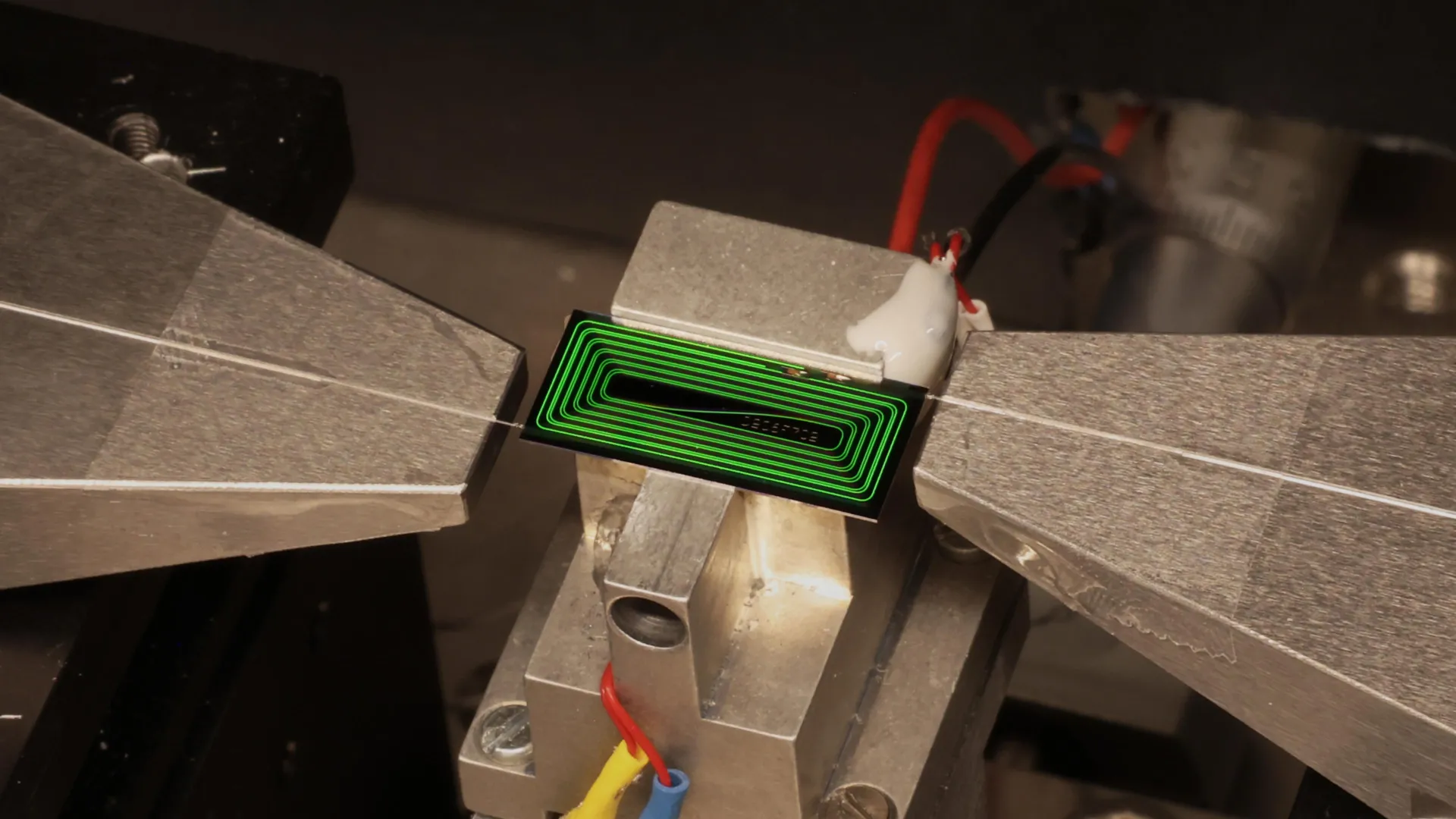
The team studied one rare version of it, the so-called ν = 1/2 state, which forms in a 70-nanometer-wide layer of gallium arsenide, a material used in solar panels and wireless electronics. To weigh the charge, they built a narrow pinch point called a quantum point contact and measured the "shot noise" of current squeezing through it. Charges pass through in a random, stop-and-start way, like rain on a roof, and the size of that noise reveals how much charge each carrier holds.
They first checked the method on known states that carry a full electron's charge and two-thirds of one. Then they turned to the ν = 1/2 state in two nearly identical devices, one at EPFL and one at Weizmann. The results were 0.250 and 0.249 of an electron's charge, with uncertainties of about 0.013 and 0.018. Both match one quarter, written e/4.
The reason physicists care is a class of exotic particles called non-Abelian anyons. Theory predicts some "even-denominator" states like this one could host them. Information stored in such particles would live in the overall pattern of how they have been moved around each other, not at any single point, which would make it naturally resistant to noise and defects. That is the idea behind topological quantum computing, a long-sought route to machines that do not need heavy error correction.
"This is important because the quantum Hall state that was studied here is special as it survives up to a few kelvins, and is thought to be only the second known state in gallium arsenide to possess special non-Abelian properties," Banerjee said. "By simply moving such particles around each other, we can create error-free quantum computers."
The measurement does not prove the particles are non-Abelian. It confirms one property the theory requires, and it does so twice, which in a field known for hard-to-reproduce results is a significant step.