Scientists Build a Single-Molecule 'Archimedes Screw' Motor That Spins on Electricity
Weizmann and Copenhagen researchers held one spiral molecule between two gold tips and found it rotates, and reverses, with the voltage, and conducts 100 times better while spinning.

Scientists have built a molecular motor that spins when electricity passes through it, shrinking one of the oldest machines in history, the Archimedes screw, down to a single spiral-shaped molecule. The device can also reverse direction when the voltage is switched.
The result is a step toward working machines at the smallest possible scale. Nature already has molecular motors inside living cells, and decades of work to copy them artificially were recognized with the 2016 Nobel Prize in Chemistry. Electrically driven molecular motors were first demonstrated in 2011, but those designs ran on surfaces and needed the tip of a scanning tunneling microscope to push them.
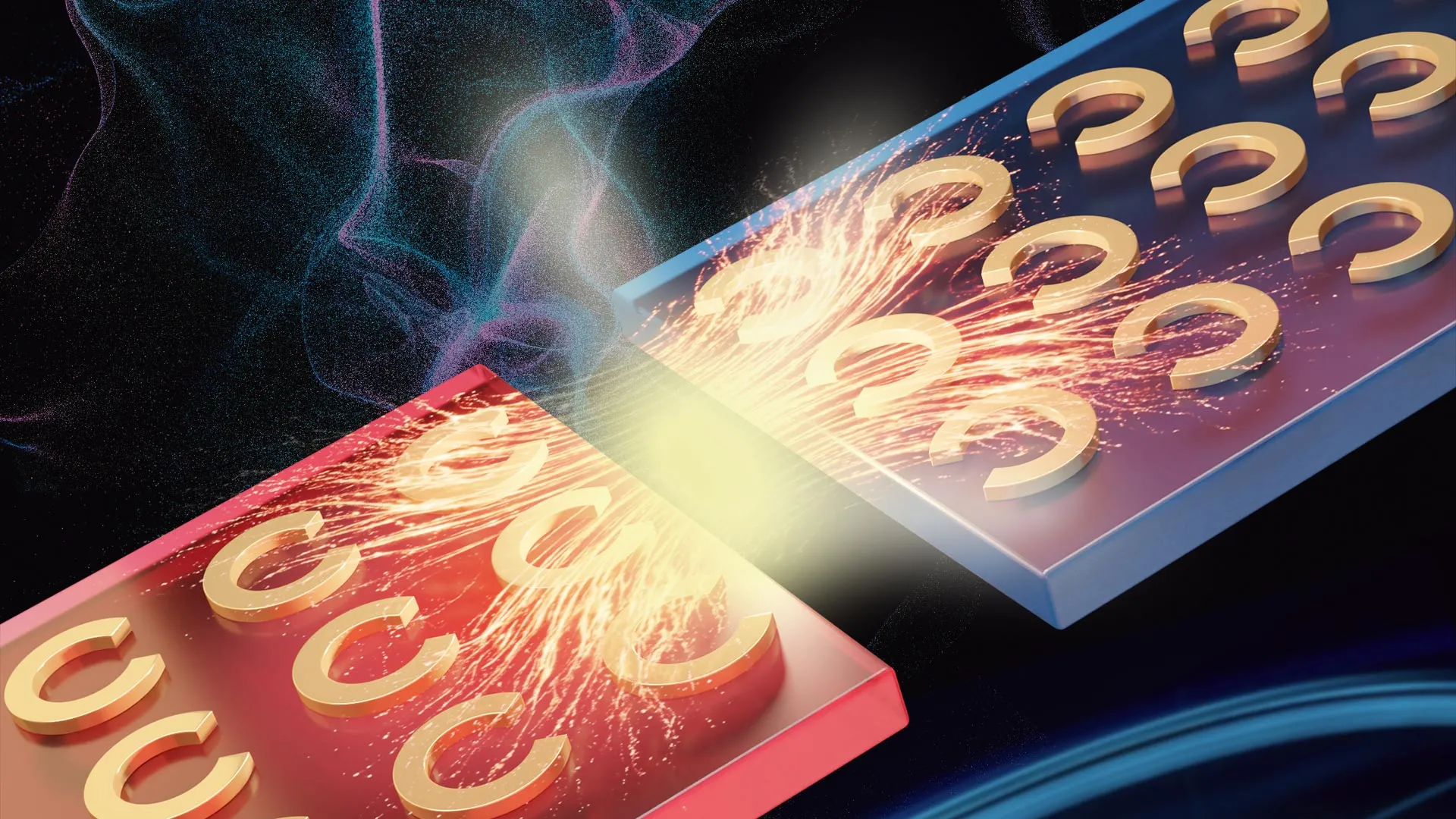
The new motor is different. Its central part is a specially designed spiral molecule made by the group of Prof. Michael Pittelkow at the University of Copenhagen. It measures only a few millionths of a millimeter and attaches to gold through sulfur atoms. At the Weizmann Institute of Science in Israel, a team led by Prof. Oren Tal and Dr. Anil Kumar Singh placed individual molecules between two gold tips sharpened to atomic dimensions. By changing the gap between the tips, they could stretch or compress the molecular screw.
When they applied a voltage, measurements showed the molecule began rotating. Flipping the polarity reversed the direction. The researchers say this is the first demonstration of a molecular motor that is driven by electrical current, firmly connected to two metal electrodes and capable of rotating in a controllable direction.
The driving force is the electrons themselves. As they travel through the spiral, they transfer angular momentum to the molecule, much as moving air turns a wind turbine. Above a threshold voltage, the movement becomes continuous rotation. The molecule's handedness, like the thread of a screw, sets how it responds.
The experiments also turned up a puzzle. The spinning molecule conducted electricity far better than a stationary one. To explain it, Prof. Fabian Pauly and PhD students Léon Martin and Yuta Ito at the University of Augsburg ran quantum simulations on the LiCCA supercomputer. They found conductivity depends strongly on the molecule's angle, rising by as much as two orders of magnitude, or 100 times, during rotation.
The reason is counterintuitive. "The surprising thing is that it is precisely the positions that the molecule avoids when at rest that conduct electricity best. It is only the rotation that makes these positions accessible," Martin said.
Theorists Per Hedegård of the Niels Bohr Institute and Jing-Tao Lü of Huazhong University of Science and Technology then built a simplified model that reproduced both the rotation and the jump in current. "In the experiment, you only see the current," Ito said. "Our calculations allow us to glimpse what is happening inside the nanocontact."
The finding shows that motion in a molecular machine does more than consume energy. It can reshape how current flows through the machine itself, a coupling that designers of future nanoscale devices may be able to exploit.