A Hollow Nanoparticle That Copies Two Tricks From Living Cells Makes Hydrogen Peroxide From Sunlight
Chinese researchers wrapped a light-absorbing core in a shell that shuttles protons the way a cell membrane does, hitting 1.2% solar-to-chemical efficiency — and it keeps working when embedded in a hydrogel and left outside.
Hydrogen peroxide is made today the way it has been made for most of a century: an energy-intensive industrial loop that cycles an organic carrier molecule through hydrogenation and oxidation in large centralized plants, then ships the product out in stabilized solution. Chemists have spent years trying to replace it with something that runs on sunlight and water. A team in China has built a particle that does, and the design borrows two structural ideas from living cells.
The work comes from the Dalian Institute of Chemical Physics of the Chinese Academy of Sciences, led by Prof. Li Can, in collaboration with Prof. Jian Liu's group at Inner Mongolia University. It was published in the Journal of the American Chemical Society on August 6.
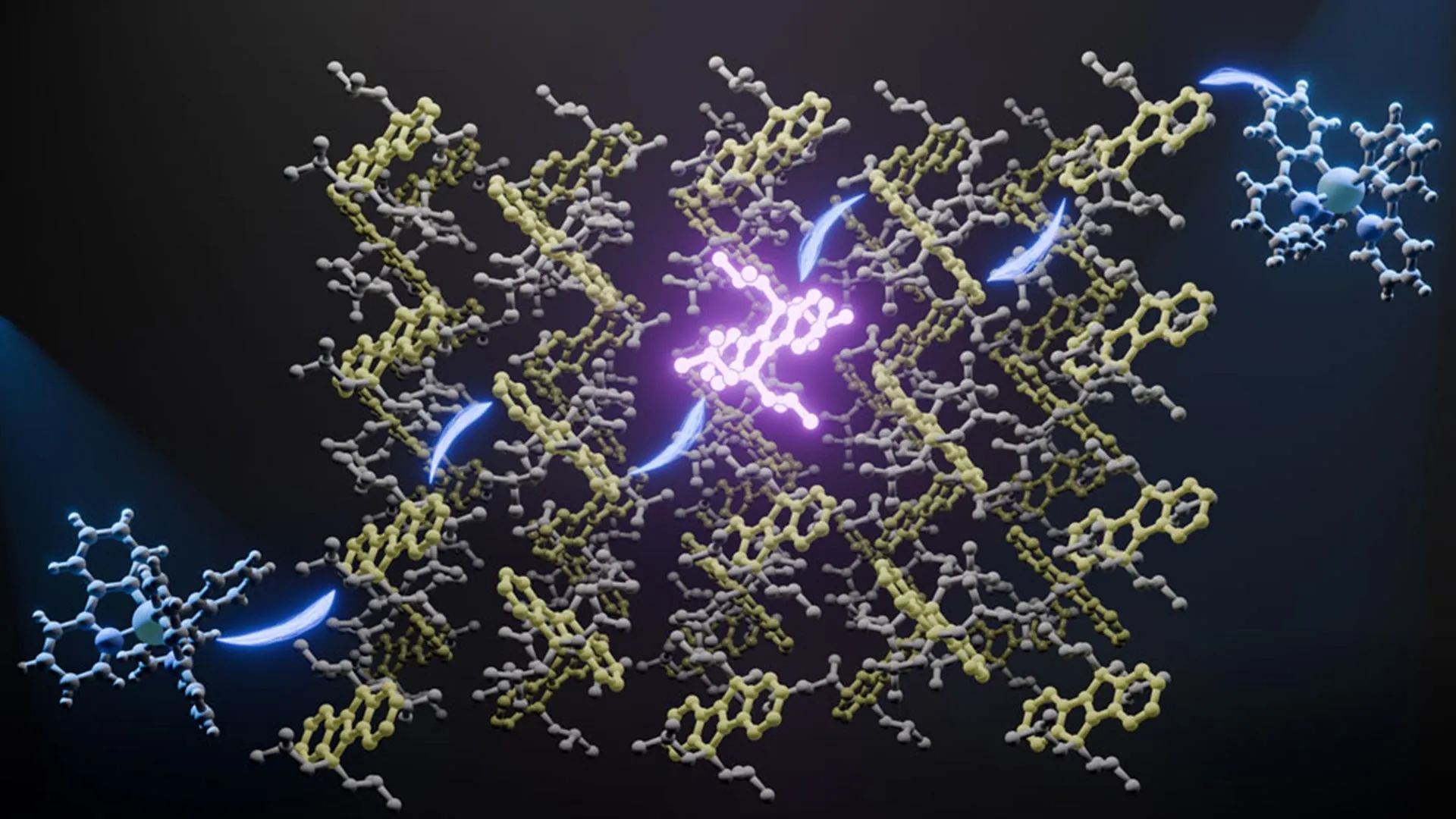
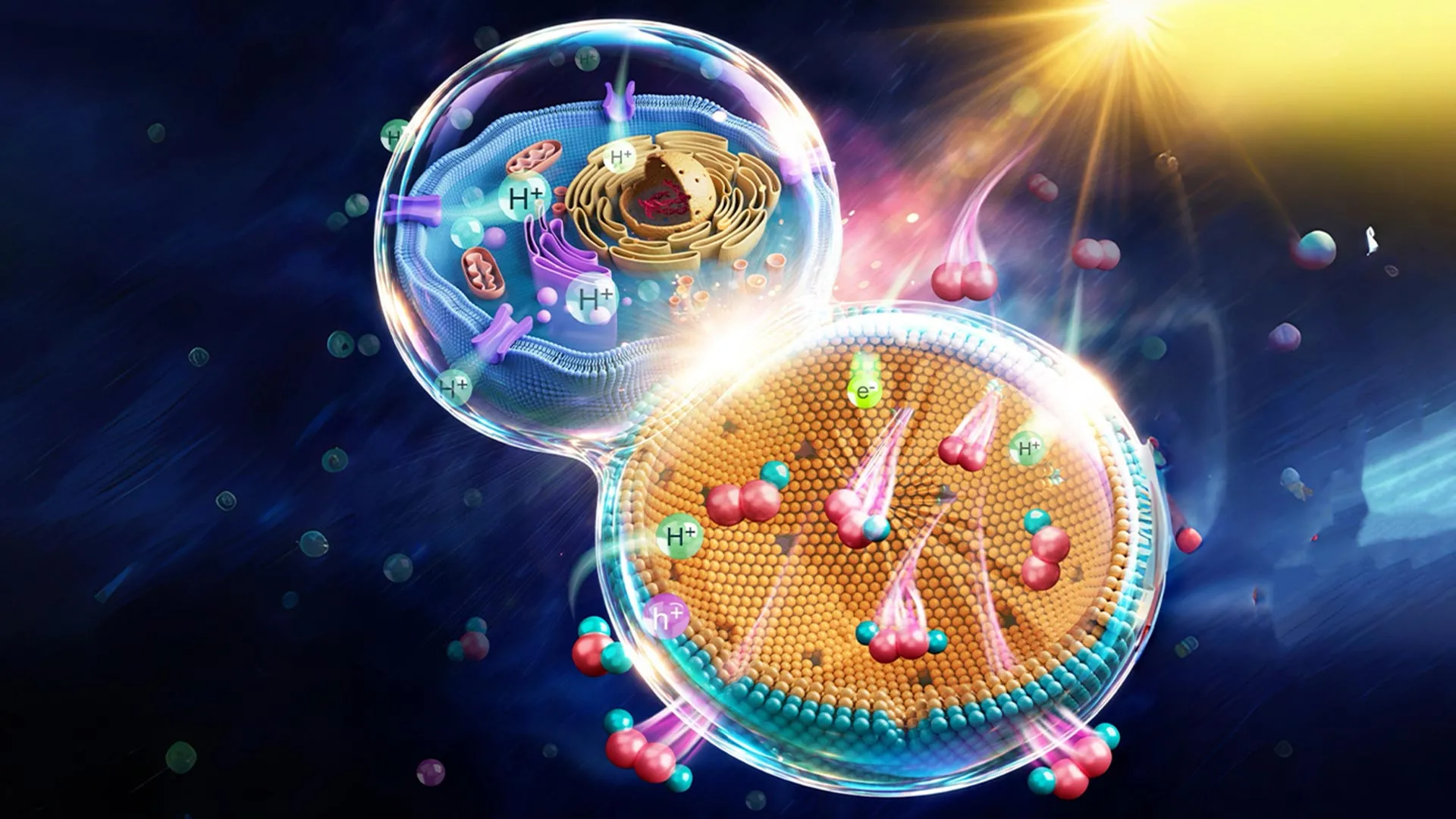
The particle is a hollow sphere of cadmium sulfide coated in polydopamine — a light-absorbing core inside a porous organic shell. Cadmium sulfide is a well-known photocatalyst; the shell is where the biology comes in. Polydopamine contains catechol groups that flip between catechol and ortho-benzoquinone forms, repeatedly accepting a proton and releasing it again. That is a proton relay, the same mechanism cells use to move protons along a membrane during respiration and photosynthesis, and it speeds up proton-coupled electron transfer — the step where an electron and a proton have to arrive at the same place at the same time for the chemistry to proceed.
The second borrowed feature is compartmentalization. The hollow cavity inside the porous shell traps light that would otherwise scatter away and lets reactants accumulate to concentrations higher than the surrounding solution, the same reason cells wall off reactions into organelles instead of letting them run loose in the cytoplasm. Together the two features balance the reaction's halves: oxygen reduction on one side, water oxidation on the other, both of which must run at matched rates for hydrogen peroxide to accumulate rather than decompose.
Under visible light the reactor produced 3.24 millimoles of hydrogen peroxide per gram of catalyst per hour, at a solar-to-chemical conversion efficiency of 1.2%. That efficiency figure sounds modest and is competitive for this reaction — natural photosynthesis converts roughly 1% of incident sunlight into stored chemical energy across a growing season, and most photocatalytic peroxide systems have landed well below that.
The more practical result is what happened when the group stopped working in a flask. Embedded in a sodium alginate hydrogel — a seaweed-derived gel — the particles kept producing peroxide continuously under natural sunlight, in a form that can be handled, recovered and reused rather than filtered out of suspension after every run.
"This approach provides a new strategy for engineering biomimetic nanoreactors that increasingly replicate the sophisticated functions of living cells," Li said.
Hydrogen peroxide is used as a bleach, a disinfectant, a rocket propellant and increasingly as a candidate liquid fuel, and demand for it is concentrated in exactly the places that cannot easily host a chemical plant: field clinics, water treatment in remote areas, decentralized sanitation. A gel sheet that makes it from sunlight, air and water is aimed at that gap rather than at replacing the industrial process.