New Solid Material Turns Ordinary Sunlight Into Higher-Energy Ultraviolet Light
After a 14-year effort, chemists in Japan built a stable solid that upconverts visible light into UV, opening the door to sunlight-powered air purification, 3D printing and photocatalysis.
Chemists in Japan have built a solid material that performs a kind of optical alchemy: it absorbs ordinary visible sunlight and emits higher-energy ultraviolet light. The advance, reported June 23 in Nature Communications, caps a 14-year research effort and could make sunlight a practical power source for processes that today depend on energy-hungry UV lamps.
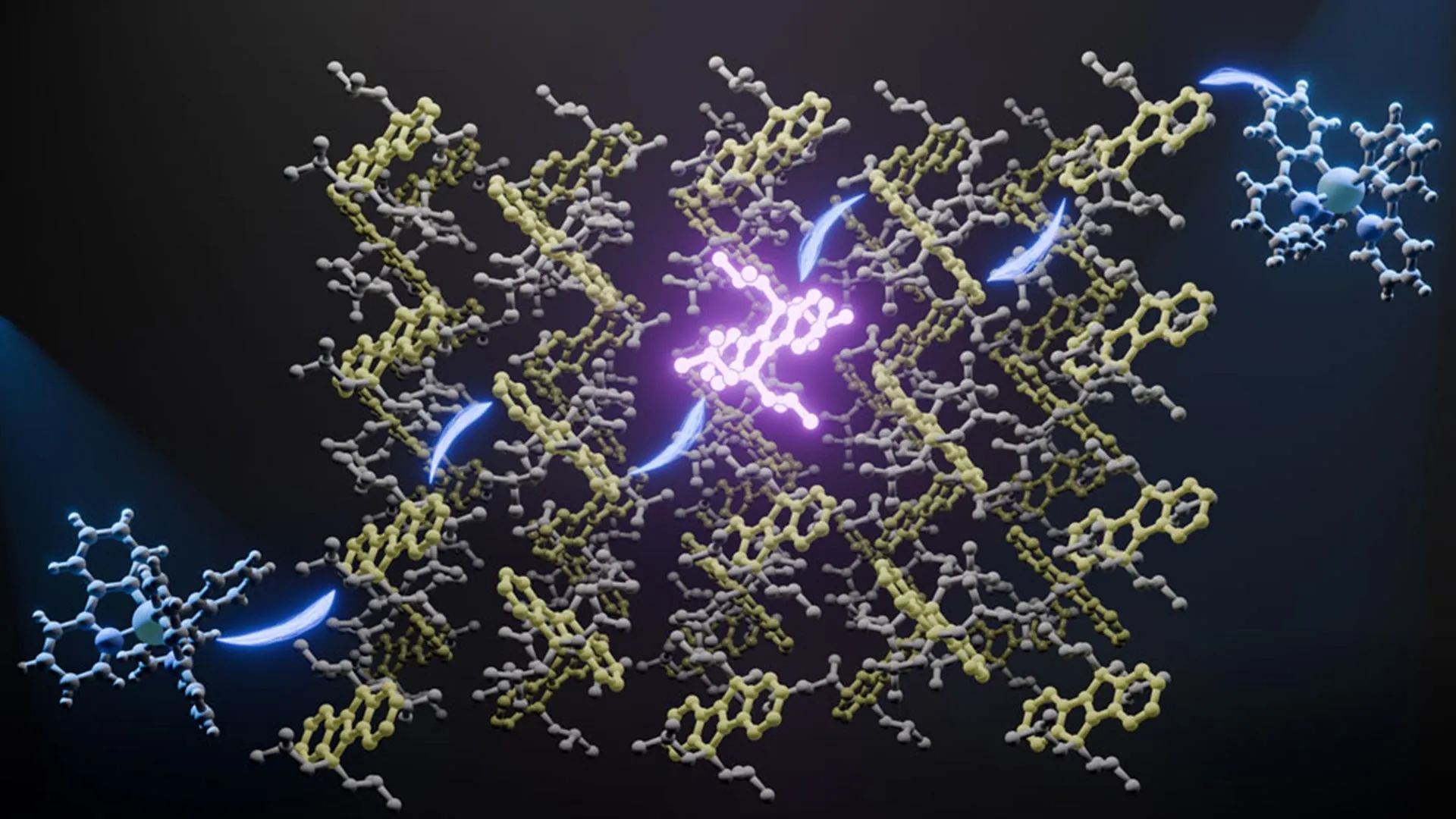
The trick is a quantum process called triplet-triplet annihilation, or photon upconversion, in which two lower-energy photons are effectively combined into one of higher energy. Achieving this efficiently in a solid has long frustrated scientists, because packing the active molecules together tightly enough to pass energy between them also tends to quench the very excited states the process relies on.
The team at Kyushu University, led by Associate Professor Yoichi Sasaki, solved that dilemma with a molecule called dihydroindenoindenedene, or DHI. By attaching alkyl side chains to specific carbon atoms, the researchers controlled the spacing between molecules — close enough for energy to hop from one to the next, but far enough apart to keep the excited states from collapsing. "Molecules must be close enough for energy to transfer but separated enough to prevent quenching of excitons," Sasaki explained.
The performance numbers are striking for a solid-state system. The material achieves a fluorescence quantum yield above 60% and a visible-to-UV upconversion efficiency of about 1.9% — meaning roughly two ultraviolet photons are produced for every 100 visible-light photons absorbed. Crucially, it works under natural sunlight, without the high-intensity laser light that many earlier upconversion schemes required. The project traces back to 2012, when Professor Emeritus Nobuo Kimizuka first set the goal in motion.
Because ultraviolet light drives a wide range of chemical reactions, a cheap, sunlight-powered UV source could have broad uses. The researchers point to solar-powered photocatalysis, indoor air purification, low-intensity 3D printing, and the curing of resins and dental fillings — all applications that currently rely on dedicated UV equipment. Turning the sun's abundant visible light into useful ultraviolet, the team argues, could make such technologies cheaper, more portable and more sustainable.
The breakthrough also matters because most of the sun's energy reaching the ground is visible and infrared light, while many of the most useful photochemical reactions demand the higher punch of ultraviolet photons. Materials that bridge that gap could let solar energy do chemistry it otherwise cannot, from breaking down pollutants in water to driving reactions for clean-fuel production. The Kyushu team cautions that the current 1.9% efficiency must climb substantially before the technology is commercially viable, and the next phase of research will focus on tuning the molecular design to capture a broader slice of the solar spectrum and push that figure higher.