NASA's Lucy Finds a Wobbling, Peanut-Shaped Asteroid Carrying Signs of Ancient Water
Close-up data from the Donaldjohanson flyby reveal a 155-million-year-old relic that tumbles like a spinning top and bears chemical traces of water.
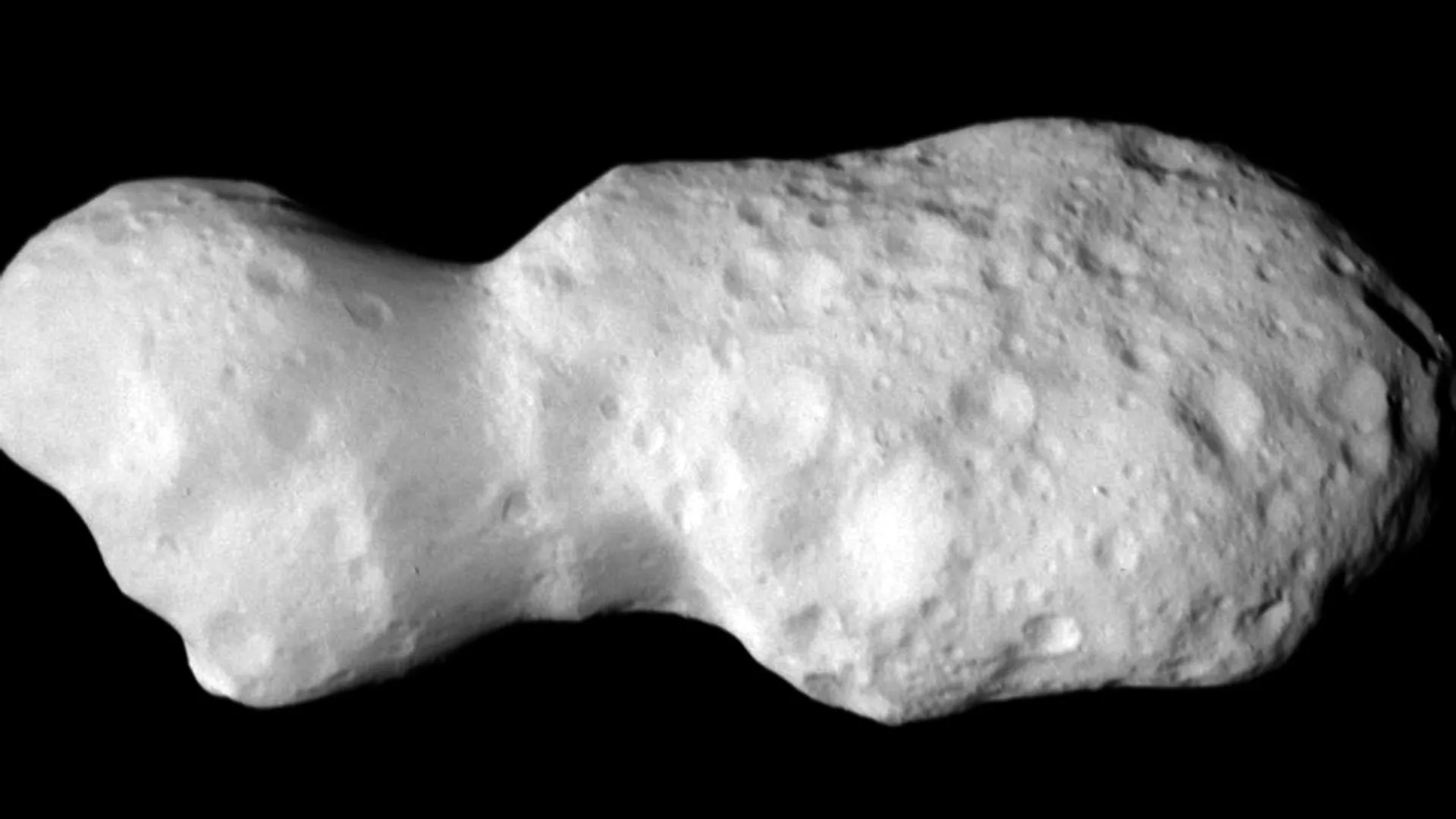
NASA's Lucy spacecraft has revealed that a small asteroid it buzzed last year is a wobbling, peanut-shaped relic — a battered fragment born in a violent ancient collision, slowly reshaped by sunlight, and carrying chemical fingerprints of water from the dawn of the solar system.
The asteroid, named Donaldjohanson after the paleoanthropologist who discovered the "Lucy" fossil that gave the mission its name, came into sharp focus when the spacecraft swept past it on April 20, 2025, capturing the first close-up images from a distance of just 650 miles. Researchers have now published their analysis in the journal Science, and the object turns out to be far stranger than expected.
Donaldjohanson formed roughly 155 million years ago, when fragments left over from a catastrophic smashup gradually drew together into a single, elongated body. Its distinctive shape — two lobes joined like a peanut shell — points to that gentle reassembly. Rather than spinning neatly around a single axis the way most asteroids and planets do, it tumbles in a complex, wobbling motion akin to a spinning top losing its balance, a behavior scientists call non-principal-axis rotation.
Perhaps most intriguing are the traces of ancient water locked in the asteroid's makeup. Such chemical signatures offer a window into the conditions of the early solar system, when water and other volatile compounds were distributed among the building blocks that would eventually form planets. Studying a relatively pristine fragment like Donaldjohanson lets researchers read those conditions almost directly, without the heavy processing that larger worlds have undergone over billions of years.
The flyby was a warm-up act. Lucy's primary mission is to reach the Trojan asteroids — two swarms of primitive bodies that share Jupiter's orbit around the sun and are thought to be leftover scraps from the era of planet formation. Over the coming years the spacecraft will visit a record number of these ancient objects, and the success at Donaldjohanson has given mission scientists confidence that Lucy's instruments are ready to decode the solar system's deep history when it arrives at the main targets. Each encounter, they say, is like opening a time capsule sealed 4.5 billion years ago.
The wobble itself carries information. Scientists believe sunlight has been gently torquing the asteroid over millions of years through an effect known as YORP, in which uneven heating and re-radiation of solar energy slowly alters a small body's spin. Catching an object mid-tumble offers a real-world laboratory for studying how these subtle forces sculpt the countless fragments drifting through the asteroid belt. Donaldjohanson sits in the main belt between Mars and Jupiter, and at roughly five miles across it is larger than the boulder-strewn rubble piles that recent missions have sampled, yet small enough to bear the unmistakable scars of its violent birth. By comparing it with the Trojan asteroids still to come, researchers hope to assemble a family portrait of the leftovers from planet formation — and to better understand the raw materials from which Earth and its water were ultimately assembled.