Four-Winged 'Jian' Dinosaur Found in China May Be the Predator That Hunted Early Birds
A newly named microraptor relative, Jian changmaensis, glided on four feathered limbs and may explain piles of crushed bird bones in a 120-million-year-old fossil bed.

Paleontologists have identified a new feathered dinosaur in China that may finally solve a long-standing fossil mystery: who, or what, was hunting the early birds whose crushed bones litter an ancient lakebed in the country's northwest.
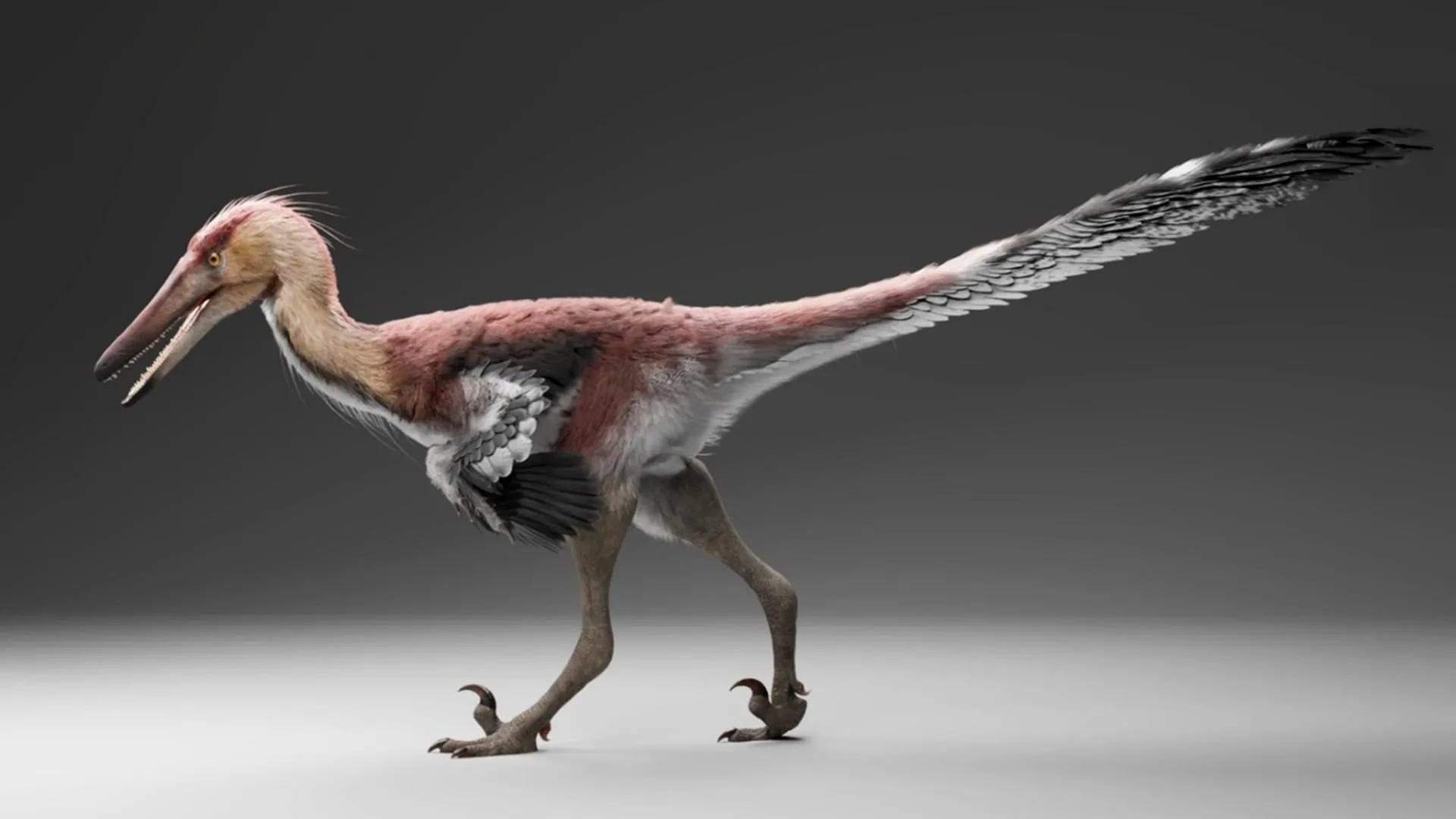
The newly named species, Jian changmaensis, was a four-winged glider and a close cousin of the famous raptor Velociraptor. Described in the journal Annals of Carnegie Museum, it belonged to a group of small, feathered predators known as microraptorines — dinosaurs that sported flight feathers not only on their arms but on their legs as well, giving them four wing-like surfaces they likely used to glide between trees.
For years, researchers had puzzled over a fossil bed in the Changma Basin of Gansu province strewn with the remains of hundreds of prehistoric birds. Some of those bird bones were broken and compacted into dense pellets, eerily similar to the regurgitated pellets coughed up by modern owls after a meal. Scientists suspected a larger predator was responsible, but for a long time the culprit left no trace of itself in the rock.
Jian changmaensis fits the profile. One of the largest microraptorines ever found, it had an upper arm bone about four inches long, implying a wingspan of roughly four feet — about the size of a modern barn owl. That scale, combined with its predatory anatomy, makes it a plausible candidate for the hunter that preyed on the basin's early birds some 124 to 120 million years ago, during the Early Cretaceous.
The name carries layers of meaning. In Chinese mythology, "Jian" refers to a mythical winged creature, a nod to the animal's four-winged body plan, while "changmaensis" honors the Changma Basin where the fossil was unearthed. The discovery helps flesh out a vivid picture of a Cretaceous ecosystem in which feathered dinosaurs and the ancestors of today's birds shared — and sometimes fought over — the same skies and forests.
Beyond solving a local whodunit, the find adds to a growing body of evidence blurring the once-sharp line between dinosaurs and birds. In plain terms, scientists think they've found the winged hunter behind a heap of mysterious crushed bird bones — a barn-owl-sized, four-winged dinosaur that glided through Cretaceous China more than 120 million years ago.
The discovery also feeds a lively scientific debate about how these four-winged dinosaurs actually moved. Researchers generally agree that microraptorines could glide, using their feathered limbs to slow descents and steer between perches, but whether any achieved true powered flight remains contested. Each well-preserved specimen like Jian changmaensis sharpens that picture, offering fresh data on wing proportions, body size and the ecological roles these animals played alongside the earliest birds.
/https://tf-cmsv2-smithsonianmag-media.s3.amazonaws.com/filer_public/3c/1f/3c1f6ba0-0486-41be-90f9-b9d192cfd29a/notebook-and-fossil.jpeg)