Photosynthesis Runs on a Trick Nobody Had Watched Happen. Two X-Ray Machines Just Caught the Water Moving
PNNL and SLAC combined ultrafast X-ray spectroscopy and scattering to see the solvent rearrange as a molecule picked up a proton — the coupling at the heart of proton-coupled electron transfer.

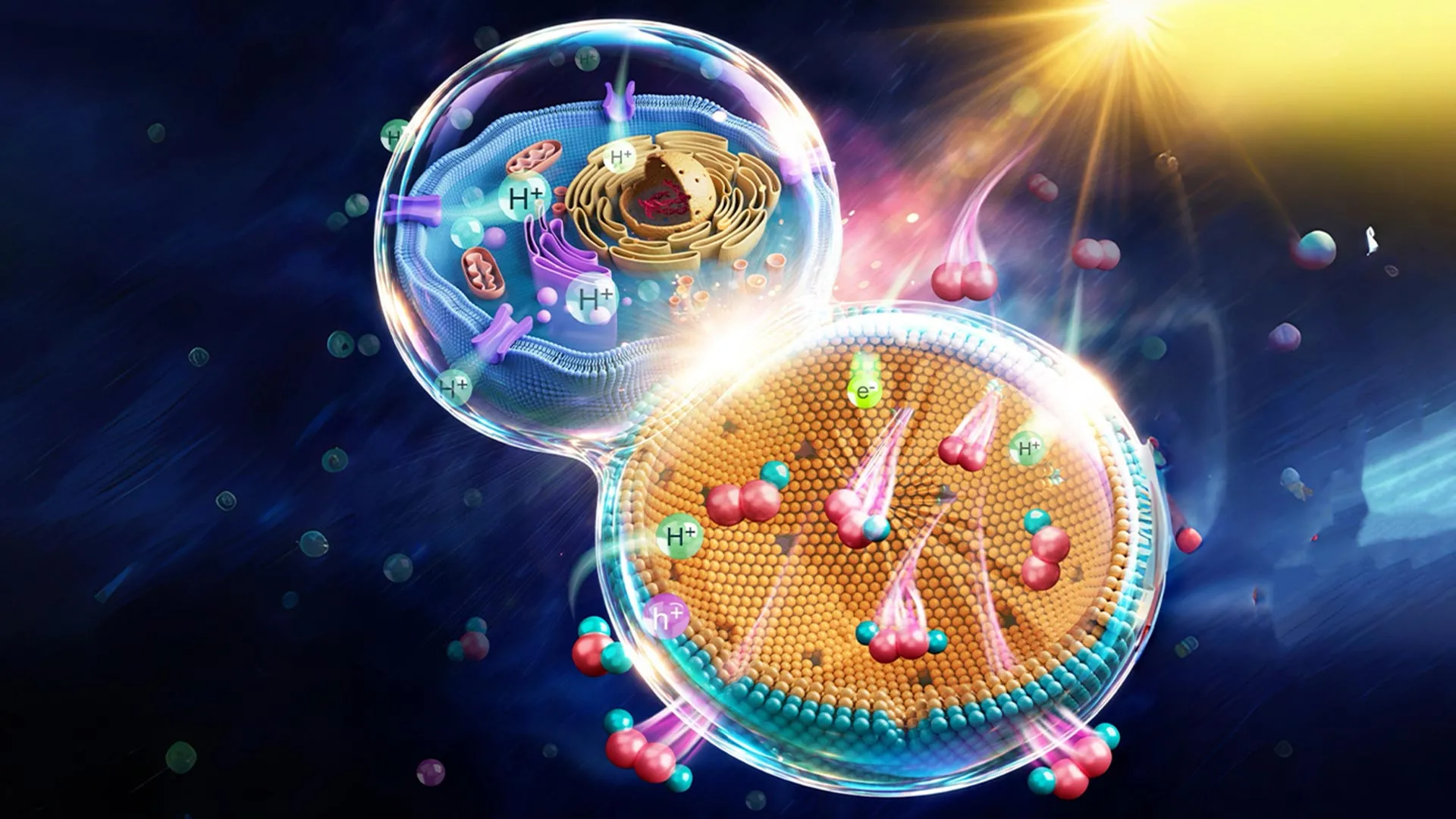
Nearly every process that moves energy through a living thing depends on the same maneuver: an electron and a proton move together, in coordination, rather than one after the other. Chemists call it proton-coupled electron transfer, and it underlies photosynthesis, cellular respiration, and most of the catalysis that industry would like to imitate. Until now, nobody had watched the water around it respond.
Researchers led by the Department of Energy's Pacific Northwest National Laboratory, working with SLAC National Accelerator Laboratory and academic collaborators, reported in Nature Communications on Friday that they have captured how a molecule's electronic structure changes as it gains a proton — and how the surrounding water rearranges itself at the same instant.
"We captured for the first time how electronic changes associated with proton transfer are coupled to reorganization of the surrounding solvent," said Elisa Biasin, the PNNL experimental chemical physicist who led the work.
The measurement required two instruments running on the same beam. At SLAC's Linac Coherent Light Source, the team used ultrafast X-ray spectroscopy at the chemRIXS instrument to track where electrons sat within the molecule, and time-resolved X-ray scattering at the XCS instrument to follow how atoms — including the water molecules packed around the reactant — physically shifted. Neither technique alone answers the question. Spectroscopy sees the electrons but not the solvent; scattering sees the arrangement but not the electronic state. Running both against the same reaction is what produced the coupling. Theorists Niranjan Govind and Amity Andersen supplied time-dependent density functional theory calculations and molecular dynamics simulations to interpret the signals.
The test subject was a ruthenium-based molecule, chosen for being boring. It undergoes proton-coupled electron transfer without the extra electronic and structural rearrangements that would muddy the X-ray signature, which made it possible to isolate the effect the team was after. The collaboration included Abdullah Kahraman, formerly of PNNL and SLAC, Christopher Larsen of the University of Auckland, and SLAC scientists Roberto Alonso Mori and David Hoffman.
One thing the experiment could not do is see the proton itself. X-ray scattering responds to electron density, and a proton is a bare hydrogen nucleus with essentially none. What the team measured is the shadow the proton casts — the electronic and structural response of everything around it. That is a real limitation, and the researchers state it plainly.
The practical target is catalyst design. Flow batteries, fuel cells and artificial photosynthesis all depend on moving protons and electrons together efficiently, and chemists have largely had to optimize those systems by trial and error because the intermediate steps were invisible. "An important first step in combining X-ray scattering and spectroscopy," Hoffman called it, pointing toward the LCLS-II upgrade, whose far higher repetition rate would let the same approach tackle messier and more useful molecules.