165-Million-Year-Old Otter-Sized Fossil Shows Mammals Had Suckling Anatomy by the Jurassic
Megacauda sungei, a semiaquatic relative of mammals from Inner Mongolia, carried bony palate hooks like those that support suckling and swallowing in living mammals.

A newly described fossil from China suggests that the anatomy mammals use to suckle milk began evolving nearly 165 million years ago, long before modern mammals appeared. The animal, named Megacauda sungei, was a large mammaliaform that lived during the Middle Jurassic in what is now Inner Mongolia. The findings are published in Nature, and an Ohio University summary of the work appeared October 11.
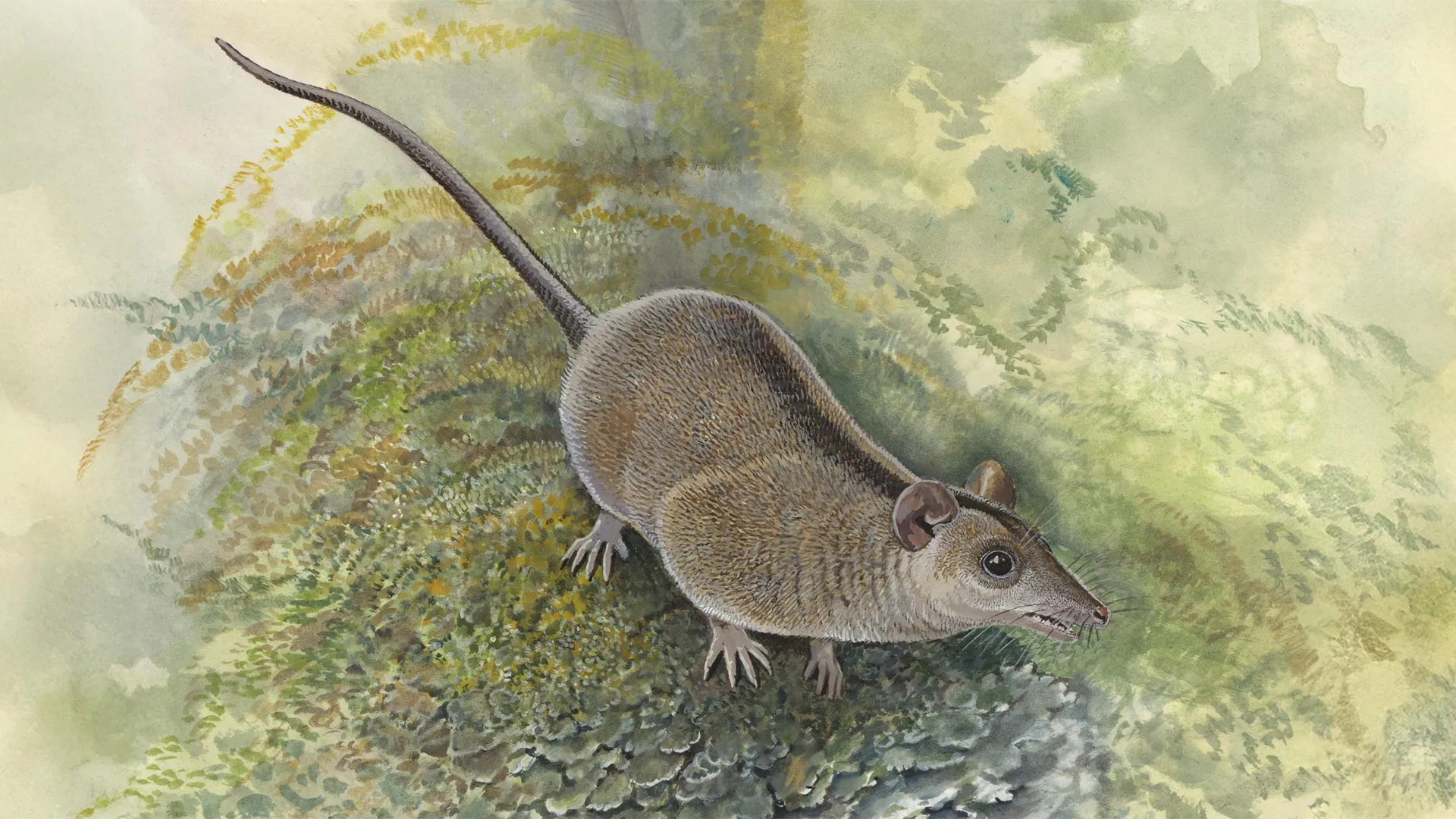
An international team led by scientists from the University of Chicago, Shenyang Normal University, Shandong University of Science and Technology, the University of Bonn and Ohio University used high-resolution microCT imaging to reconstruct the skull and skeleton. They found a surprising mix of features. Megacauda had blade-like cheek teeth resembling those of modern seals, a platypus-like pelvis and an otter-like tail. Together these point to a semiaquatic predator that hunted small vertebrates and invertebrates in freshwater, and at roughly the size of a modern otter it is among the largest known Jurassic mammaliaforms.
The most significant discovery was a pair of small bony projections on the roof of the mouth. They closely resemble structures in living therian mammals, the group that includes marsupials such as kangaroos and opossums and placental mammals such as elephants and humans. In those animals, the structures help support the soft palate and the muscles used in suckling, swallowing and protecting the airway. Soft tissue rarely fossilizes, so scientists have struggled for decades to learn when these feeding structures first appeared.
The team also found highly specialized hyoid bones in the throat. In living mammals those bones anchor muscles for swallowing. The evidence suggests Megacauda probably had an early version of the coordinated muscle system modern mammals use to move milk and food safely from the mouth to the esophagus. "The anatomy of Megacauda suggests that structures involved in coordinating swallowing and sucking had already begun to evolve by the Middle Jurassic," said Zhe-Xi Luo, a professor of organismal biology and anatomy at the University of Chicago and the study's senior author. "This discovery helps us better understand the biological foundations of one of the defining characteristics of mammals: feeding young with milk."
The fossil also challenges a long-held assumption. The therian-like bony hooks existed in Megacauda alongside more primitive bony ridges known from earlier mammaliaforms and mammal ancestors. Because the two sets of structures coexist in one animal, the modern structures could not have evolved directly from the primitive ridges, as researchers had thought. "This fossil captures an important stage in mammalian evolution," Luo said. "Megacauda provides some of the clearest evidence yet that many of these innovations emerged well before the rise of modern mammals."
The finding also bears on living animals. Monotremes, the platypus and echidnas, obtain milk in a different way and lack some of these anatomical features. The new evidence suggests monotremes likely lost parts of the ancestral suckling apparatus over time and developed an alternative method of taking in milk.
Beyond feeding biology, the study adds to the picture of ecological variety among early mammal relatives. "These discoveries continue to reveal that the age of dinosaurs was also a time of extraordinary evolutionary innovation among early mammals," said Peishu Li, an assistant professor at the Ohio University Heritage College of Osteopathic Medicine and a co-author. The paper, titled "A Jurassic mammaliaform swimmer and transformation of the mammalian pharynx," is by Y. Li and colleagues.