A Hollow Carbon Sphere With Channels Like Spokes Let a Fuel Cell Survive 150,000 Voltage Cycles on a Sliver of Platinum
Washington University engineers cracked a trade-off that has blocked fuel-cell catalysts for years, and they are aiming it at the data centers now on track to eat 9% of U.S. electricity.

A team at Washington University in St. Louis has built a fuel-cell catalyst that kept 85% of its performance after 150,000 punishing voltage cycles — roughly equivalent to 25,000 hours of operation — while using a fraction of the platinum such devices normally require. The results were published Aug. 6 in Nature Nanotechnology.
The motivation is the American power grid. The Electric Power Research Institute estimates data centers could consume up to 9% of U.S. electricity generation annually by 2030, up from 4% of total load in 2023. "If a data center is able to supply its electricity itself by using a fuel cell, it would directly convert hydrogen and other fuels into electricity, reducing the burden on the energy grid," said Gang Wu, the Elvera and William R. Stuckenberg Professor in WashU's McKelvey School of Engineering, who led the work with collaborators at Brookhaven National Laboratory, Lawrence Berkeley National Laboratory, Northeastern University and the University of Pittsburgh.
Fuel cells combine hydrogen and oxygen to produce electricity, water and heat, and they need a catalyst to make that reaction fast enough to be useful. Platinum is the best catalyst known and one of the most expensive metals on Earth, so the entire engineering game is using as little of it as possible. Grinding platinum down into nanoparticles multiplies the exposed surface area enormously — commercial designs typically run under a quarter of a milligram per square centimetre — but nanoparticles are unstable. In operation they dissolve, wander across the support and clump together, and the cell degrades.
Platinum intermetallic catalysts, in which platinum atoms lock into an ordered lattice with a cheaper metal such as cobalt, resist that decay far better. Making them properly requires annealing at high temperature to drive what materials scientists call the order-disorder transition, the step that snaps the atoms into their regular arrangement. But heat is exactly what makes nanoparticles migrate and grow, so most manufacturers anneal below 700°C and accept a partially ordered, less durable result. That is the trade-off: order the atoms properly and lose the fine dispersion, or keep the particles small and never fully order them.
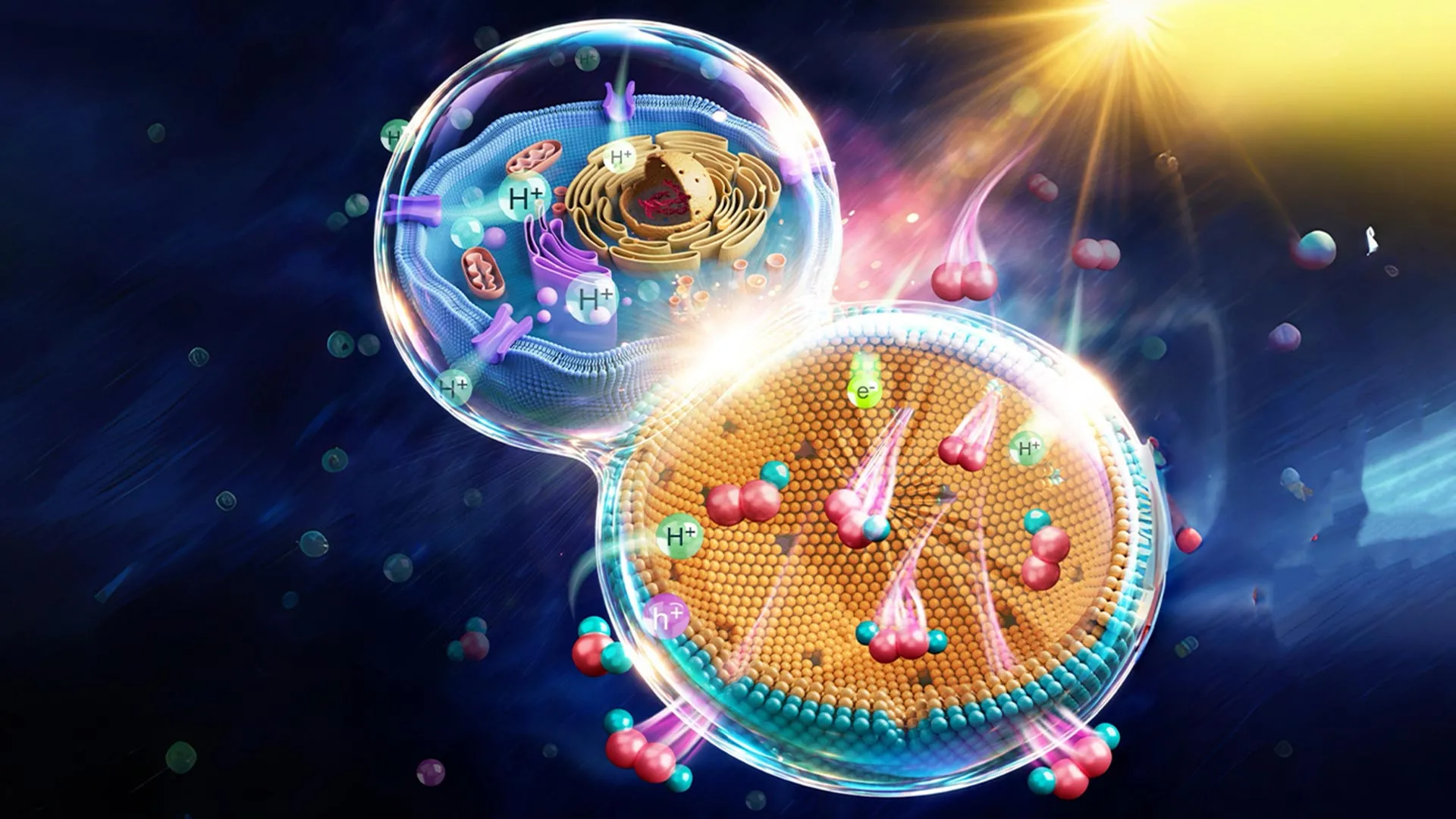
Wu's group broke it with the support material rather than the catalyst. They built porous, hollow carbon spheres threaded with an ordered array of nanochannels arranged radially, like spokes, with carefully tuned pore volume, pore size and surface area. Platinum-cobalt nanoparticles assembled densely inside those channels are physically confined by them, so they stay small and well separated even while the whole structure is heated to the temperature required for full intermetallic ordering.
"Our strategy is using this new carbon nanostructure to synthesize platinum-cobalt intermetallic nanoparticles that can reduce precious metal content and enhance activity and stability," Wu said. "Traditionally, there would be a trade-off between size and stability, but with the ordered carbon nanochannel host, platinum-cobalt nanoparticles can be confined and remain stable at very small particle sizes even at high temperatures."
The durability figure is the one that matters commercially. Accelerated stress testing at 150,000 voltage cycles is designed to compress years of real-world start-stop punishment into a laboratory run, and an 85% retention at that mark is the kind of number that moves a catalyst from an interesting paper toward something a manufacturer will cost out. Whether hydrogen fuel cells end up powering server halls depends on far more than catalysts — hydrogen supply, storage and delivery economics remain unsettled — but the catalyst has been one of the field's most stubborn bottlenecks, and this one loosens it.