The Same Silver Particle Runs the Reaction in Two Different Places Depending on Which Way the Cell Is Running
A Seoul National University team found the active site on a solid oxide cell's silver nanocatalyst moves when the device flips from making electricity to making hydrogen.
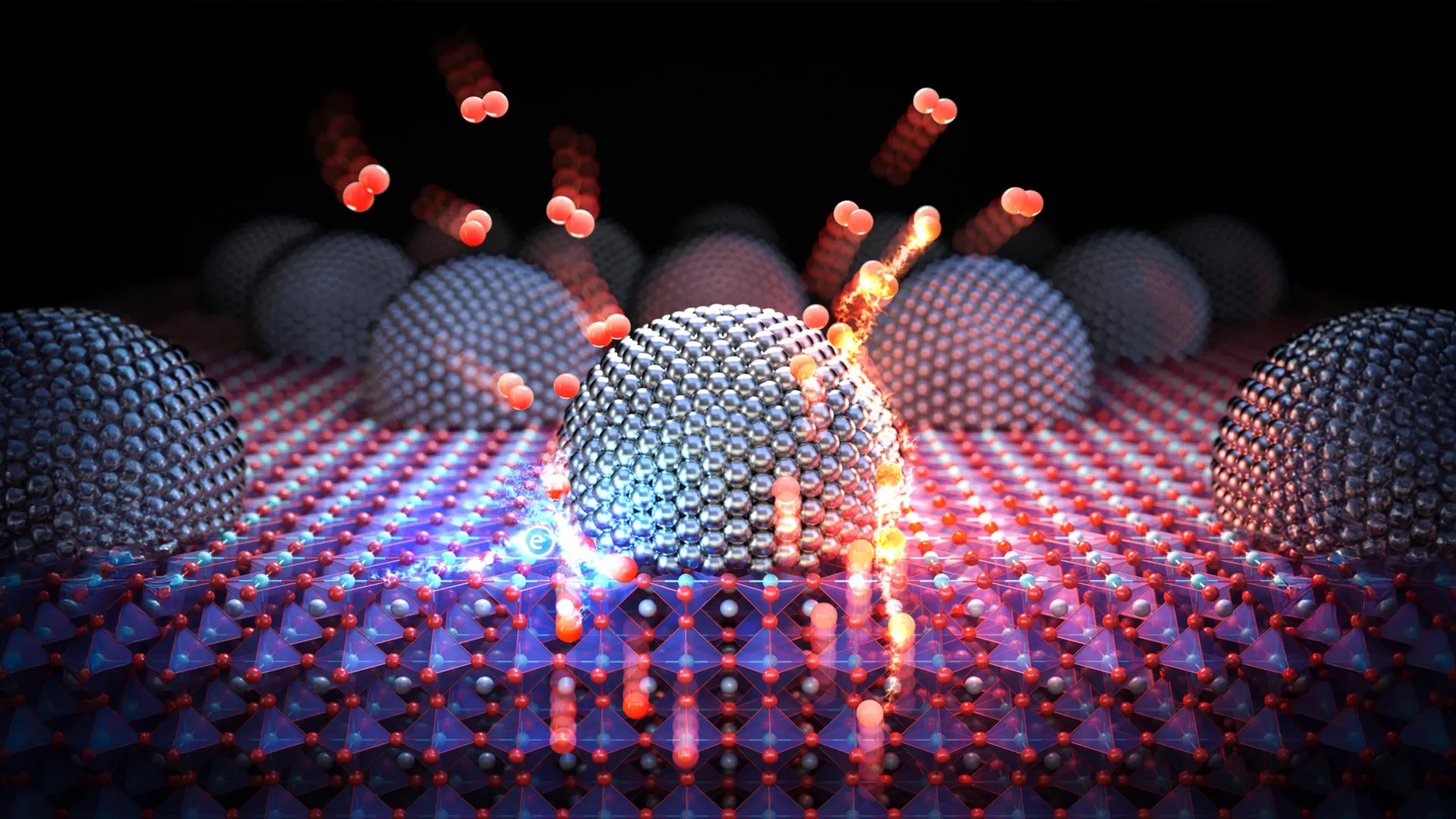
A team at Seoul National University has found that a silver nanocatalyst inside a solid oxide cell does not have one active site. It has two, and which one is doing the chemistry depends entirely on which direction the device is being run.
Solid oxide cells are ceramic devices that operate at high temperature and can be run in either direction. Forward, they are fuel cells: hydrogen or another fuel goes in, electricity comes out. Reversed, they are electrolyzers: electricity and steam go in, hydrogen comes out. That reversibility is the reason they attract attention as grid-scale storage — one box that can absorb surplus renewable power as hydrogen and later burn it back to electricity — but it also makes them hard to optimize, because a catalyst tuned for one mode is not obviously right for the other.
The Seoul National University College of Engineering group, directed by professors WooChul Jung and Jeong Woo Han with Dr. Jinwook Kim leading the experimental work, tracked where oxygen exchange actually occurs on silver nanoparticles deposited on the electrode. In electricity-generating mode, the reaction concentrates at the interface where the silver particle meets the electrode surface — the narrow contact line between metal, ceramic and gas. Switch the cell into hydrogen production, and the active region moves onto the surface of the silver particle itself.
"The same silver (Ag) nanocatalyst can operate at different reaction sites depending on whether a solid oxide cell is producing electricity or generating hydrogen," the team reported. The work was published in Energy & Environmental Science and selected for the journal's outside back cover.
The practical consequence is a design rule. If the active site shifts with operating mode, then the two modes reward opposite geometries: maximizing the contact perimeter between particle and electrode favors power generation, while maximizing exposed particle surface area favors electrolysis. A reversible cell intended to spend real time in both states has to be engineered around that tradeoff explicitly rather than by tuning for one mode and accepting whatever the other gives. Until now, catalyst development for these devices has generally assumed a single mechanism running in reverse.
The project drew on collaborators outside the university, including the team of Professor Sang Ouk Kim at KAIST and Dr. Beomgyun Jeong's group at the Korea Basic Science Institute, and was funded by South Korea's Ministry of Science and ICT through the National Research Foundation.
South Korea has staked a substantial part of its industrial decarbonization strategy on hydrogen, and solid oxide technology is one of the few routes to electrolysis efficiencies high enough to make green hydrogen competitive on cost, because running the reaction hot lets heat supply part of the energy that would otherwise have to come from electricity. Silver is also considerably cheaper than the platinum-group metals that dominate low-temperature fuel cell catalysis.