The Sun Holds 55% More Silver Than Astronomers Thought, and It Finally Matches the Meteorites
A Swedish team rebuilt the physics of how silver atoms absorb sunlight and closed a stubborn gap between our star and the oldest rocks in the solar system.
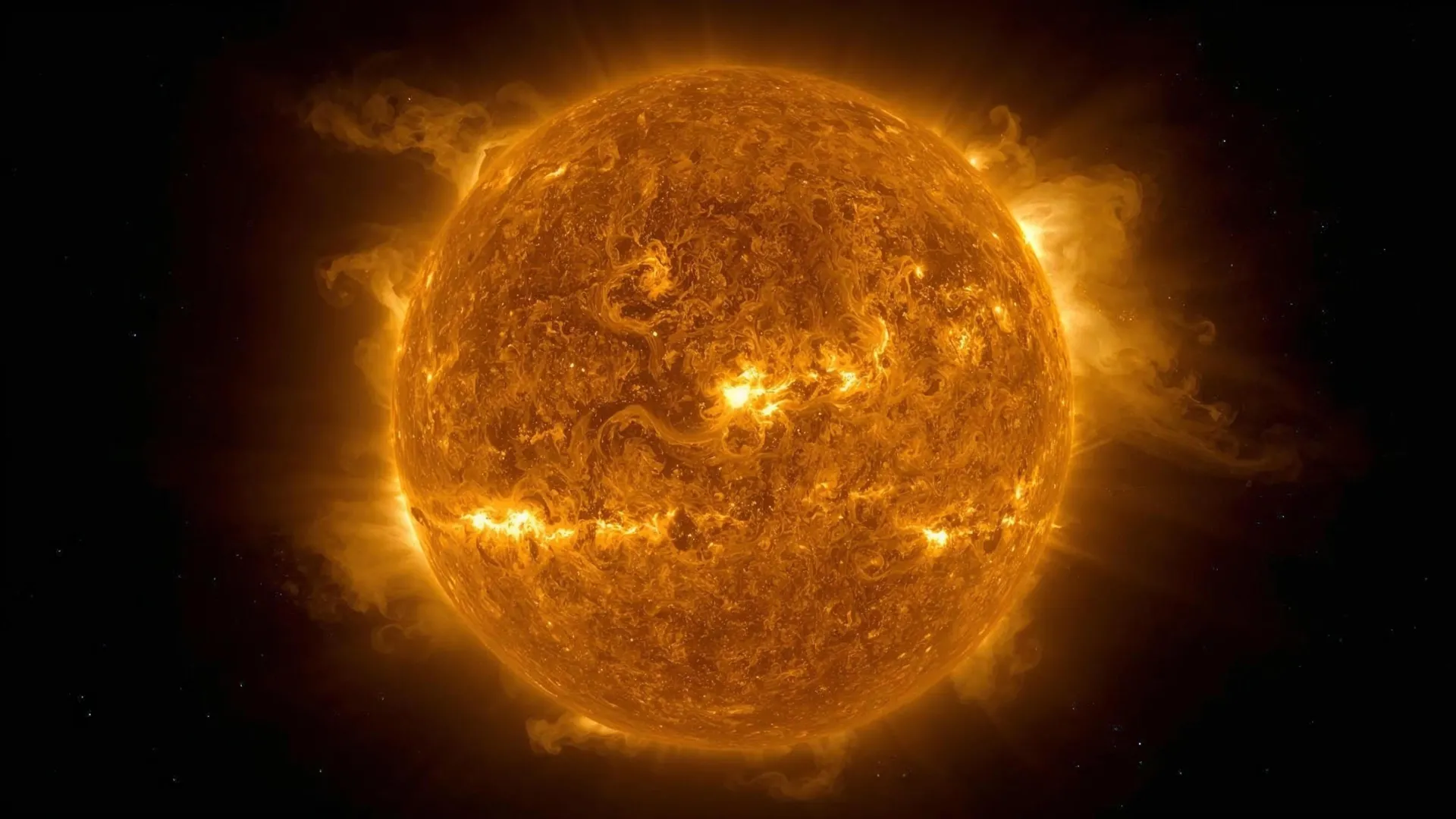
The Sun contains 55% more silver than astronomers have been assuming, according to a new analysis from Uppsala University that resolves a discrepancy scientists had lived with for decades.
The number matters far beyond silver. The Sun is astronomy's reference standard: when researchers want to know how much of any element a distant star, a planet or a cloud of interstellar gas contains, they measure it against the Sun. An error in the solar recipe propagates outward into everything measured against it.
Astronomers read the Sun's composition through spectroscopy — sunlight is split into its constituent wavelengths, and each element leaves dark absorption lines where its atoms have swallowed light at characteristic frequencies. The depth of those lines is supposed to reveal how many atoms are doing the swallowing. Converting line depth into an abundance requires a model of the solar atmosphere, and the standard models assume the gas sits in local thermodynamic equilibrium, a simplification in which the atoms' energy states are set purely by temperature.
That assumption breaks down for silver. In the Sun's outer layers, the radiation field itself pushes silver atoms into and out of excited states, so the atoms are not in equilibrium with their surroundings. Sema Caliskan, who led the work during her doctorate at Uppsala's Department of Physics and Astronomy, built a model that tracks those non-equilibrium effects atom by atom, running the calculations on the Tetralith supercomputer at Sweden's National Supercomputer Center. It is the first time the method has been applied to solar silver. The results appear in the journal Astronomy & Astrophysics.
The revised figure lands almost exactly where an independent line of evidence said it should. Primitive meteorites — chunks of rock that condensed out of the same disk that formed the Sun roughly 4.6 billion years ago and have gone essentially unchanged since — can be dissolved and measured in a laboratory, no atmospheric modeling required. Their silver content had long run higher than what spectroscopy said the Sun contained. The two now agree.
"The new knowledge about the Sun's composition is important for the understanding of other stars, planets and cosmic material," Caliskan said. Silver is forged in neutron-capture reactions in dying stars and in stellar explosions, so its abundance is a tracer for how heavy elements have been built up and spread through the Milky Way over billions of years. Getting the Sun's value wrong by half meant getting a piece of that chemical history wrong too.