Astronomers Find a 'Planet Factory' Just Beyond Jupiter That Churned Out Worlds for Two Million Years
A dust trap in the infant solar system acted as a breeding ground, producing generation after generation of planetary building blocks, a new study finds.
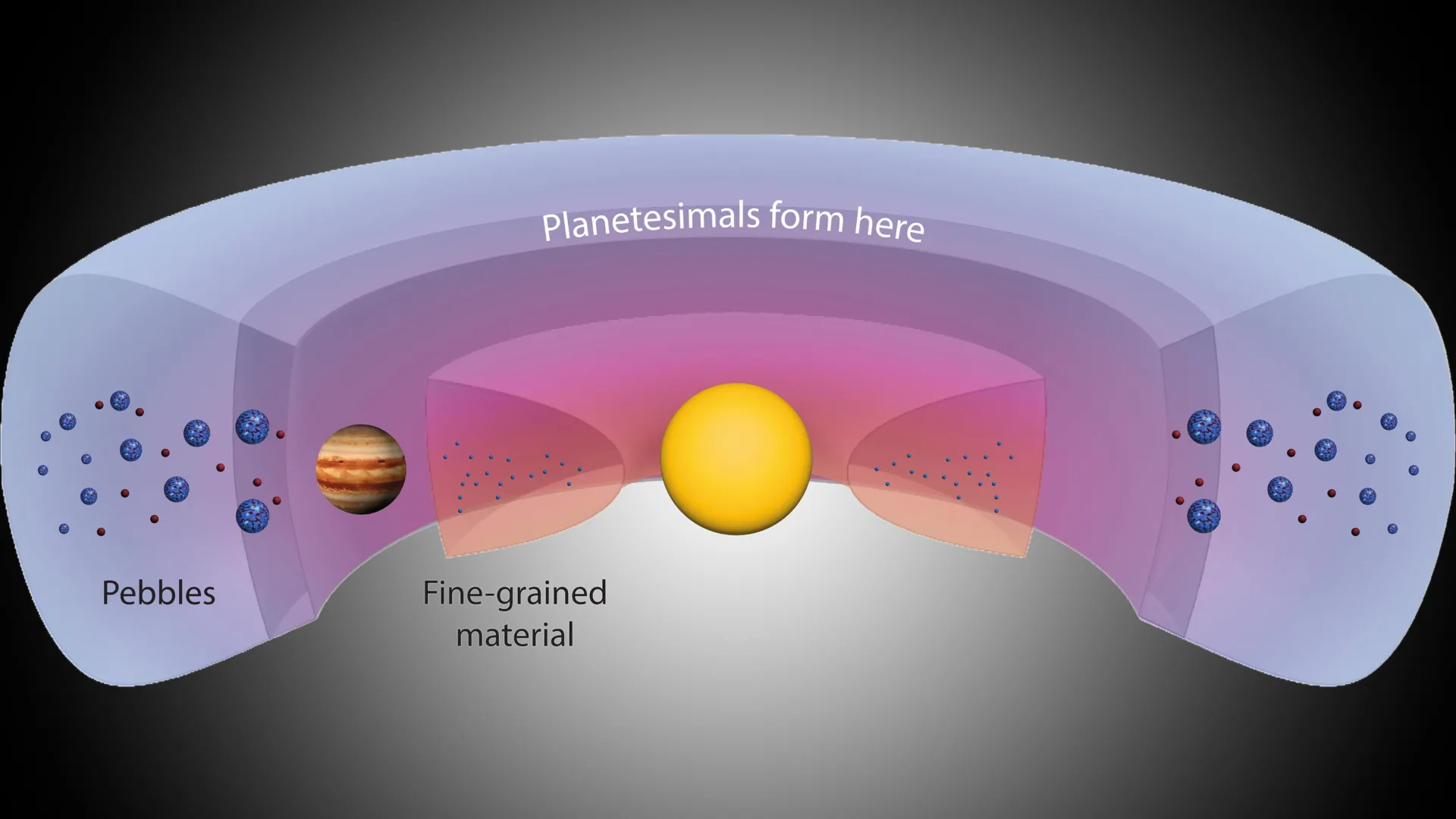
Just beyond the orbit of Jupiter, in the chaotic first few million years of the solar system, a ring of dust appears to have operated like a cosmic assembly line — churning out generation after generation of planetary building blocks, according to new research that helps explain one of planetary science's enduring puzzles.
The study, published in The Astrophysical Journal by scientists at the Max Planck Institute for Solar System Research in Germany, models how a "dust trap" in the disk of gas and dust surrounding the young Sun could continuously manufacture planetesimals — the kilometer-scale bodies that eventually clump together to form planets, moons and asteroids. Rather than forming all at once, the building blocks emerged in waves over roughly two million years.
"Different types of planetesimals apparently formed in the same region of the early dust and gas disk, only at different times," said Joanna Drążkowska, who heads the institute's Lise Meitner Group on planet formation. That staggered production, the team argues, neatly accounts for why the meteorites that rain down on Earth today come in such chemically distinct varieties — particularly the carbon-rich carbonaceous chondrites prized by researchers as time capsules from the dawn of the solar system.
The key to the process, the researchers say, is the dust trap itself: a region where the pressure of the surrounding gas slows the inward drift of solid particles, allowing them to pile up densely enough to collapse under their own gravity into new bodies. "There is strong evidence that dust traps were the preferred birthplace of planetesimals in our solar system," Drążkowska said. The simulations suggest the first major phase of planetesimal formation lasted around 500,000 years, with production continuing in fits and starts for roughly two million years in total.
Lead author Nerea Gurrutxaga, a doctoral student, and co-authors including Max Planck director Thorsten Kleine, a cosmochemist, combined the physics of how dust behaves in a swirling disk with the chemical fingerprints locked inside meteorites. The marriage of those two approaches — modeling and lab analysis of real space rocks — gave the conclusions unusual grounding, tying an abstract simulation to material scientists can hold in their hands.
The findings reframe planet formation not as a single, tidy event but as a prolonged, episodic process governed by the shifting structure of the protoplanetary disk. Understanding how and when those first solid bodies assembled around our own Sun also sharpens the lens astronomers turn on the thousands of planetary systems now being discovered around other stars, where similar dust traps may be quietly building worlds today.