Ultrafast X-Rays Catch a Molecule Bending, One Atom at a Time
At the European XFEL, physicists tracked light turning into motion inside a single ring-shaped molecule — and found that different atoms in the same molecule tell completely different stories about what happened.
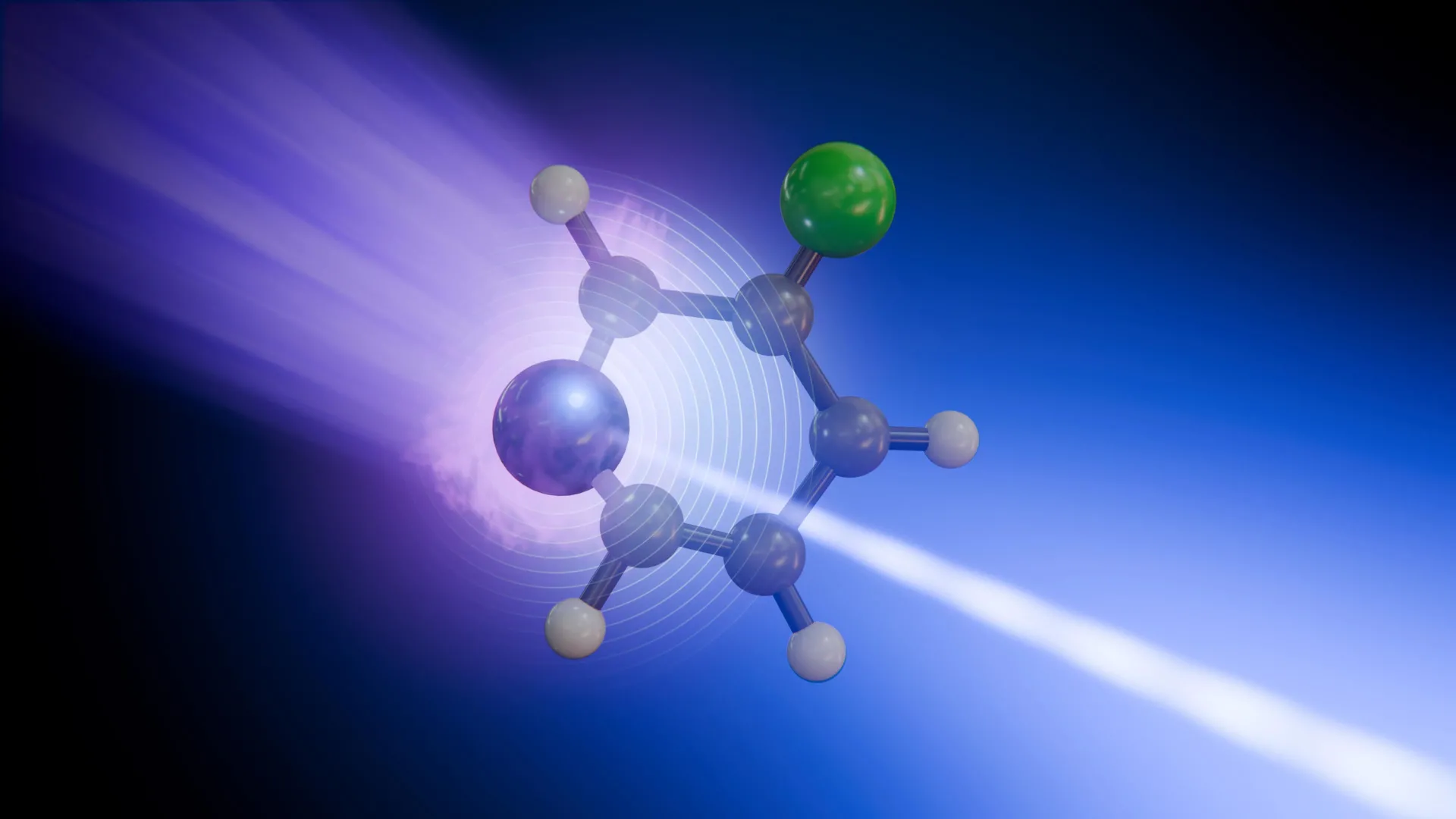
Researchers at the European XFEL have watched a molecule absorb a flash of ultraviolet light and convert it into motion, following the process atom by atom over trillionths of a second — and discovered that different atoms within the same molecule report different parts of the story.
The experiment used time-resolved X-ray photoelectron spectroscopy, a technique that works something like stop-motion photography for chemistry. A first pulse of ultraviolet light excites the molecule. Then, at a series of precisely staggered delays, a soft X-ray pulse strips electrons from specific atoms. Because the energy required to remove an electron depends on that atom's immediate chemical surroundings, each measurement is a snapshot of one atom's local environment at one instant. Chain the snapshots together and you get a film.
The molecule was 3-fluoropyridine, a flat ring containing both a nitrogen atom and a fluorine atom. Hit with ultraviolet light, the ring buckles out of its plane, passes through what physicists call a conical intersection — a point where the motion of the electrons and the motion of the nuclei become inseparably coupled — and drops back to its ground state, dumping the leftover energy into vibration. Conical intersections are the funnels through which most light-driven chemistry actually proceeds, and they are notoriously difficult to observe because molecules pass through them in femtoseconds.
Having two chemically distinct reporter atoms in one molecule turned out to be the point. The fluorine atom, sitting off to the side of the electronic action, registered the vibrational relaxation cleanly. The nitrogen atom, directly involved in the excitation, showed both the redistribution of electrons and the structural change at once. "We can now see that not every atomic site tells the same story," one of the researchers said — which is both a result and a warning about single-probe experiments that assume a molecule responds as a unit.
The work was carried out at the Small Quantum Systems instrument at the European XFEL, the free-electron laser near Hamburg that generates X-ray pulses short and bright enough to freeze motion at these timescales. Ana Martínez Gutiérrez is the lead author, with Antonio Picón of the Instituto de Ciencia de Materiales de Madrid and Daniel Rivas of the European XFEL among the co-authors. It appeared in the Journal of the American Chemical Society on July 29.
The practical reach extends well beyond one fluorinated ring. The same funnels govern how DNA sheds ultraviolet energy without breaking apart, how the pigments in light-harvesting complexes move energy toward a reaction center, and how photovoltaic and photocatalytic materials either convert light or waste it as heat. Being able to interrogate those processes one atomic site at a time gives theorists something considerably sharper to test their models against.
Originally reported by ScienceDaily.