Laser Creates Star-Like Plasma in Trillionths of a Second, Unlocking Extreme Physics
Scientists capture split-second ionization process as copper wire transforms into million-degree plasma, advancing laser fusion diagnostics.
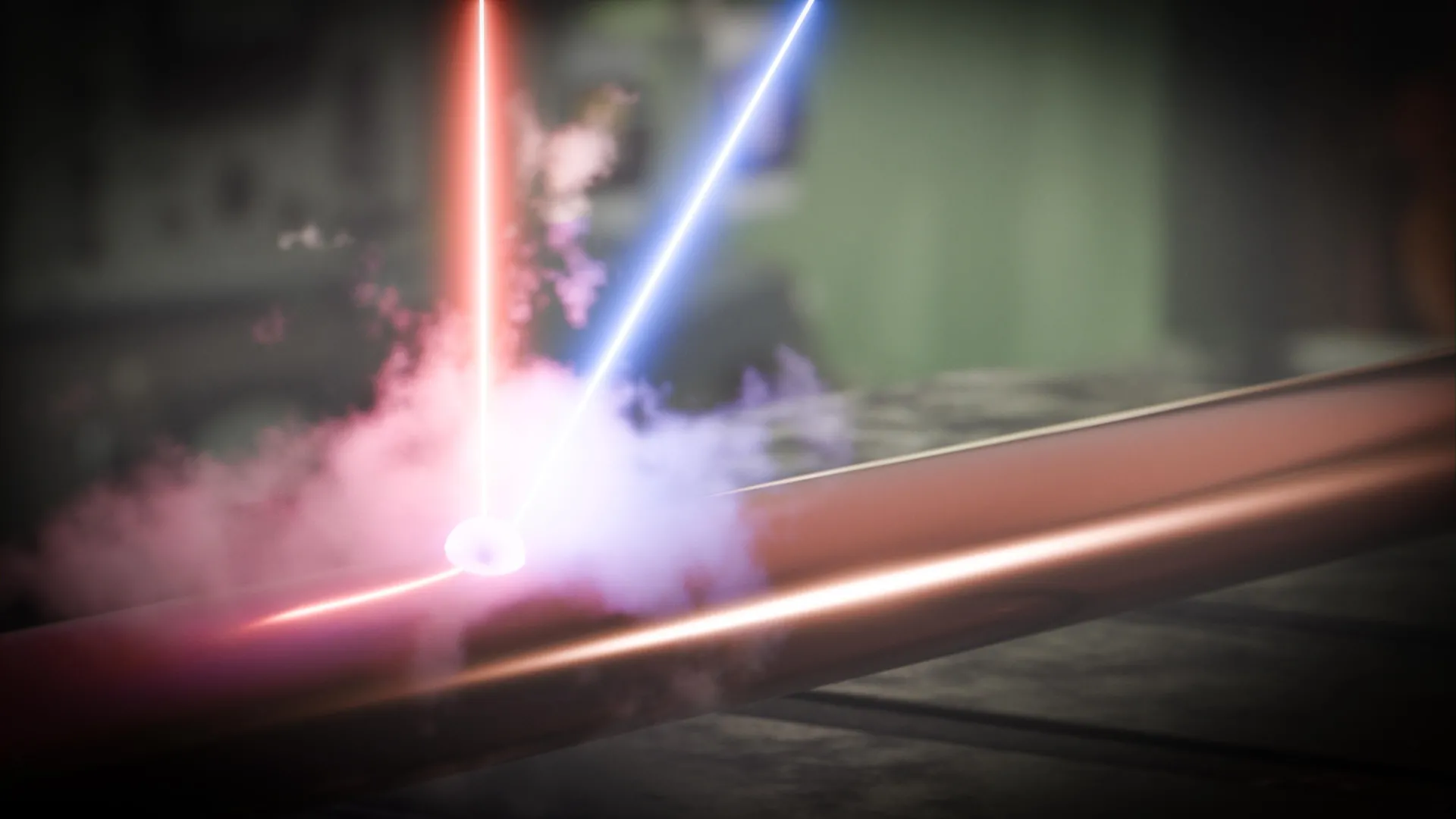
Researchers have achieved an extraordinary feat of extreme physics, using cutting-edge laser technology to transform ordinary copper wire into superheated plasma resembling conditions found near neutron stars—all in just trillionths of a second. The breakthrough, reported in Nature Communications by scientists at Helmholtz-Zentrum Dresden-Rossendorf, provides unprecedented insight into how matter behaves under the most extreme conditions and introduces powerful new diagnostic tools for laser fusion research.
The experiment combines two advanced laser systems at the European XFEL facility in Germany: an X-ray free-electron laser and the high-intensity optical laser ReLaX. Both deliver pulses lasting just 25 to 30 femtoseconds—measured in quadrillionths of a second. This ultra-short duration allows researchers to capture ionization as it unfolds, tracking how electrons are stripped from atoms almost in real time. The setup represents a major technical achievement in laser physics, enabling observations of processes that occur faster than almost any other phenomenon in nature.
When the intense laser burst strikes a copper wire just one-seventh the thickness of human hair, the energy delivered reaches an astounding 250 trillion megawatts per square centimeter. This immense power density instantly vaporizes the copper, creating plasma with temperatures reaching several million degrees. Under these conditions, copper atoms lose multiple electrons and become highly charged Cu²²⁺ ions—copper atoms stripped of 22 electrons each. Such extreme ionization states are typically found only in cosmic environments like stellar cores or during explosive astrophysical events.
The researchers employed a sophisticated pump-probe technique to study the plasma's evolution. After the initial laser pulse creates the plasma, a second X-ray pulse from the European XFEL examines its properties. These probe pulses are precisely tuned to 8.2 kiloelectronvolts, matching specific electronic transitions in the highly charged copper ions. 'In our pump-probe experiment, we exactly measure the temporal development of this stimulated X-ray emission,' explains Dr. Lingen Huang, who heads experimentation in HZDR's High-Energy Density Division. This approach creates a series of snapshots, like frames in a movie, showing how the plasma changes over time.
The implications extend far beyond basic science curiosity. Understanding how matter behaves under such extreme conditions is crucial for advancing inertial confinement fusion, where lasers compress fuel pellets to achieve nuclear fusion. The diagnostic techniques developed in this study could help researchers better monitor and control fusion reactions, potentially accelerating progress toward practical fusion energy. The work also contributes to fundamental physics research, providing new ways to study matter under conditions that bridge laboratory experiments with cosmic phenomena occurring in some of the universe's most extreme environments.

