Scientists Turn Metal Into Star-Like Plasma Using Laser in Trillionths of a Second
Researchers capture split-second chaos as copper atoms lose and regain electrons, creating highly charged ions in extreme conditions.
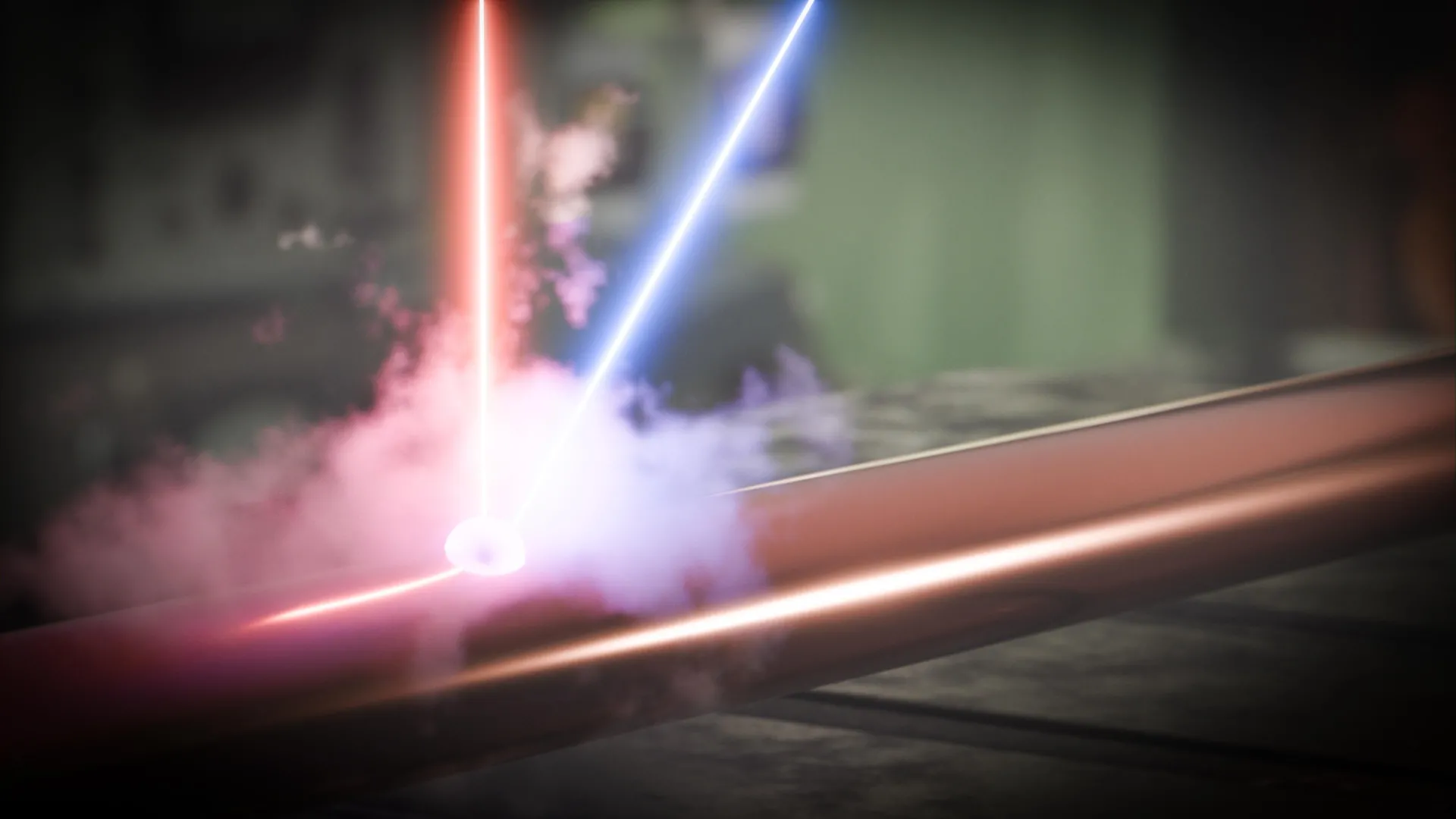
Scientists at Helmholtz-Zentrum Dresden-Rossendorf have achieved a remarkable feat by capturing the ultrafast process of turning solid metal into star-like plasma using powerful laser technology. The research, published in Nature Communications, provides unprecedented insight into how matter behaves under extreme conditions similar to those found near neutron stars or during gamma-ray bursts in space.
The experiment involved striking an extremely thin copper wire, about one-seventh the thickness of a human hair, with an intense laser burst delivering approximately 250 trillion megawatts per square centimeter. This immense energy density, concentrated over an extraordinarily brief moment, instantly vaporized the copper and created plasma with temperatures reaching several million degrees. The process demonstrates how matter transforms when subjected to the kind of extreme conditions that exist only in the most violent cosmic environments.
To capture this lightning-fast transformation, researchers combined two cutting-edge laser systems at the European XFEL facility in Schenefeld, Germany. The high-intensity optical laser ReLaX created the plasma, while an X-ray free-electron laser served as a probe to observe the process. Both lasers produced pulses lasting just 25 and 30 femtoseconds respectively, or mere trillionths of a second, allowing scientists to track how copper atoms lose and regain electrons in real time.
Dr. Lingen Huang, who heads experimentation in HZDR's Division of High-Energy Density, explained that these ultrashort pulses were essential for observing ionization as it unfolds. The team specifically focused on Cu²²⁺ ions, copper atoms that had lost 22 electrons, using X-ray pulses tuned to 8.2 kiloelectronvolts to match specific electronic transitions. This resonant absorption technique allowed them to measure exactly how many highly charged ions existed in the plasma at any given moment.
The research has significant implications for laser fusion studies and understanding extreme astrophysical processes. By providing new methods for improving diagnostics in laser fusion research, the work could contribute to the development of clean energy technologies. Additionally, the ability to create and study matter under such extreme conditions in laboratory settings offers scientists a window into understanding phenomena that occur in some of the universe's most violent and energetic events, from stellar explosions to the formation of black holes.