Pilot Said 'We're Managing the Ice' Seconds Before Mayday in Palm Beach Jet Crash
Air traffic audio shows a 20-year-old co-pilot calling out a plunge of 20,000 feet per minute, as NTSB investigators say the Learjet may have been breaking up before impact.
Air traffic control recordings released after Sunday's deadly Florida jet crash capture the pilots reporting ice and turbulence moments before declaring an emergency. "We're managing the ice, but it is moderate turbulence," the pilot says in one transmission. Shortly after: "722 Bravo Delta, we're descending 8,000, Mayday, Mayday, we're descending 10,000 feet per minute." The final calls grow more urgent. "Declare an emergency 722 Bravo Delta, we are in an overspeed condition descending 20,000 feet per minute."
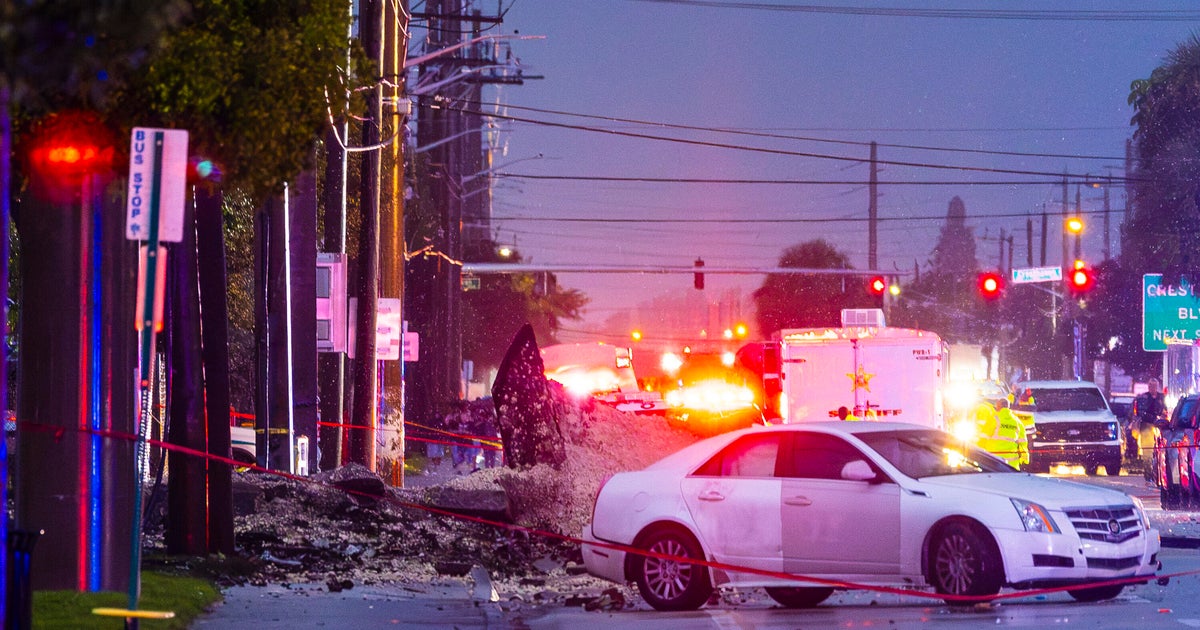
The Learjet 60 left Austin, Texas, bound for the Bahamas and crashed into a neighborhood along a busy road in Palm Beach County, killing all nine people aboard. It burst into a fireball and left a large crater. The FAA said the pilot began reporting weather and turbulence problems before the crash, and officials believe severe weather may have been a factor. No one on the ground was killed, though the NTSB said one person suffered a leg injury.
The plane's last data broadcast showed it at nearly 9,000 feet before it nosedived at more than 32,000 feet per minute, about 363 mph. NTSB board member Tom Chapman told reporters Monday afternoon, "We do have some indication that the aircraft was breaking up before impact." He said parts may be found some distance from the impact site.
Sources confirmed to CBS News that the co-pilot was Nathalia Filgueiras, 20. The captain was identified as Jeffrey Gregory, 55, according to a source with direct knowledge and a manifest obtained by CBS. The passengers were identified in a statement from their families as Adam Robinson and Helen Sharp, a couple from Austin, and their children Emma, 4, and Charlie, 2, along with Rachael Reed, Charmi Fehr and Anita Maria Cetina. Their families said "Adam and Helen were devoted parents."
A longtime friend of Filgueiras, Mikaela Schluth, said the recording "was definitely, probably the worst thing I've ever heard," but that she is proud of how Filgueiras stayed calm and kept giving information until the end.
Investigators are weighing two scenarios, said Robert Sumwalt, former NTSB chair and a CBS News transportation safety expert: icing, or thunderstorm turbulence. Weather data shows the aircraft entered a rapidly intensifying storm cell shortly before the pilots reported ice and severe turbulence. Sumwalt said it is very hard to regain control once icing causes a loss of control. "It adds weight, but more importantly, it disrupts the smooth flow of air across the top of the wings," he said. Investigators are also asking whether the horizontal stabilizer broke off, which would make the plane virtually uncontrollable, and whether the crew understood the storm ahead. A Learjet 60 typically carries weather radar, as airliners do.
The NTSB's priority is recovering the cockpit voice recorder. Investigator in charge Timothy Monville said the biggest obstacle will be digging the major wreckage out of the crater in the roadway. Sumwalt said he is confident investigators will determine the cause and recommend ways to prevent a repeat.