Amazon Cut Off 21 Air a Week After Its 767 Ran Off a Miami Runway and Killed Five. The NTSB Says a Pilot Kept Saying 'We're Going Too Fast' and No Reversers Were Used.
The cargo jet touched down at 182 mph, went to go-around power 15 seconds after landing, then back to idle. Amazon is shifting the routes to Sun Country and Hawaiian while the investigation continues.
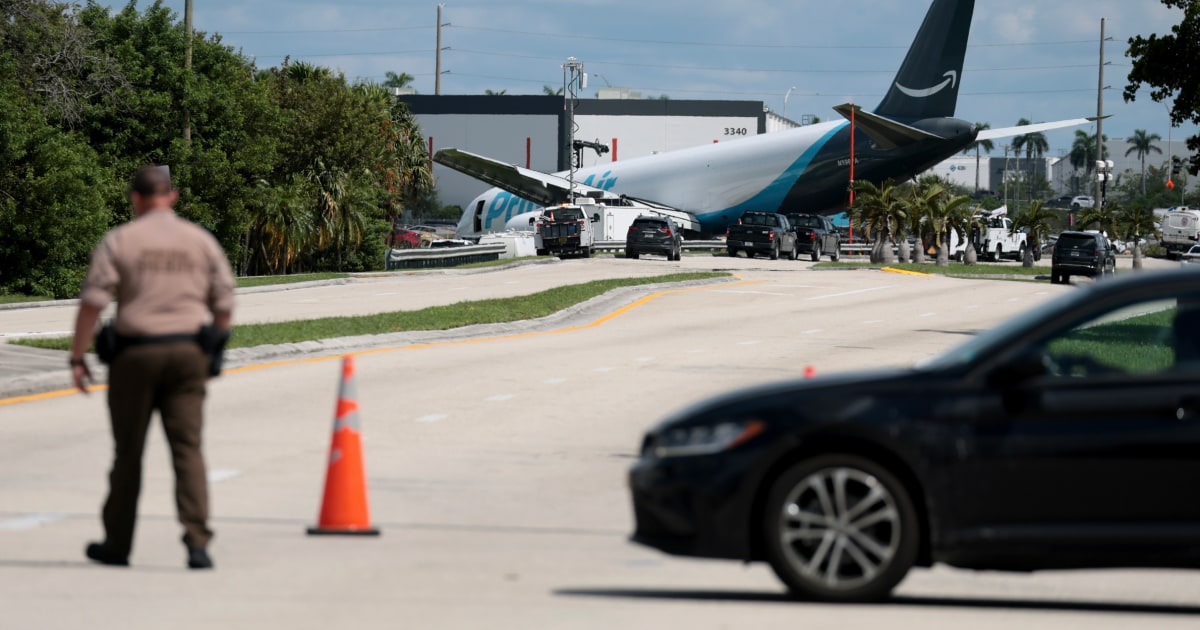
Amazon has stopped flying with 21 Air, the cargo carrier whose Boeing 767 overran a runway at Miami International Airport on September 6 and plowed into two vehicles, killing five people on the ground. The decision came days after federal investigators released cockpit recorder data showing one pilot repeatedly warning that the jet was going too fast, and no sign that the aircraft's speed brakes or thrust reversers were ever deployed.
"After the tragic incident last weekend, we've spent time supporting the investigation and reviewing some of the surrounding circumstances, and we've decided to pause our operations with 21 Air," Amazon spokesperson Kelly Nantel said. The company will route the affected shipments through other contract carriers, including Sun Country Airlines and Hawaiian Airlines. 21 Air said in a statement that it is "confident in our safety policies, procedures and training," and that it is supporting the people affected and cooperating with investigators.
The aircraft, a 32-year-old 767-300 converted to a freighter and flown as 21 Air Flight 7598, was arriving from San Juan, Puerto Rico, with about 32,000 pounds of cargo, mostly contact lenses, on its third leg of the day. It landed on Runway 30 in light storms and gusty winds, ran off the end of the pavement and traveled roughly 1,300 feet farther before it struck a van carrying airline cleaning workers and an SUV. The five people killed were Yoel Rodriguez Naranjo, 53; Rolando Aleman Leon, 55; Julio C. Pineda, 75; Carlos Acosta Fajardo, 53; and Javierkys Reyes Quevedo, 47. Five others were injured, including both pilots, who survived.
The National Transportation Safety Board's preliminary summary, released September 9, describes an approach that was unstable well before the wheels touched. The cockpit voice recorder captured one pilot saying "we're going too fast" several times, with what investigators called "no consistent verbal response" from the other. The board did not say which pilot was speaking. The ground-proximity system called out "sink rate" and announced "too low terrain" four times. The crew asked for the final flap setting only as the jet passed about 40 feet, moments before touchdown.
The flight data recorder shows the nose and right main landing gear hit the runway first at 158 knots, about 182 mph. The left main gear did not touch down until 11 seconds later, at 134 knots. Brakes were applied, then released at 120 knots as the throttles advanced to go-around thrust, about 15 seconds after the first touchdown and after the recorder picked up the call to go around. Four seconds later, the throttles came back to idle and the brakes were reapplied at 117 knots. The jet left the pavement shortly after. "The speed brakes and the thrust reversers were not deployed," NTSB investigator Chihoon Shin said. Investigators have not determined why.
The captain, 55, had 7,145 total flight hours and had been rated on the 767 only since May. The first officer, 37, had 2,655 hours and had held the 767 rating since April 2025. The NTSB said its investigation will examine landing performance, crew coordination, training, weather, the runway condition, how the converted freighter's systems behaved, Federal Aviation Administration oversight of 21 Air, and the contractual relationship between the carrier and Amazon. A probable cause finding typically takes a year or more.
21 Air, based in Greensboro, North Carolina, operates a small fleet of 767 freighters, most of them on behalf of Amazon Air, the retailer's in-house logistics network. Amazon does not own the jets or employ the crews that fly them; it contracts with operators like 21 Air, Sun Country, Hawaiian and Atlas Air, which fly aircraft painted in Amazon's livery.
Originally reported by NBC News.