High-Speed Train Slams Into Stopped Train in Central Spain, Killing at Least 64
Two high-speed trains carrying 544 passengers collided near Toledo on Wednesday, derailing two cars in Spain's second deadly rail disaster this year.
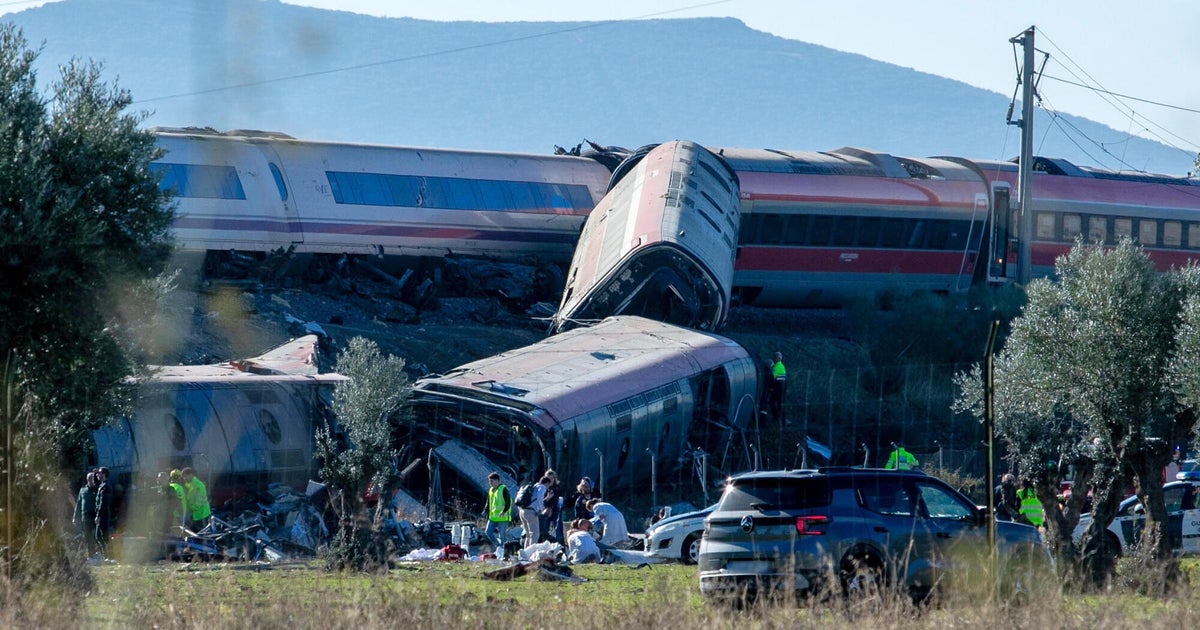
A high-speed train rammed into the rear of another train that had stopped in central Spain on Wednesday morning, derailing two cars and killing at least 64 people, according to local authorities.
The regional government of Castilla-La Mancha told the Reuters news agency that the death toll had risen to 64. Earlier in the day, officials had reported about 80 people injured. The toll climbed through the morning; early reports spoke of 30 dead, and emergency crews were still working at the site as the figures were updated.
The crash happened in the province of Toledo, according to ADIF, Spain's rail infrastructure operator. Rail service was suspended between Madrid, Ciudad Real and Andalusia while rescue teams and investigators worked at the scene.
A government official identified as Padilla told state broadcaster TVE that both trains were heading in the same direction, from Madrid to Seville, and that one ran into the tail of the other while it was stopped, knocking two of its cars off the track. She said the cause of the crash was not known. One train belonged to the state-owned operator Renfe and the other to the private company Iryo. Padilla said 397 passengers were aboard the Renfe train and 147 on the Iryo train, 544 people in all.
Manuel Galán, the mayor of the nearby town of Urda, told TVE that passengers had been hurt and that civil protection authorities had asked his town hall to prepare a sports pavilion to treat survivors. Emiliano García-Page, the regional president of Castilla-La Mancha, wrote on X that he was on his way to the crash site.
Trains run by those same two companies were involved in a deadly crash earlier this year. In January, 45 people died in southern Spain when a train jumped the track and struck an oncoming train. That crash was the deadliest in Spain since 2013, when 80 people were killed, and it shook the country's confidence in its extensive high-speed rail network, one of the largest in the world.
Wednesday's collision is likely to deepen that anxiety. Investigators will have to determine why one train was stationary on a main high-speed line and why a second train, running behind it on the same route, did not stop in time. Spain's rail system relies on automated signaling meant to keep a safe distance between trains, and a rear-end collision of this kind raises immediate questions about whether those systems worked as designed, whether a signal or human error was involved, and how the stopped train came to be on the line.
No cause has been announced. Authorities have not said how many of the injured are in serious condition, and the death toll could still change as rescuers reach the damaged cars and hospitals report on the wounded. Rail service between Madrid and Andalusia, a key corridor linking the capital to Seville and Malaga, remained suspended as of Wednesday afternoon.
The disaster comes as Spain is already heading into a politically charged stretch, with a snap general election called for Nov. 29. The government is expected to face pressure to explain what has gone wrong with the country's flagship rail system twice in a single year.