Sun's Spiky Jets Are Really Pleated Plasma Curtains, Swirling Like Cyclones, Simulations Show
A team from Sheffield, Newcastle and Bengaluru reports that spicules are warped three-dimensional sheets, with swirls wider than Great Britain driving their spin.

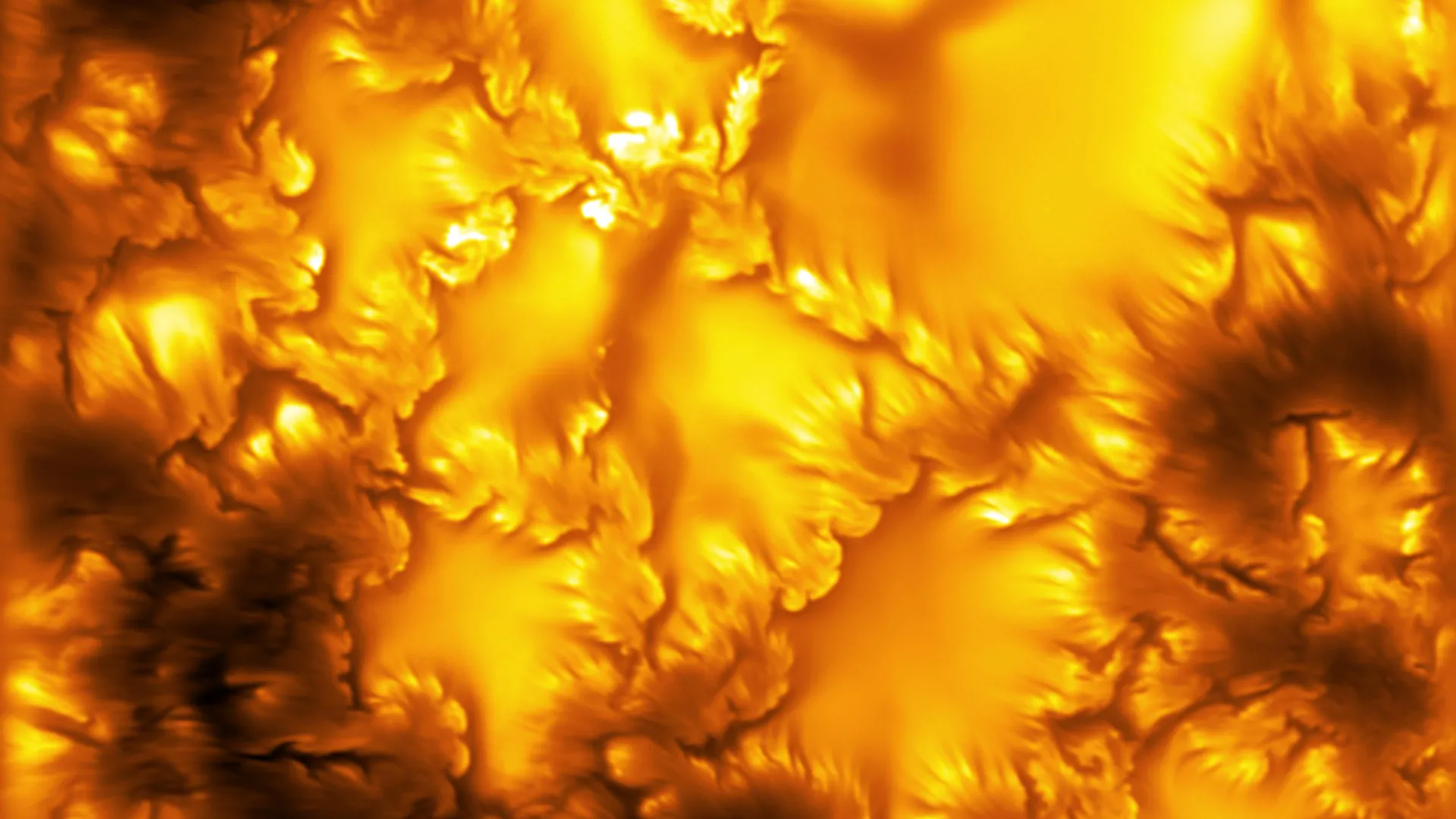
The thin jets of hot gas that fill the sun's lower atmosphere are not spikes at all, according to a new study. They are warped, dense sheets of plasma that hang like pleated drapes, and their rapid spinning comes from giant swirls in the solar atmosphere that behave like cyclones on Earth.
An international team from the University of Sheffield and the Indian Institute of Astrophysics, led by a postdoctoral researcher at the University of Newcastle in Australia, reported the finding in The Astrophysical Journal.
The jets in question are called spicules. They stretch 6 to 8 megameters long, or 6,000 to 8,000 kilometers, and at any given moment hundreds of thousands or even millions of them populate the region between the visible solar surface, the photosphere, and the million-degree corona, the sun's outermost atmosphere. They shoot upward quasi-periodically against the sun's gravity, and most of the material falls back toward the surface.
Astronomers have usually interpreted spicules as spike-like or cylindrical because they have mostly been observed in two dimensions, as seen against the sky. The new work finds instead that they take a pleated, curtain-like three-dimensional form made of dense plasma. The rotation seen in observations, the authors say, is the two-dimensional projection of more complicated motion.
The simulations also revealed hundreds of spiraling plasma columns, with diameters reaching hundreds of kilometers, forming alongside the spicules. The authors named them coronal swirling conduits, or CoSCos. They often extend into the corona and connect multiple regions of the solar atmosphere. They are made of plasma, a very hot, magnetized, gas-like state of matter composed of electrons and ions.
Spicules are known to move up and down, and they frequently show apparent rapid spinning and sideways oscillations. The jetting and oscillation are fairly well understood, but the origin of the spin has been a long-standing mystery. The study found that these short-lived rotations are produced by plasma swirls wider than Great Britain, which may number in the thousands or even millions in the solar atmosphere at any moment. The team ran numerical simulations on the U.K. high-performance computing facility Dial/CSD3 to explain the spinning clusters.
Dr. Sahel Dey, the Newcastle researcher who led the work, said the actual formation of the spicules and the associated rotating plasma drapery is currently very hard to observe directly, because it would take ultrahigh-resolution telescopes viewing from multiple vantage points.
The finding bears on one of solar physics' big puzzles. The mass and energy carried by the waves and the spicules help heat the upper chromosphere and the low corona, and supply the plasma that forms the solar wind. Dr. Piyali Chatterjee of the Indian Institute of Astrophysics said the jet-induced swirls in the model draw energy from the jets' thermal and magnetic reservoirs and carry it into the corona. Observational confirmation has not yet been achieved, she said, and will need high-resolution measurements of the coronal magnetic field and velocity field.