Radio Waves Drive Current Inside a Fusion Plasma, a First That Could Keep Reactors Running
General Atomics physicists showed 'helicon' waves can be absorbed deep in the DIII-D tokamak's plasma and push electrons, a goal pursued since the 1980s.

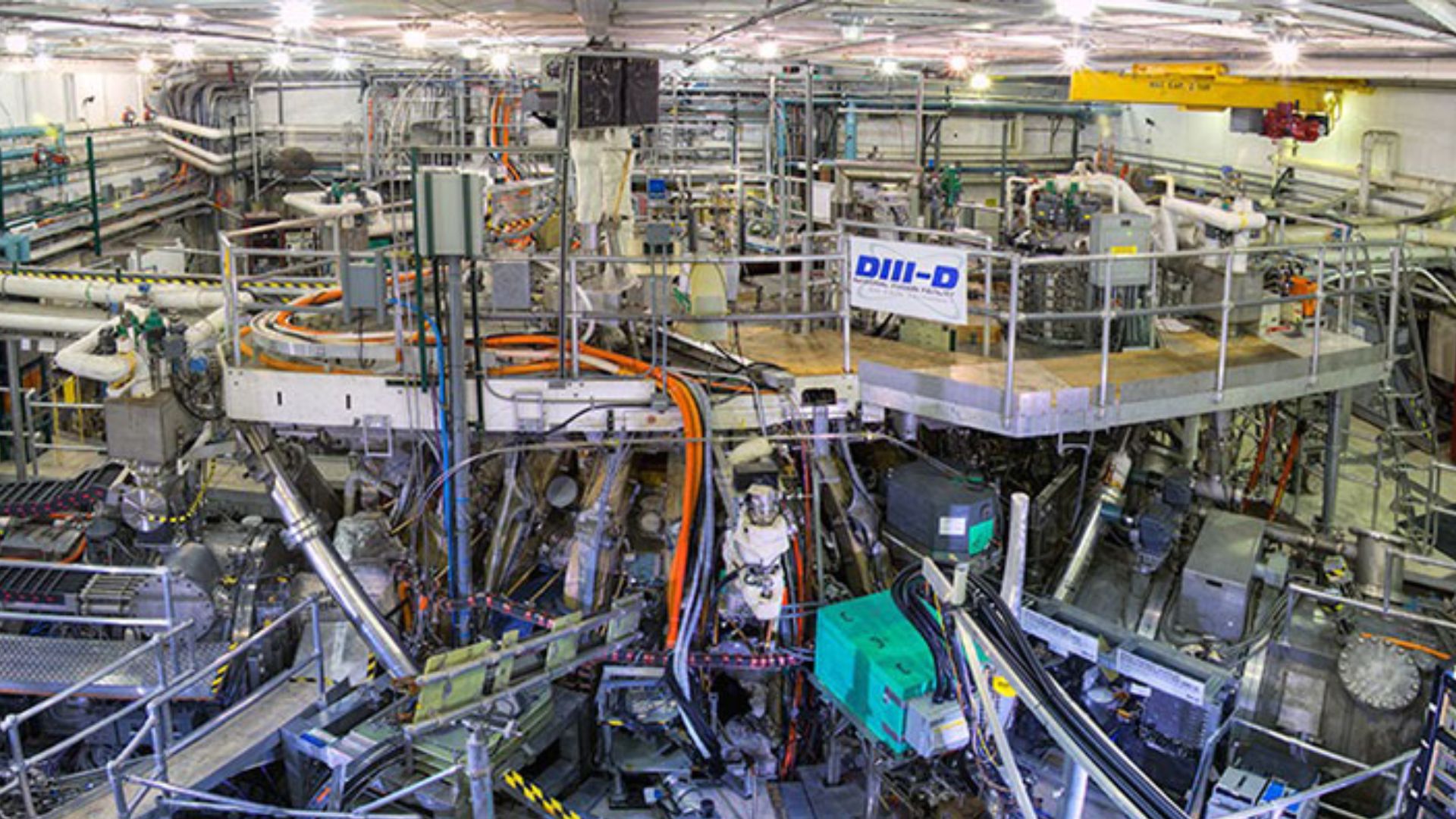
SAN DIEGO — Physicists in the United States have clearly demonstrated a "helicon current drive" in a nuclear fusion experiment for the first time, showing that radio waves steered around a tokamak can be absorbed by the plasma inside and drive an electric current there. The team, led by Jeff Lestz at General Atomics in San Diego, reported the result in Physical Review Letters. It could help future fusion reactors operate continuously.
The tokamak, a hollow donut-shaped reactor that holds plasma with powerful magnetic fields, is the most heavily studied route to fusion power. It underpins projects including the ITER reactor under construction in France and General Atomics' own DIII-D research tokamak. Much of the confining magnetic field comes from a strong electric current flowing around the donut through the plasma itself. In conventional designs, that current is induced by a central solenoid in the hole of the donut, which acts like the primary coil of a transformer.
The catch is that a transformer only induces current while its magnetic field is changing. Once the solenoid has swept through its full range, a quantity called the flux swing, the plasma current can no longer be sustained and the plasma must be shut down while the solenoid is reset. "The drawback of this arrangement is that the pulse length of the tokamak is limited by the available flux-swing in that primary solenoid," explained Bob Pinsker of General Atomics, who has studied tokamak fusion since the 1980s. "The pulse length in the DIII-D tokamak is limited to about 10 seconds, while the very much larger ITER device will be limited to less than about 1,000 seconds in its nominal operation."
The way around it is to drive the plasma current without the solenoid. The most efficient technique demonstrated so far beams radio waves into the plasma to push electrons in one direction around the torus. In larger, hotter reactor plasmas, though, those waves would likely be absorbed too close to the edge, before reaching the region where extra current is needed. In the 1980s, physicists proposed using a different kind of radio wave in the same frequency range, called the helicon. Because electrons absorb helicons less readily, they should penetrate deeper into a hot reactor plasma.
The waves are launched with a specialized "comb-line" antenna, a row of radiating elements laid out along the tokamak's long way around. Power fed into one end passes from element to element so each oscillates slightly later than its neighbor, creating a rippling pattern that sends the waves preferentially in one direction. Electrons moving along the magnetic field at roughly the wave speed can then "surf" along them, sustaining the current with no help from the solenoid.
Lestz, Pinsker and colleagues began considering a DIII-D test in 2014. "In one sense, our approach of using the fast wave in the lower hybrid range of frequencies for non-inductive current drive in a tokamak plasma was quite old," Pinsker said. "But the confluence of three developments at DIII-D was new, and they made the experiment practical." Those developments were comb-line antennas that can launch helicons efficiently in a single direction, plasmas hot enough to absorb them directly, and better measurements that can detect tiny amounts of current deep inside the plasma.
Using a megawatt-level helicon system, the team showed the waves deposited their energy in the plasma's core. Compared with similar experiments in which helicons were replaced by a comparable amount of microwave heating, the structure of the plasma's magnetic field changed noticeably faster. That is a clear signature of extra current driven by the helicons.
"Despite the long history of attempts to do closely related experiments dating back to the mid-1980s, our result represented the first clear success in this effort," Pinsker said. He added that the antenna success is also a first, with very clear electron heating observed using that wave launcher, and that it should encourage other efforts to use similar designs. The paper, "First Experimental Evidence of Helicon Current Drive," is by J. B. Lestz and colleagues.