Princeton Scientists Crack Decades-Long Fusion Mystery: Plasma Rotation Was the Missing Piece All Along
Researchers found that the spinning motion of plasma inside a tokamak — not just cross-field particle drift — drives the stubborn exhaust asymmetry that has defied simulation for decades, clearing a key path for commercial fusion.
Scientists at Princeton University's Princeton Plasma Physics Laboratory have resolved a decades-long mystery at the heart of nuclear fusion research, discovering that the rotation of plasma inside a tokamak reactor — not just the sideways drift of particles across magnetic fields — is the critical missing ingredient that explains why fusion exhaust behaves so differently from standard computer simulations, and why building the next generation of fusion reactors has been more difficult than the models predicted.
The finding, published in Physical Review Letters, addresses one of the most persistent puzzles facing fusion energy engineers worldwide. For years, experiments at multiple fusion devices have revealed a consistent and confounding asymmetry: when superheated plasma escapes from the reactor core through the exhaust system, particles overwhelmingly hit the inner wall of a component called the divertor far more frequently than the outer wall. The imbalance matters enormously for practical engineering, because whichever surface receives the greater particle flux must be built from materials capable of withstanding extreme and sustained heat and physical erosion. If that asymmetry is miscalculated — even by a modest margin — the result is a divertor that either fails prematurely or is over-engineered at enormous cost. For decades, researchers could not reproduce the asymmetry in standard computer models, creating a fundamental gap between prediction and reality.
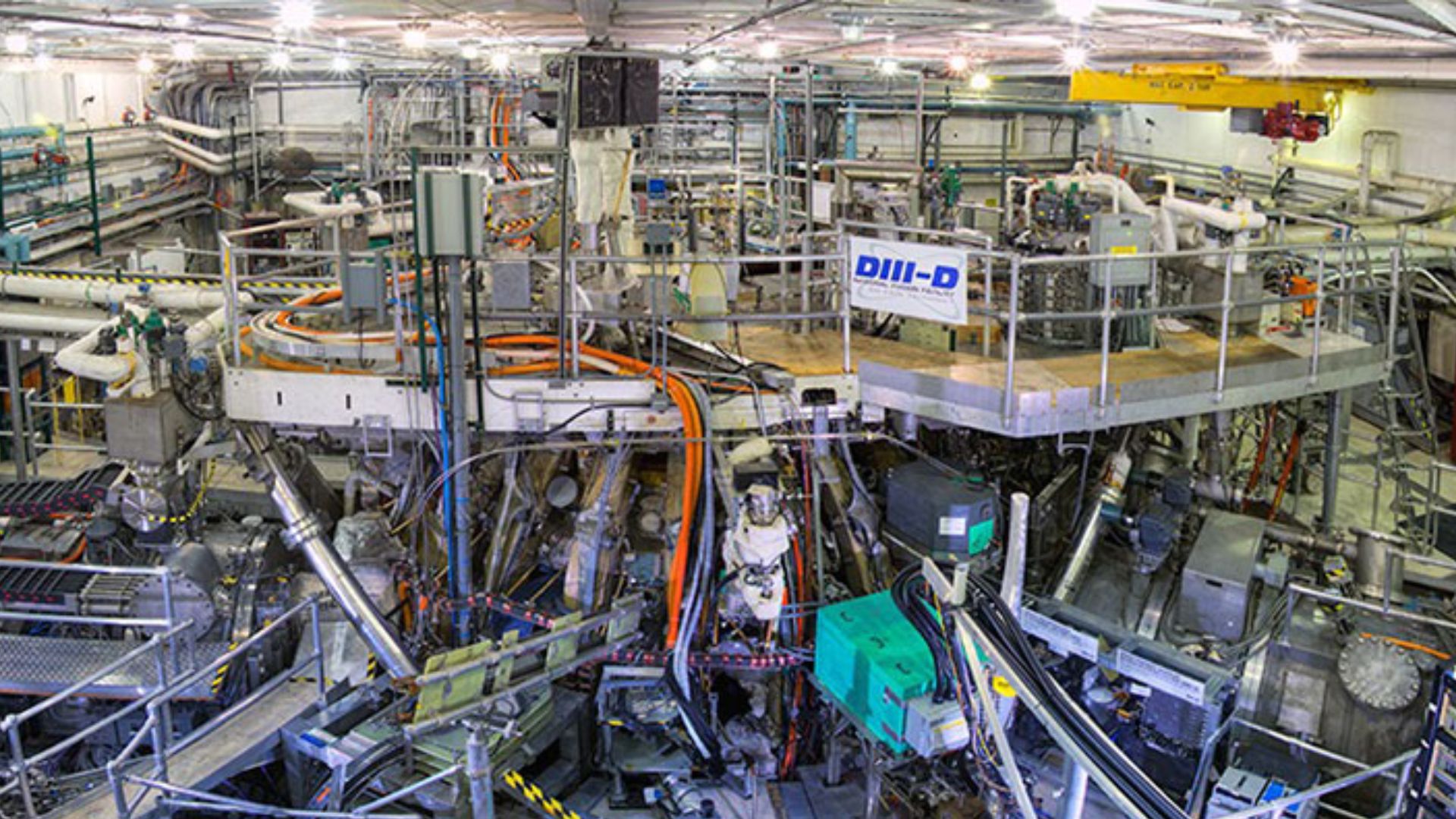
The breakthrough came when lead author Eric Emdee, an associate research physicist at PPPL, and collaborators tested their simulations against experimental data from the DIII-D tokamak in California, one of the world's premier fusion research facilities. The key step was incorporating the measured plasma rotation speed — 88.4 kilometers per second — into a widely used divertor modeling code called SOLPS-ITER. When rotation was included, the simulations snapped into agreement with what the experiments actually showed. Without it, the models consistently diverged. "There's cross-field flow, where particles drift sideways across the magnetic field lines, and parallel flow, where they travel along those lines," Emdee explained. "A lot of people said cross-field flow was what created the asymmetry. What this paper shows is that parallel flow, driven by the rotating core, matters just as much."
The physical mechanism involves what researchers call "toroidal rotation" — the circular spinning motion of plasma as it races around the donut-shaped tokamak vessel. This rotation creates a pressure distribution that actively channels particles toward the inner divertor, and its interaction with cross-field drifts amplifies the asymmetry far beyond what either effect alone would produce. Previous simulations that omitted plasma rotation were systematically wrong, and the models used to design critical components in fusion reactors around the world had all been working from an incomplete physical picture.
The practical implications could significantly accelerate the timeline toward commercial fusion energy. ITER, the massive international tokamak under construction in France, relies on divertor materials designed based on particle flux predictions from simulations now known to have omitted a key physical variable. The new insight gives engineers a reliable correction tool and more confidence that plasma behavior can be predicted accurately before a reactor is built. For private-sector fusion projects — including Commonwealth Fusion Systems' SPARC, the UK's STEP program, and multiple other ventures pursuing commercial fusion — the corrected physics removes a significant source of engineering uncertainty. Understanding where particles actually land in the exhaust, and why, is foundational to building fusion machines that are both safe and commercially viable. The paper represents a rare case in modern physics: a long-standing experimental anomaly finally explained, with immediate engineering implications for one of humanity's most ambitious energy projects.