Princeton Scientists Crack Decade-Long Mystery Inside Fusion Reactors
Researchers found that plasma core rotation—not just cross-field drift—causes uneven heat loading in tokamak divertors, enabling better designs for future fusion plants.

Researchers at Princeton Plasma Physics Laboratory have solved a years-long mystery about the behavior of superheated plasma inside tokamak fusion reactors, publishing findings that could meaningfully improve the design of future fusion power plants. The team discovered that rotation of the plasma core—a factor previously excluded from most theoretical models—plays an equal or greater role than cross-field drift in determining how heat and particles strike the walls of a reactor's exhaust system.
The mystery centered on an asymmetry that fusion scientists had observed in virtually every tokamak experiment: plasma particles and heat consistently struck the inner target of the reactor's divertor system far more intensely than the outer target. Divertors are the components designed to handle the exhaust heat from fusion reactions, and uneven loading represents a major engineering challenge—intense heat focused on a single region can erode reactor walls and reduce the operational lifetime of the machine. Simulations built on existing physics models were unable to explain why this imbalance occurred.
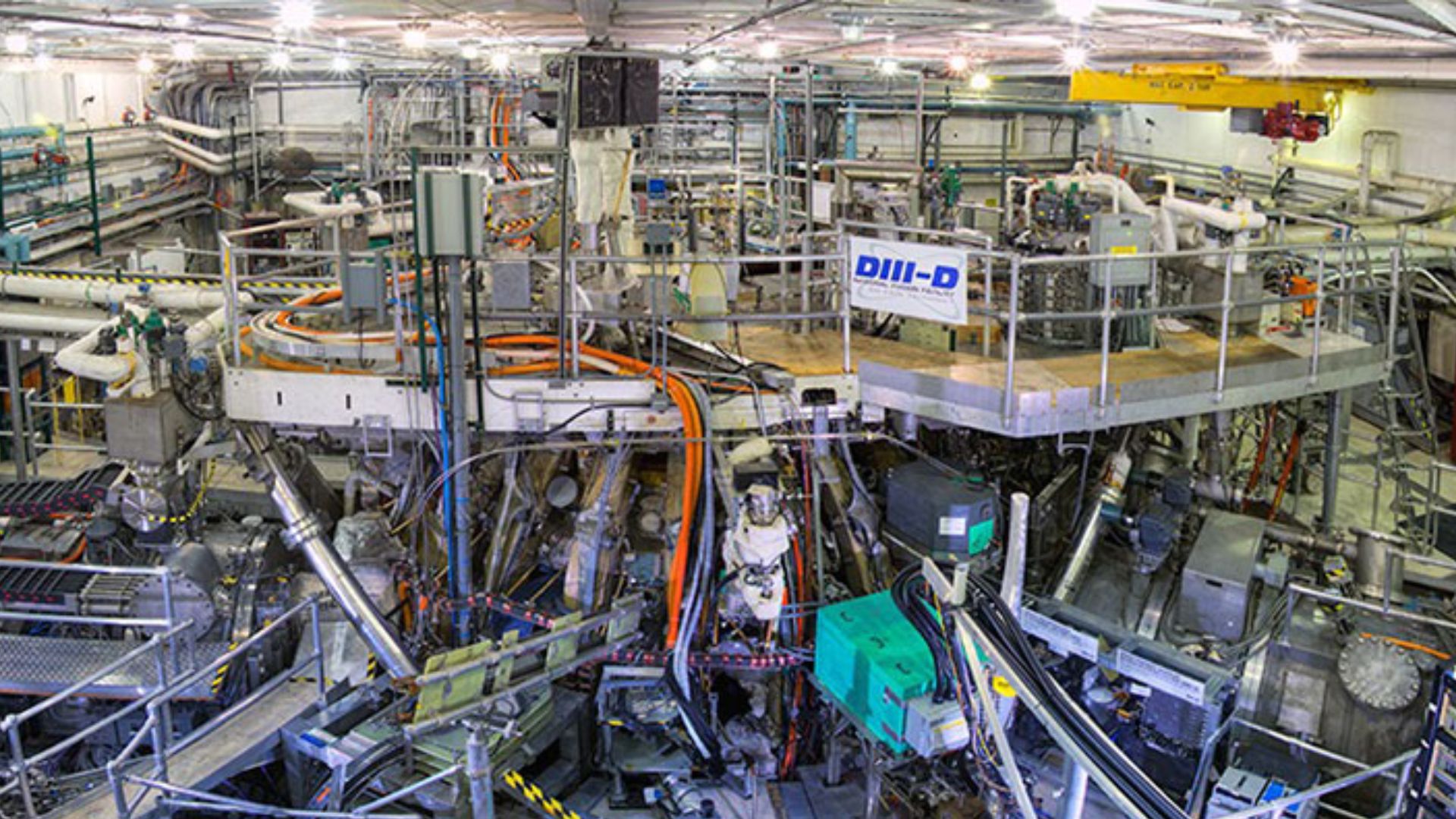
Eric Emdee, an associate research physicist at PPPL and the study's lead author, and his collaborators from MIT and North Carolina State University analyzed data from California's DIII-D tokamak using the SOLPS-ITER plasma modeling code. They tested four computational scenarios, systematically varying whether plasma rotation and cross-field drift were included. Simulations only matched experimental observations when both factors were included simultaneously, with the plasma's measured core rotation of 88.4 kilometers per second playing a critical role. "There's cross-field flow, where particles drift sideways across the magnetic field lines, and parallel flow, where they travel along those lines," Emdee explained. "Parallel flow, driven by the rotating core, matters just as much."
The results, published in Physical Review Letters, have direct implications for the design of ITER, the international fusion reactor currently under construction in France, and for future commercial fusion plants. Accurate prediction of heat distribution in the divertor is essential for selecting materials that can withstand real-world operating conditions over decades of use. If heat asymmetry is not properly accounted for in engineering calculations, components could fail prematurely, significantly raising operating costs and reducing overall reactor viability.
The finding also highlights a broader methodological lesson in fusion research: complex plasma behaviors often result from the interaction of multiple physical mechanisms rather than any single dominant effect. Fusion scientists have made significant progress in recent years toward sustaining plasmas at conditions approaching those needed for net energy gain, but managing plasma exhaust remains one of the hardest engineering challenges on the path to commercial power. Princeton's breakthrough suggests that plasma simulations across the field have been systematically underestimating the importance of core rotation, and that updating models could yield a substantially more accurate picture of how future reactors will perform under realistic operating conditions.